POWERED SUBWOOFER CONTROLS
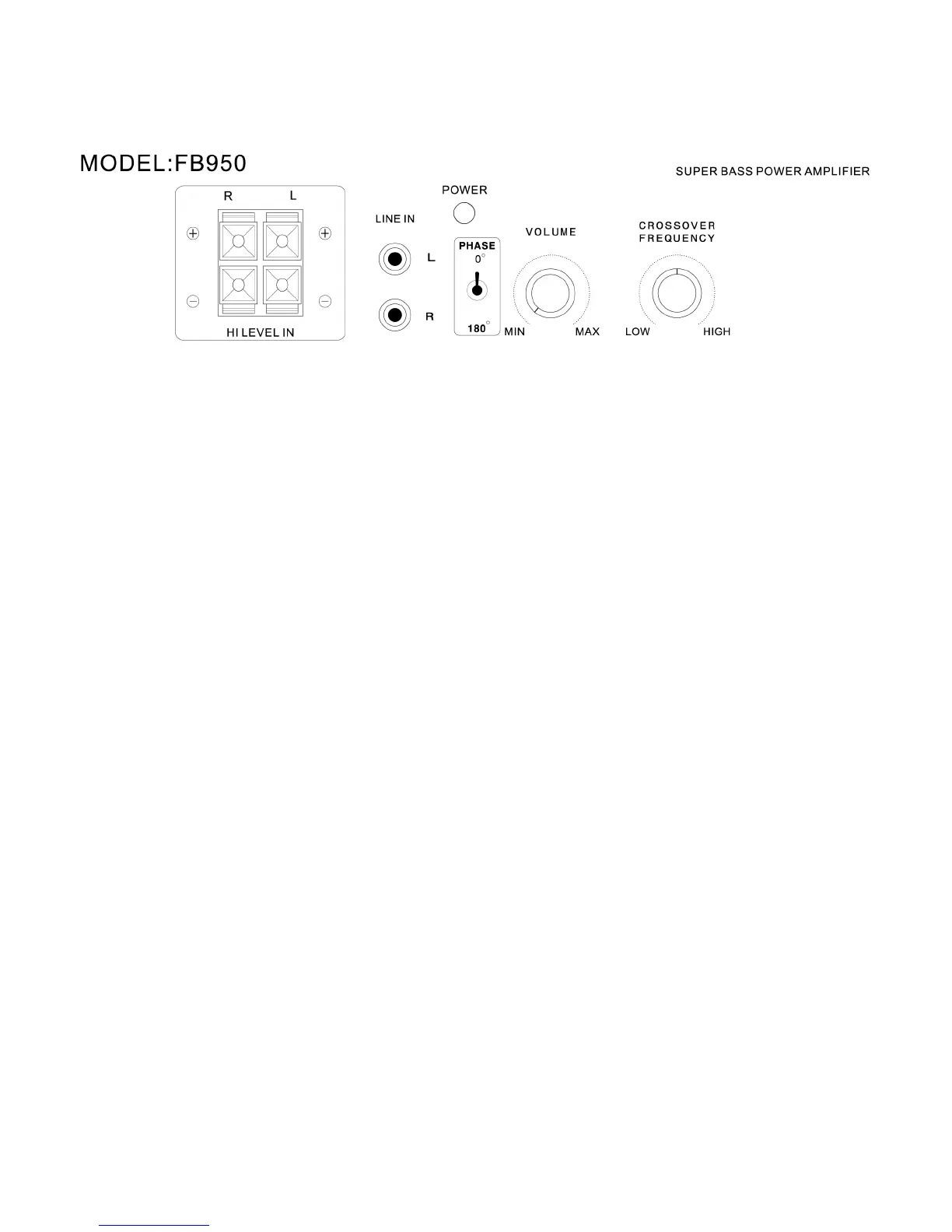
Adjustment controls of this powered subwoofer are located on the rear of the unit. See figure 4.
Figure 4.
VOLUME adjustment knob: This rotary control adjusts the output level of your Pro-Linear subwoofer and should be used to
balance the volume level of the subwoofer with that of your main satellite speakers. See Subwoofer Calibration below.
FREQUENCY adjustment knob: This control adjusts the high frequency roll-off of the subwoofer. Continuously variable from
40Hz to 180Hz, it is used to precisely match the subwoofer bass reproduction with that of your main/satellite speakers. See
Subwoofer Calibration below.
PHASE switch: This switch allows matching of the phase of the subwoofer with that of your main/satellite speakers. It
compensates for the mid-bass acoustic effects of different speaker locations and listening room acoustic effects.
SUBWOOFER CALIBRATION
1. Set the subwoofer VOL adjustment knob to its zero position. Set the subwoofer FREQ knob to 40Hz. Set any loudness,
bass/treble, and/or equalizer controls on your preamplifier or integrated amp/receiver to their normal or mid-point positions.
2. Play a familiar CD, record, or video soundtrack that has substantial bass content.
3. Gradually turn the subwoofer Volume knob clockwise until you achieve a neutral balance between the subwoofer’s deep bass
output and your main/satellite speakers.
4. Slowly turn the Subwoofer FREQ knob clockwise to reach the best mid bass blend with your main/satellite speakers. This will
be the point at which the bass retains solid impact and fullness. If the mid bass becomes “boomy” or ill defined, you have gone
too far and should turn the control counter-clockwise to the best balance point. If the sound is too thin (i.e., male vocals are not
full sounding) then turn the control clockwise to the best balance point.
NOTE: The subwoofer Volume control is designed to control the balance between your subwoofer and main/satellite speakers and
should not be used as a substitute for the bass or loudness controls on your amplifier or receiver. Adjust the subwoofer’s level for
smoothest low frequency performance. If more bass is desired, then advance the bass and/or loudness controls on your main
amplifier or receiver.
A FEW WORDS ABOUT POWER HANDLING AND YOUR WARRANTY:
Almost any speaker can be used successfully with almost any amplifier. Conversely, almost any speaker can be damaged by almost
any amplifier - regardless of either unit’s power rating. The power recommendations that we publish for our loudspeakers are
based on several assumptions about the amplifier, the type of music and the conditions of use. First and foremost, we assume that
the volume is never set above the point of audible distortion. Distortion is an indication that either the amplifier or the loudspeaker
is operating outside its normal design limits. Loudspeaker damage is likely within a short period of time if distortion is heard. If you
hear distortion, immediately turn the volume down. Failure to do so may result in damage that is not covered by the warranty. Our
loudspeakers are designed to reproduce music and speech in a home environment. They are not designed for use in sound
reinforcement systems or for reproducing sound effects or test tones at other than moderate levels in a home setting. When used
within their limits, our loudspeakers should provide many years of trouble free performance.



 To Next Page
 Loading...