Need help?
Do you have a question about the Procom DGC-6D and is the answer not in the manual?
Microprocessor/microcontroller based automatic generator start and supervisory device.
Details voltage protection, speed supervision, cranking attempt, and other safety features.
Explains parameters displayed on LCD and LEDs for voltage, current, frequency, and RPM.
Lists LED indicators for Mains, Generator, Battery, Frequency, and Load status.
Lists various timers for start delay, crank, supervision, and restoration.
Explains mode selection, auto mode operation, genset starting, and fault monitoring.
Details two modes for engine solenoid contact: cranking and running, and stopping the generator.
Describes the LCD display for voltages and the 14 LEDs for annunciations.
Details programmable parameters, default settings, and operational ranges.
Explains the function of each switch: Next, Increment, Decrement, Reset, MCB, and GCB.
Categorizes faults into Internal and External, describing their detection and impact.
Details internal faults like Generator Fail to Start, Voltage Unhealthy, Over-Speed, Battery issues.
Details external faults like Low Lube Oil Pressure (LLOP) and High Water Temperature (HWT).
Explains how to reset internal faults and LLOP, and conditions for HWT/Low fuel reset.
Provides technical specifications for AC voltage, accuracy, battery voltage, and contact ratings.
Illustrates wiring connections for the DGC-6D model.
Illustrates wiring connections for the DGC-6D11 model.
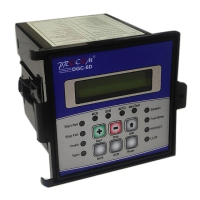
The DGC-6D/6D1I is a microprocessor/microcontroller-based automatic generator start and supervisory device, designed for ease of operation. Housed in a 96 x 96 flush-mounted enclosure, it serves as an ideal replacement for logic-based AMF (Automatic Mains Failure) units by integrating the functions of discrete logic-based AMF units into a single compact device, thereby simplifying panel wiring and reducing overall size.
The DGC-6D/6D1I monitors the Mains supply. If the Mains supply voltage varies beyond the set limits (under and over voltage) for more than the Mains supervision time, the DGC-6D initiates the genset start sequence. It provides a cranking signal via a potential-free contact to the crank motor. The crank command is withdrawn upon detection of engine start, either by an external engine start input or by the build-up of generator voltage. The maximum duration of the crank command and the number of crank attempts are user-settable. If the generator fails to start after the programmed number of attempts, the FST (Fail to Start) LED blinks, indicating a fault, and the hooter is activated.
While the genset is running, the DGC-6D monitors for external faults such as LLOP (Low Lube Oil Pressure), HWT (High Water Temperature), and Emergency Stop, as well as the voltage healthiness. Upon detection of any fault, the genset is stopped after a set time delay, and the hooter is activated. When a healthy EB (Electricity Board) supply is restored for the set duration, the genset is stopped after a user-set recooling time. Load changeover is performed automatically.
The device supports both Auto and Manual/Test modes. In Auto mode, the unit automatically manages genset operation based on Mains supply conditions. In Manual/Test mode, the DG can be started or stopped by pressing the Start and Stop buttons, respectively. The main contactor (MCB) and generator contactor (GCB) can also be switched on/off manually.
The engine solenoid contact (Terminals 15 & 16) can be configured in two modes:
The DGC-6D, equipped with a four-seven segment display, shows:
The DGC-6D/6D1I is a robust and comprehensive solution for automated generator management, offering detailed monitoring, protection, and user-friendly control.
 General
| Brand | Procom |
|---|---|
| Model | DGC-6D |
| Category | Controller |
| Language | English |

 To Next Page