This document is a user manual for Proline range hoods, specifically covering models PLJW109, PLFW109, PLJW125, and PLJW129. It provides comprehensive information on the installation, operation, maintenance, and troubleshooting of these kitchen appliances.
Function Description
A range hood is an appliance designed to remove smoke, grease, heat, and odors from the air above a cooktop. The Proline range hoods achieve this by directing heat and smoke into an internal blower system, which then vents the air to the outside of the home through a chimney. For installations where external venting is not possible, charcoal filters can be used to clean and recirculate the air within the home. The hood's primary function is to maintain a cleaner and more comfortable cooking environment by effectively extracting airborne contaminants produced during cooking.
Usage Features
The range hood features a control panel that allows users to manage its various functions. The control panel includes buttons for lights, fan speeds, and power.
- Lights: The hood is equipped with 20-watt halogen lights, offering two levels of illumination: high and low. A single tap of the light button turns them on or off, while tapping again cycles between the high and low settings. The number of lights varies depending on the specific model.
- Fan Speeds: The hood offers four fan speeds, allowing users to adjust the ventilation power according to their cooking needs. The lowest speed is designed for quiet operation, while the highest speed provides maximum extraction power for heavy cooking. To select a fan speed, the user simply presses the button corresponding to their desired speed.
- Power: The power button controls the overall operation of the hood. Pressing it once turns the hood on, and pressing it twice turns it off.
- Auto-Shutoff: A convenient auto-shutoff feature is included. When the fan is running at any speed, pressing the power button once activates this function. A flashing blue light indicates that the auto-shutoff is active, and the hood will automatically turn off after three minutes. If the user wishes to turn off the hood before the three-minute countdown, they can simply press the power button again.
- Venting Options: The manual outlines various venting options, including horizontal wall venting (two options) and vertical roof venting. These diagrams help users understand how the hood can be integrated into their home's existing ductwork or how new ductwork should be planned.
- Height and Venting Requirements: For optimal performance, the manual recommends installing the hood between 28 and 36 inches (71-91 cm) above the cooking surface. It also advises on ducting specifications, suggesting 6-inch or 8-inch round (or 3-1/4 x 10-inch rectangular) metal ducting. To maximize airflow, users are advised to use as few elbows as possible (no more than three 90-degree elbows) and ensure at least 24 inches (61 cm) of straight vent between any elbows. All joints in the vent system should be sealed with silver or duct tape, and exterior openings around the cap should be sealed with caulking. It is crucial to always use metal or aluminum ducts and keep them clean for proper airflow. The manual explicitly warns against terminating the vent system into an attic or other enclosed area, using 4-inch (10.2 cm) laundry-type wall caps, or using plastic venting.
Maintenance Features
Regular maintenance is crucial for the longevity and efficient operation of the Proline range hood. The manual provides detailed instructions for cleaning and filter replacement.
- Cleaning Exterior Surfaces: Regular care helps preserve the appearance of the stainless steel surfaces. Users should wipe stainless steel surfaces with the grain to avoid scratches, using hot soapy water and a clean cotton cloth periodically. For heavier soil, a liquid degreaser such as 409™ or Fantastic™ can be used. If the hood appears splotchy, a stainless steel cleaner can be applied and gently removed with a soft towel or wipe. After cleaning, a non-abrasive stainless steel polish (like 3M™ or ZEP™) can be used to buff out the luster, scrubbing lightly with a clean cotton cloth. The manual strongly advises against using corrosive or abrasive detergents (e.g., Comet Power Scrub™ or EZ-Off™ oven cleaner), steel wool, or scouring pads, as these can scratch and damage the stainless steel surface. It also warns against allowing cleaning solutions to leak onto or into the control panel, allowing deposits to accumulate, or letting salt solutions, disinfectants, bleaches, or cleaning compounds remain in contact with the stainless steel for extended periods.
- Cleaning the Filters: Proline hoods come with either aluminum mesh or stainless steel baffle filters. Both types are dishwasher safe for easy cleaning. If handwashing, the instructions for cleaning exterior surfaces should be followed.
- Baffle Filters: These filters are equipped with a spring-loaded handle. To remove, pull the handle back toward the wall and then down. The baffle filter can also be opened for deeper cleaning by unscrewing the cylindrical handle and separating the layers.
- Charcoal Filters (Ductless Installations): For hoods not vented outdoors, charcoal filters are used to clean impurities and odors. There are two styles: round and square, depending on the hood model. To install, users first remove the stainless steel or aluminum filters. Then, they locate the existing raised support screws on each side of the internal motor(s). The charcoal filter is positioned over its support screw and rotated to lock into place. It is recommended to replace charcoal filters after 150 hours of cooking or every 3-6 months, depending on usage frequency.
- Replacing the Light Bulb: Before replacing a bulb, the range hood must be unplugged or the circuit breaker turned off. A flat-head screwdriver can be used to gently remove the light cover. The defective bulb is then pulled straight out and discarded. A cotton glove or cloth should be used to handle the replacement bulb to avoid shortening its life. The new bulb is pushed gently but securely into the light socket, taking care not to push too hard to prevent breaking the bulb legs. Finally, the light cover is replaced, and the breaker is turned on to test the operation.
- General Safety Precautions for Maintenance: Before servicing or cleaning the hood, the power must be turned off. Users should never put their hand into the fan housing while the fan is operating. It is also important to ensure the cooktop and hood are cool before cleaning and to completely dry the filter(s) immediately after cleaning.

 Need help?
 General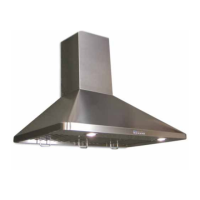

 To Next Page