
 Need help?
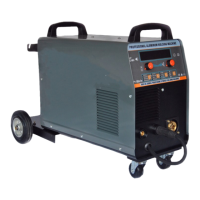
Do you have a question about the Proline PROMAX MIG-250DP and is the answer not in the manual?
Explains symbols used in the manual for safety and operation.
Emphasizes reading and retaining all safety instructions for future use.
Introduces various hazards associated with welding processes and equipment.
Details the severe danger of electric shock from live parts and improper grounding.
Warns about the dangers of inhaling welding fumes and gases and necessary precautions.
Describes the risks of arc rays and protective measures for eyes and skin.
Outlines fire and explosion hazards from sparks, hot materials, and improper welding practices.
Warns about eye injury from flying metal debris during welding operations.
Advises caution regarding hot machine parts that can cause burns.
Informs pacemaker wearers about potential risks from magnetic fields.
Highlights the risk of hearing damage from loud welding equipment and the need for protection.
Warns about the explosive potential of damaged gas cylinders and proper handling.
Details hazardous environmental conditions for welding operations.
Lists the various welding processes supported by the machine.
Details the key benefits and features of the welding machine.
Details the function and display of the LED screen for operation.
Explains the use of rotary knobs for parameter adjustment and menu navigation.
Introduces the quick selection menu for choosing welding methods.
Explains entering the advanced menu for method selection and parameter adjustment.
Details parameters like Freq, Duty, Ip-P, PU, BU, and Slop for pulse MIG welding.
Explains the operation of 2-act (2T) and 4-act (4T) welding control modes.
Explains the special two-act (S2T) and four-act (S4T) modes with hot start and final current.
Explains the normal spot welding (SPOT) and cyclic spot welding (CPOT) modes.
Details the procedure for saving current welding settings to memory channels.
Explains how to recall previously saved welding settings from memory channels.
Covers connecting the welder to mains power and fitting welding cables.
Details the process of installing and preparing the welding wire.
Explains how to connect the shielding gas cylinder and regulator.
Provides instructions on gas feeding and initial operational setup.
Provides a chart for recommended wire sizes based on material thickness.
Details specific wire types (ER70S-6, E71T-11, ER4043, ER 308L) and their applications.
Offers practical advice on MIG/MAG welding techniques and arc control.
Explains the MMA welding process, modes, and parameter considerations.
Details the steps for performing TIG LIFT welding.
Outlines essential periodic checks for maintaining the welding machine.
Provides guidance on cleaning, lubrication, and component replacement.
 General
| Brand | Proline |
|---|---|
| Model | PROMAX MIG-250DP |
| Category | Welding System |
| Language | English |

 To Next Page