
 Need help?
Do you have a question about the Prolyte PRO LYFT AETOS PAE-250DC Series and is the answer not in the manual?
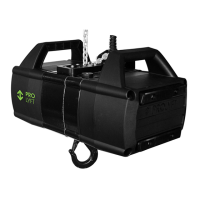
The ProLyft AETOS series electric chain hoists are designed for lifting and lowering loads up to their rated capacity, specifically tailored for the entertainment industry. These hoists are configured for "motor down" use as standard, featuring a multilayer disentangle plate to guide the chain smoothly, minimizing the risk of blocking. For "motor up" applications, the chain bag bracket swivels to the correct position, and it is recommended to rotate the covers with handgrips 180 degrees.
The AETOS hoists are robust devices for controlled vertical movement of loads. They are equipped with a spring-activated disc brake for reliable stopping and an overload protection device set to prevent overloading during lifting. This device is factory-set to 125% + 25% of the rated capacity. The hoists incorporate end limit switches as a safety feature for the lowest and highest hook positions, though these should not be used as operational limiting devices.
Control options include "Direct Control" and "Low Voltage Control." Direct controlled hoists lift or lower immediately upon activation, with the direction determined by the phase rotation of the mains supply. The pendant control for these hoists features "dead man" functionality, meaning power is cut when the button is released, and an E-stop button that must always switch off the mains supply. Low voltage controlled hoists connect to a reversing contactor inside the hoist, and a separate pendant control activates lifting or lowering circuits. These also feature "dead man" functionality and an E-stop button that must switch off the mains supply.
Each hoist is supplied with a test certificate and an electronic RFID tag, enabling owners to track the hoist's history and access the ProLyft Service Base. This system supports a unique Lifetime Warranty program, contingent on yearly inspections and re-certifications at a ProLyft Service Point.
The hoists are designed for operation in ambient temperatures between -10°C and +40°C. In cold conditions (below 0°C), it is advised to check the brake by lifting and lowering a small load three times. While suitable for humid conditions, heavy rain should be avoided, and covers are recommended. Drain holes in the chain guide cabinet prevent water accumulation and should be regularly checked for blockages. Protection against high humidity and temperature changes is crucial, with recommendations to dry hoists after such transitions.
Operators must be suitably trained and competent, familiar with all relevant safety regulations. Before each use, a visual inspection of the hoist, chains, and all load-bearing components is required, along with a short work cycle to test the brake and ensure correct attachment. Loads must be attached using approved and certified slings or lashing devices, always seated in the saddle of the hook, not the tip. The load chain should never be used as a sling chain or for lashing. Lateral loading on the housing or bottom block is prohibited, and the load chain must be in a straight line between the suspension bracket and hook.
For hoists with two speeds, the first stage of button depression activates slow speed, while further depression activates faster speed. Slow speed should be used for initial lifting and short distances. The chain end stop is not to be used as an operational limit switch. The red mushroom-shaped emergency stop button immediately halts all movement; it must be rotated clockwise to release.
When lifting or suspending loads above people, extra safety measures are required, based on a risk assessment and national legislation. These may include doubling the safety factor, reducing the nominal load by 50%, or requiring a second brake. Full awareness of the lifted load per hoist and proper overload protection are essential in such scenarios.
Regular inspections and maintenance are critical for safe and economic operation, reducing repair costs and extending the hoist's lifetime. Service and inspections must be performed by competent personnel, ensuring all safety devices are present and fully operational. Service intervals are typically annual but may be shorter under adverse working conditions (e.g., heat, high humidity, chemical environments, frequent transportation).
Daily checks include visually inspecting the pendant control switch and cable for damage, and functionally testing the brake, end limit switch, and lifting/lowering operations. Prior to initial operation, the load chain should be lubricated, and all screwed connections and locking devices checked for tightness. The chain drive reeving and chain bag bracket fit must also be verified.
Load chains require lubrication before initial operation and monthly thereafter, or after every 50 operating hours. Cleaning the chain before lubrication is essential, avoiding methods that corrode the material or hide flaws. Lubrication should be done in a no-load condition, allowing lubricant to penetrate between links. Visual inspection of the load chain for deformation, cracks, flaws, elongation, wear, or corrosive pitting is required every 3 months or after 200 operating hours. Chains must be replaced if nominal thickness is reduced by more than 10% or pitch is elongated by more than 5% over 11 pitches.
The gearbox is largely maintenance-free, with oil/grease changes recommended every 10 years or after 800 operating hours. During oil changes, the electric power supply must be cut off. The motor brake's air gap should be checked and adjusted to between 0.15 and 0.6 mm, and the brake lining replaced if wear reaches the maximum admissible air gap. The motor must be switched off and unloaded when checking the air gap. The overload protection device's adjustment and testing must only be carried out by authorized, competent personnel. After any maintenance work, a functional test with a nominal load is required.
 General
| Type | Electric Chain Hoist |
|---|---|
| Safe Working Load (SWL) | 250 kg |
| Lifting Speed | 6/1.5 m/min (dual speed) |
| Motor Power | 0.5 kW |
| Protection Class | IP54 |
| Power Supply | 50 Hz |
| Weight | 25 kg |
| Safety Features | Overload protection, emergency stop |

 To Next Page