This document is an operator manual for a Promate Gasoline Pressure Washer, providing essential information for its safe and effective use, maintenance, and troubleshooting.
Function Description
The Promate Gasoline Pressure Washer is a powerful cleaning tool designed to use highly pressurized water for various cleaning tasks. It is powered by a gasoline engine, which generates the electric power needed for its operation. The device is equipped with a high-pressure pump that recirculates water when the spray gun trigger is not squeezed (Bypass Mode). A thermal relief valve is integrated to prevent water temperatures from reaching harmful levels in Bypass Mode, releasing a jet of water to cool the pump. The pressure washer comes with five color-coded spray nozzles, each delivering a specific spray pattern and pressure suitable for different cleaning jobs, including a chemical nozzle for applying special cleaning solutions.
Important Technical Specifications
The manual provides specifications for two models: PW2700 and PW3500.
PW2700:
- Max. Water Flow: 2.2 GPM (Gallons Per Minute)
- Pump Type: Axial (AL)
- Engine Type: 6.5HP / OHV
- KW/RPM: 3.8 / 3600
- Displacement: 196CC
- Fuel Tank Capacity: 3 Liters
- Low Oil Sensor: YES
- Thermal Relief Valve: YES
PW3500:
- Max. Water Flow: 3.3 GPM
- Pump Type: Triplex
- Engine Type: 7.5HP / OHV
- KW/RPM: 4.5 / 3600
- Displacement: 223CC
- Fuel Tank Capacity: 3 Liters
- Low Oil Sensor: YES
- Thermal Relief Valve: YES
Both models require a minimum water supply of 20 PSI and a flow rate of 5 GPM. The engine carburetor is factory-adjusted for optimum operation from 0 to 1500 meters above sea level. For altitudes above 1500 meters, high altitude adjustment may be required. The engine oil recommended is 30-weight non-detergent oil, with a capacity of 40-450ml for the pump and 30-600ml for the engine. Unleaded gasoline of 87 Octane (or higher) grade is specified for fuel.
Usage Features
- Assembly: The pressure washer requires some assembly, including attaching wheels, legs, and gun holders to the frame. The handle is designed to be raised upright and locked into position.
- Hose and Gun Connection: The high-pressure hose connects to the pressure pump and spray gun using quick-disconnect fittings. The spray wand threads onto the spray gun.
- Nozzle Selection: Five color-coded nozzles are provided:
- 0° Nozzle (Red): Pinpoint, extremely powerful, for small areas on metal or concrete. Not for wood.
- 15° Nozzle (Yellow): Powerful 15-degree spray, for intense cleaning of small areas on materials that can withstand high pressure.
- 25° Nozzle (Green): 40-degree spray pattern, less powerful, for areas that can withstand pressure.
- 40° Nozzle (White): Wide 40-degree spray pattern, for most general cleaning jobs.
- Chemical Nozzle (Black): Weakest pressure stream, for applying special chemicals and cleaning solutions.
- Nozzle Storage: Nozzles are stored in receptacles on a panel mounted to the handle.
- Starting the Pressure Washer:
- Ensure a proper nozzle is selected and attached.
- Connect to a water source and turn it on.
- Wear protective safety glasses.
- Operate outdoors in a well-ventilated area, on a flat, level surface, at least 5 ft (1.5 meters) away from dwellings, with the exhaust facing away.
- Set the Throttle lever to "FAST."
- Slide the fuel valve lever to "ON."
- Slide the Choke lever to "START."
- Turn the Engine ON/OFF switch to "ON."
- Point the nozzle in a safe direction and squeeze the spray gun trigger to relieve pressure for easier starting.
- Pull the starter cord slowly until resistance is felt, then pull rapidly to start the engine. Release the trigger.
- Slide the choke lever to "RUN."
- Operating the Spray Gun: The spray gun has a trigger lock for safety. Squeeze the trigger to start water flow and release to stop.
- Washing/Cleaning: Firmly grip the spray gun with both hands. Point the nozzle in a safe direction and squeeze the trigger to purge air impurities before directing it to the working surface.
- Pressure Adjustment: Pressure can be adjusted by varying the distance between the spray wand and the surface, changing the spray nozzle, or adjusting the pump pressure regulator knob (counterclockwise for decrease, clockwise for increase).
- Usage Tips: For effective cleaning, keep the spray nozzle 8 to 24 inches from the surface. Avoid getting too close (especially with high-pressure modes) to prevent surface damage. Do not get closer than 6 inches when cleaning tires.
- Using Chemicals and Cleaning Solvents: Only use soaps and chemicals designed for pressure washers. DO NOT use chlorine bleach. Chemicals will not siphon with high-pressure nozzles; use the black chemical nozzle. To apply detergent, fill the detergent tank with prepared solution, attach the black nozzle, and apply to a dry surface using long, even, overlapping strokes. Allow detergent to soak for 3-5 minutes before rinsing. To rinse, replace with a high-pressure nozzle and spray from top to bottom. To flush the system after detergent use, fill the detergent tank with clean water, remove the nozzle, and run the engine to flush clean water through the system.
- Shutting Down:
- Turn the engine switch to "OFF."
- Slide the Fuel Valve lever to "OFF."
- Turn off the water supply and disconnect the garden hose.
- Squeeze the gun trigger to release remaining water.
- Store the spray gun and hoses in their designated holders.
Maintenance Features
Regular maintenance is crucial for performance and longevity.
- Engine Oil: Check oil level each time before use. Replace every 50 hours or 3 months. Add 30-weight non-detergent oil until the level reaches the threads inside the oil reservoir. The low oil sensor prevents engine damage by stopping the engine if oil levels are insufficient.
- Fuel: Use fresh, high-quality unleaded gasoline (minimum 87 Octane). Do not overfill the tank. Add fuel stabilizer for storage longer than 30 days.
- Air Cleaner (Filter): Check every 20 hours or month. Clean or replace as needed, more often in dusty environments.
- Spark Plug: Check and adjust every 50 hours or 3 months. Replace every 300 hours or year. Adjust gap to 0.6-0.7 mm.
- Spark Arrester: Clean every 100 hours or 6 months.
- Idling: Check and adjust every 300 hours or year.
- Valve Clearance: Check and adjust every 300 hours or year.
- Fuel Tank: Clean every 300 hours or year.
- Fuel Supply Line: Check every two years and replace if necessary.
- Pressure Pump Oil: Check oil site gauge on the pressure pump. Oil should cover the site gauge. Add 30-weight non-detergent oil if needed. To change pump oil, drain old oil and refill with new oil until the level is above the midpoint on the oil level window.
- Nozzle Cleaning: If the nozzle becomes partially clogged, use the provided cleaning needle to remove obstructions under running water.
- Water Inlet Screen Filter: Check periodically and clean by flushing both sides with water. Do not operate the pressure washer without the screen filter in place.
- Cleaning the Pressure Washer: Inspect for fuel or oil leaks daily or before use. Clean accumulated debris from outside and inside the pressure washer, ensuring all linkages, springs, engine controls, cooling air slots, and openings are clean and unobstructed. Use a damp cloth, soft bristle brush, and shop-vacuum as needed.
- Storage:
- Engine: Add fuel stabilizer to the fuel tank and run the engine for at least two minutes to circulate it. This allows fuel storage for up to 24 months. To protect against rust, remove the spark plug, pour approximately ½ oz (15ml) of clean engine oil into the cylinder, install the spark plug, and slowly pull the starter cord 2-3 times to distribute the oil (do not start the engine).
- Pressure Pump: Drain all water from the pressure hose, spray gun, and spray wand. For storage longer than 30 days or in freezing temperatures, use RV antifreeze. Connect a 36-inch garden hose to the water inlet, add 6 ounces of RV antifreeze, and slowly pull the engine starter cord until antifreeze comes out of the pressure hose connection (do not start the engine).
- General: Allow the engine to cool down before folding the handle. Cover the pressure washer with a suitable cover that does not retain moisture. Store in a clean, dry area.
- Preparing for Use After Storage: Slowly pull the starter cord a few times to clear oil or antifreeze from the cylinder/pump. Remove the spark plug, wipe oil, and retighten. Reconnect the spark plug wire.

 Need help?
 General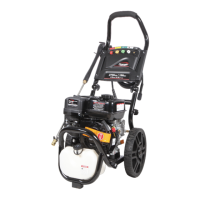

 To Next Page