21
Rev. C / January 2012
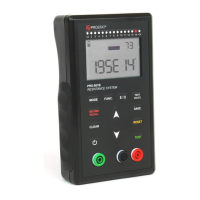
PRS-812 Resistance Meter
Be sure to press aer your last measurement to save it in your Memory
Register before turning the PRS-812 OFF. If the instrument is turned OFF before
pressing the last measurement will be lost.
Good Measurement Pracces, specic Operaonal Procedures and descripons of funconal
modes are covered in detail, below.
B. Good Measurement Pracces
Several factors will aect precision resistance measurements. Most praconers are aware of the
importance of using care when handling instruments, proper use of connecons, lead resistance,
grounding, and the impact of electrical or electrostac elds on their equipment.
As with most very precise instruments, the PRS-812 circuits and its cables are sensive to the ef-
fects of electromagnec and electrostac elds. These eects are minimized by instrument and
test lead design. However, good measurement pracces should be exercised at all mes to ensure
accuracy and repeatability. Follow the recommendaons below to obtain opmal performance
from the PRS-812.
1. Instrument handling and preparaon
a. Do not drop or cause mechanical shock to your instrument
b. Store the instrument in a clean, dry environment. Do not expose the instrument to wet,
extremely hot or cold condions.
c. If the unit is stored in a cold environment, allow it to stabilize at room temperature before
powering up the unit.
d. Be sure fresh baeries are installed when beginning an extensive measurement sequence.
Periodically check the condion of your alkaline baeries by pressing . If is
indicated, replace your baeries.
Low voltage Baeries will aect measurement accuracy.
e. When making resistance measurements below 10 ohms, perform The Low Range Calibra-
on Procedure. Repeat the procedure to conrm the instrument’s response.
f. During resistance measurements, stand back, away from the instrument to avoid body
capacitance or elds from eecng instrument accuracy.
g. To avoid body elds from interfering with instrument accuracy, wear a wrist strap aached
to a tested ESD ground to dissipate body charges.



 To Next Page