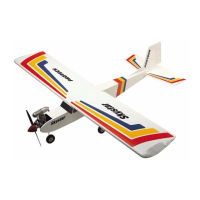
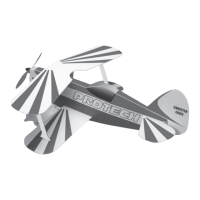
The device described in the manual is the Protech Skyraider, an electric-powered, Almost Ready to Fly (ARTF) radio-controlled (R/C) airplane. This kit is designed for hobbyists to assemble and operate, emphasizing that it is not a toy.
Function Description:
The Skyraider is an R/C model aircraft designed for recreational flight. It is controlled via a 4-channel FM transmitter, allowing for precise manipulation of its flight surfaces and motor. The model is powered by an electric motor and a Li-Po battery, with an electronic speed controller (ESC) managing power delivery. The primary function is to provide an enjoyable and instructive model flying experience, with an emphasis on safe operation.
Important Technical Specifications:
- Model Type: Electric powered airplane, ARTF (Almost Ready to Fly) kit.
- Transmitter: Avenger 4 Channel FM Transmitter (available in 35 MHz and 40-41 MHz versions).
- Receiver: Micro RX FM (35 MHz or 40-41 MHz).
- Servo: B160 servo (quantity not specified but implied for control surfaces).
- Electronic Speed Controller (ESC): PRO.20MPC-E Micro ESC 20A.
- Battery: Li-Po battery 7.4V - 1000 mAh.
- Charger: Balance charger with adapter for Li-Po Charger (UK version also available).
- Motor: Specific motor unit (part T0442.009).
- Propeller: Included (part T0442.005).
- Wing Span/Length: Not explicitly stated but implied by the model's appearance.
- Control Surfaces: Ailerons, elevator, rudder (implied by 4-channel control).
- Landing Gear: Included (part T0442.015).
- Construction: Fuselage (T0442.003), Wing set (T0442.002), Tail set (T0442.004).
- Center of Gravity (CG): Located 60 mm from the leading edge of the wing.
- Control Throws:
- Elevator: 15mm up/down.
- Ailerons: 12mm up/down.
- Rudder: 10mm left/right.
- Transmitter Battery: 8 pcs dry cells LR-6 (AA Alkaline batteries).
- Frequency Bands: 35 MHz and 41 MHz (France only) bands are supported, with specific channels listed for various countries (D, B, A, DK, F, I, L, N, NL, S, CH).
Usage Features:
- Assembly: The model comes as an ARTF kit, requiring assembly of the tail, control surfaces, motor, wing, and landing gear. Detailed instructions with illustrations are provided for each step.
- Control System: A 4-channel FM radio control system is used. The manual describes both MODE 1 and MODE 2 configurations for the throttle and control sticks.
- Pre-Flight Checks: Emphasizes critical pre-flight checks including:
- Verifying correct operation of all electronic components.
- Always turning on the transmitter BEFORE the model and turning off the model BEFORE the transmitter.
- Ensuring the throttle stick is in the lowest (OFF) position before powering on.
- Checking control surface movement in the correct "sense" relative to stick input.
- Verifying the Center of Gravity (CG) before every flight with an empty fuel tank.
- Checking the frequency is vacant to avoid radio interference.
- Battery Charging: Instructions for charging the Li-Po battery using the supplied balance charger are provided. A crucial warning is given: "DO NOT LEAVE BATTERY UNATTENDED WHILE CHARGING!"
- Flight Operation:
- Flying Area: Recommends choosing an open flying area away from buildings, roads, power lines, trees, and water to avoid turbulence and interference.
- Antenna: Always fully extend the transmitter antenna.
- Wind: Check wind direction before takeoff; beginners should fly on days with little or no wind.
- Flight Pattern: The plane should fly in a cone shape, no more than 30 meters (100 feet) away from the pilot.
- Pilot Position: Always keep the plane in front of you; avoid flying directly overhead to prevent loss of perception.
- Landing: Instructions for landing involve turning into the wind at about 10 meters (30 feet) above ground, lowering speed, and cutting off the motor.
- Safety Notes: Extensive safety notes are provided, covering general R/C model operation, propeller safety, radio interference, and specific Li-Po battery handling precautions.
Maintenance Features:
- Rubber Bands: Advised to replace rubber bands (used for securing components, though not explicitly shown in assembly for the main structure) from time to time as they deteriorate.
- Pre-Flight Inspection: Before each operation, check the model and all its components (propeller, gearbox, R/C components) for good condition and damage. Do not fly if a fault is found.
- Li-Po Battery Care:
- Use a correctly specified Li-Po charger and ensure it's set to LiPo mode.
- Set the charger to the correct series cell count ("s") for the pack.
- Handle and transport batteries carefully to avoid piercing, deformation, or short circuits.
- Disconnect batteries from ESCs with BEC to prevent slow over-discharge.
- Ensure connectors are correctly insulated.
- Check batteries for physical and electrical damage before charging or discharging.
- Never overcharge (above 4.25V per series cell) or over-discharge (below 3.0V per series cell).
- Avoid exposing batteries to intense heat.
- Do not charge damaged or swollen cells.
- Stop charging if any part of the pack gets warm (LiPo packs should charge cool).
- Do not charge unattended.
- Disposal: If a battery is deemed unusable, discharge it slowly to "dead flat" before disposal or recycling to prevent short-circuit danger. Methods suggested include using a light bulb or immersing in salt water.
- CG Adjustment: If the model's nose drops, move the battery towards the rear; if the rear drops, move the battery/receiver forward. Small amounts of lead can be added if necessary, ensuring it's securely fixed.

 Need help?

 To Next Page
 General