
 Need help?
Do you have a question about the PROTMEX PT6708 and is the answer not in the manual?
Press and hold 'H' and 'MAX' keys, then press power button until LCD lights up to enter debugging mode.
Turn on standard sound source, set output to 1kHz, 94dB. Use buttons to control audio output and frequency.
Insert microphone, start sound source, save stable data with 'H' key. Switch to C-weighting and save again before shutting down.
This document outlines the calibration method for the PT6708 Digital Sound Level Meter, a device designed for measuring sound levels. The calibration process ensures the accuracy of the meter's readings by adjusting it against a known standard sound source.
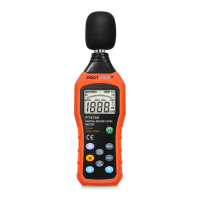
The PT6708 is a digital sound level meter used to measure ambient sound levels. It features a range of 30dB to 130dB, making it suitable for various applications from environmental noise assessment to industrial sound monitoring. The device displays sound levels on an LCD screen, providing clear and immediate feedback to the user. Key functions include the ability to switch between different weighting curves (A/C) and to capture maximum sound levels (MAX). The "H" button is crucial for saving calibration data, indicating its role in maintaining measurement accuracy.
The operation of the PT6708 involves a straightforward calibration procedure to ensure its reliability. To enter debugging mode, which is essential for calibration, the user must first ensure the device is off. Then, simultaneously press and hold the "H" and "MAX" keys. While holding these, press the power button. Continue holding all three buttons until the LCD screen illuminates, at which point all buttons can be released. This sequence initiates the debugging mode, preparing the device for calibration.
Once in debugging mode, the next step involves using a standard sound source. The standard sound source should be turned on and adjusted to output a 1kHz, 94dB signal. This precise output serves as the reference point for calibrating the PT6708.
The standard sound source itself has several operational features. It includes an "Audio source output button." Pressing this button once activates the audio source output, and the screen lights up to confirm the output is active. Pressing it again deactivates the output, and the screen turns off. This allows for precise control over when the reference sound is being emitted.
Another important feature of the standard sound source is the "Frequency switch button." This button allows the user to cycle through different output frequencies. However, it's important to note that the frequency can only be switched when the audio source is actively being output. This ensures that any frequency changes are made while the device is in an operational state.
For the calibration itself, the microphone head of the PT6708 (the product under test) is inserted into the standard sound source. With the standard sound source output active, the PT6708's LCD screen will display corresponding sound level data. The user must wait for this data to stabilize, indicating a consistent reading from the standard source.
Once the data is stable, the "H" key on the PT6708 is pressed. The screen will flash three times, confirming that the calibration data for the current weighting (typically A-weighted by default) has been successfully saved. To perform C-weighted calibration, the "A/C" key is then pressed to switch the device to C-weighting. Again, the user waits for the data to stabilize, and then presses the "H" key to save the C-weighted calibration data. After both A and C weighting calibrations are complete and saved, the device can be shut down.
The PT6708's design, including its buttons for "FAST/SLOW" response times and "dB/SONE" units, suggests a versatile tool for various sound measurement scenarios. The "MAX" button allows users to capture the highest sound level recorded during a measurement period, which is useful for identifying peak noise events. The "A/C" button facilitates switching between A-weighting, which approximates the human ear's response to sound, and C-weighting, which provides a flatter response across the frequency spectrum, often used for measuring overall noise levels.
While the document primarily focuses on calibration, the calibration process itself can be considered a key maintenance feature. Regular calibration ensures that the PT6708 continues to provide accurate and reliable measurements over its lifespan. The clear steps for entering debugging mode and saving calibration data make this essential maintenance task manageable for users. The flashing screen after saving data provides immediate feedback, confirming the successful update of calibration parameters. This systematic approach to calibration helps in maintaining the instrument's performance and compliance with measurement standards. The robust design, indicated by its professional appearance, suggests it is built to withstand regular use in various environments.
 General
| Temperature Accuracy | ±1°C |
|---|---|
| Humidity Accuracy | ±5% RH |
| Display | LCD |
| Humidity Range | 0%RH~100%RH |
| Power Supply | 2 * 1.5V AAA Batteries(Not Included) |

 To Next Page