This document serves as a beginner's guide for the "38" ACOUSTIC GUITAR" by PROTOCOL, designed to help novices become comfortable with finger placement and basic guitar playing.
Function Description
The guide provides fundamental instructions for playing an acoustic guitar, focusing on chord playing, guitar anatomy, tuning, and finger placement. It aims to introduce new players to the instrument in an accessible way.
Important Technical Specifications
While the manual does not list detailed technical specifications for the guitar itself (such as materials, dimensions beyond the 38" size, or specific hardware details), it does illustrate the key components of a standard acoustic guitar:
- Head: The top part of the guitar where the tuning knobs are located.
- Tuning Knobs: Used to adjust the tension of the strings, thereby changing their pitch.
- Nut: A small strip of material at the base of the headstock that guides the strings into the tuning pegs and sets the string height at the headstock end.
- Neck: The long, slender part of the guitar that extends from the body to the head, where the frets are located.
- Frets: Metal strips embedded into the fretboard of the neck, which divide the neck into segments and allow for precise pitch changes when strings are pressed against them.
- Sound Hole: The opening in the body of the guitar that allows the sound produced by the vibrating strings to resonate and project.
- Body: The main hollow part of the guitar that amplifies the sound.
- Bridge: A component on the body of the guitar that anchors the strings and transfers their vibrations to the soundboard.
- Strings: The vibrating elements that produce sound when strummed or plucked. The manual specifically labels the strings with their standard tuning notes: E (thickest), A, D, G, B, E (thinnest).
Usage Features
The manual outlines several key usage features for beginners:
Playing a Chord
- Finger Placement: Players are instructed to place their left-hand fingers according to numbered diagrams, which indicate where to press on the frets and strings. An example of an "E Major" chord is provided, showing specific finger positions on the fretboard.
- E Major Chord Example:
- Finger 1: On the 3rd string (G string), 1st fret.
- Finger 2: On the 5th string (A string), 2nd fret.
- Finger 3: On the 4th string (D string), 2nd fret.
- The 6th (low E), 2nd (B), and 1st (high E) strings are played open (unfretted).
- Strumming Technique: With the right hand, players should start with an open fist position and gently strum down with their index finger. The fingernail side should be used for downstrokes, and the flesh side for upstrokes (though the diagram only explicitly mentions downstrokes in the initial instruction).
Tuning Your Guitar
- Recommended Method: For beginners, using an electronic tuner is highly recommended to match the string to the correct pitch. Electronic tuners are described as inexpensive and an easy way to stay in tune.
- Online Resources: If a tuner is not available, players are directed to ProtocolDesign.com for instructions on how to tune the guitar.
- Standard Tuning: The manual visually represents the standard tuning for a 6-string acoustic guitar, from thickest to thinnest string: E, A, D, G, B, E.
Finger Placement (Left Hand)
- Numbered System: The guide emphasizes the importance of knowing which fingers go where when practicing chords. Fingers are represented by numbers (1, 2, 3, 4) in chord diagrams, which correlate to a diagram of the left hand.
- Finger 1: Index finger
- Finger 2: Middle finger
- Finger 3: Ring finger
- Finger 4: Pinky finger
- Right-Handed Focus: The instructions are designed for right-handed players. It notes that the principles are the same for left-handed players, but playing and chord finger positions will be reversed.
Maintenance Features
The manual does not explicitly detail maintenance features for the guitar itself (e.g., cleaning, string changes, humidity control). However, it does provide a resource for "further tips and practice instructions" and "chord charts" at ProtocolDesign.com, which would likely include information relevant to maintaining the instrument and improving playing skills. The recommendation to use an electronic tuner can also be seen as a preventative measure to ensure the guitar is always in tune, which is crucial for practice and performance.

 Need help?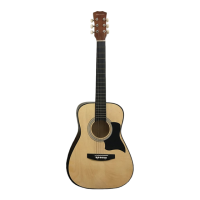

 To Next Page
 General