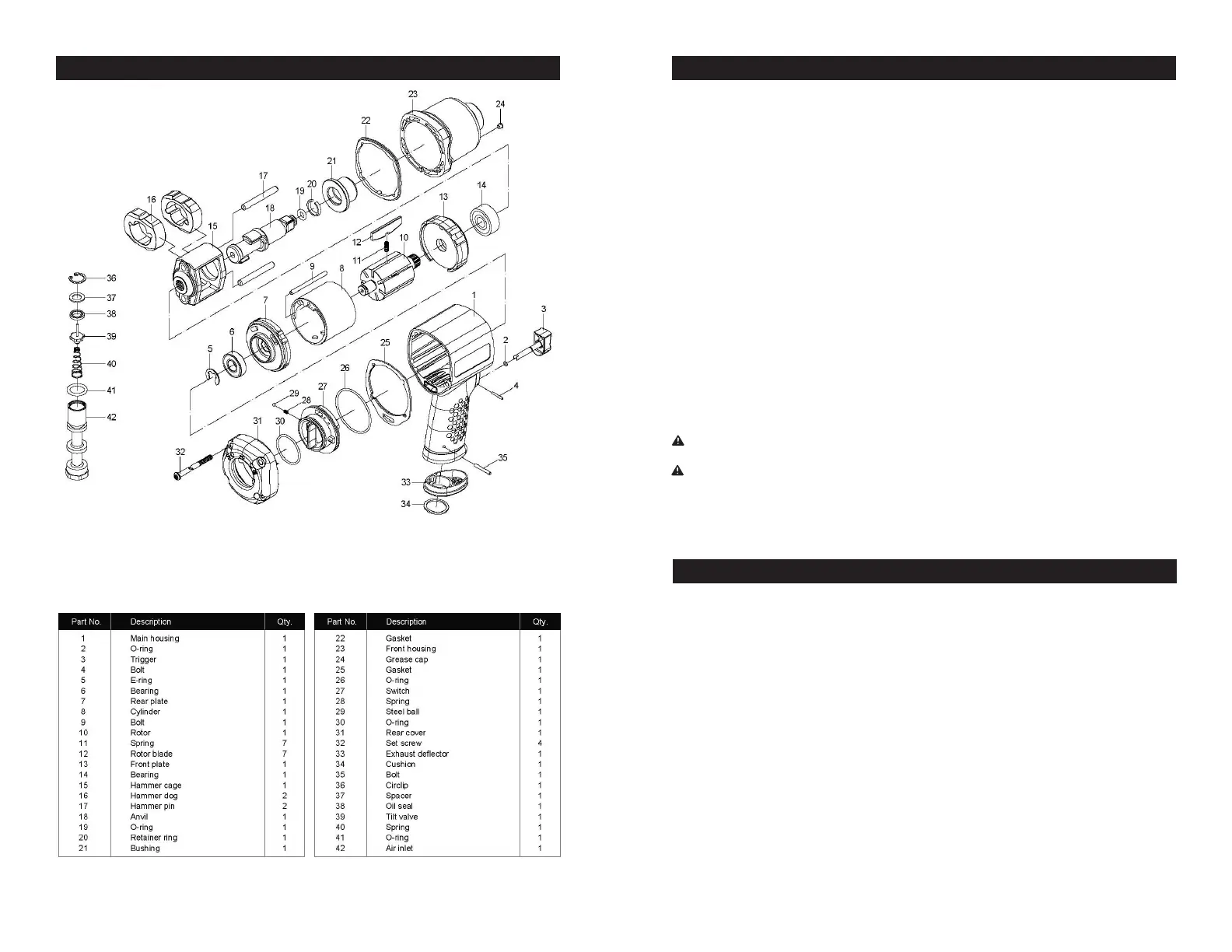
PARTS LIST AIR IMPACT WRENCH SAFETY
1. Use only clean, dry, regulated compressed air as the power source.
2. Air compressors used with the tool must comply with the appropriate European
Community Safety Directives.
3. Make sure that the air compressor being used for the tool operation supplies the
correct output (CFM).
4. Have the tool in "off" position when connecting the tool to the air supply.
5. Use normal 90psi working pressure for the tool. High pressure and unclean air will
shorten the tool life due to the faster wear and also may create a safety hazard.
6. Drain water from the air compressor tank daily, as well as any condensation in the air
lines. Water in the air line may enter the tool and cause damage to the tool mechanisms
at operation.
7. Clean the tool air inlet screen filter for blockage weekly. Clean if necessary.
8. Usually a 3/8" (inner diameter) air hose is recommended for air supply and airflow to
get the optimum performance of tool.
9. A long air hose (usually over 8 meters) may cause up to 15psi drop in pressure, so
you need to set the output pressure of the air compressor higher to maintain the
required working pressure at the tool.
10. Use proper hoses and fittings. We do not suggest connecting quick change couplings
directly to the tool since they may cause failure due to tool vibration at operation.
Instead, add a lead hose and connect coupling between air supply and hose whip.
11.
Check hoses for wear before each use. Make certain that all connections are in security.
AIR SOURCE
1. Always use the impact wrench in the manner and for the functions described in this manual.
2. Always ensure the wrench is not moving and disconnected from the air supply when
changing sockets etc. Only use impact sockets. Do not use standard sockets.
3. Always finish tightening wheel nuts or engine parts with a torque wrench or suitable
spanner to the correct torque as recommended by the vehicle manufacturer.
4. Always avoid excessive use of the impact wrench. When tightening a nut or bolt,
never allow the wrench to impact more than 8 times. This is to avoid over-tightening. 3
to 4 impacts is normally sufficient.
5. Always ensure that the socket is correctly installed onto the tool anvil before starting the tool.
6. Due to the possible presence of asbestos dust from brake linings, always wear suitable
respiratory protection.
7. Never carry the impact wrench by the air supply hose.
8. Always disconnect the tool from the air supply when changing impact sockets or when
the wrench is not required for immediate use in order to avoid accidental start.
9. Hold the tool correctly. Always use both hands to control the impact wrench.
10. Always ensure that the wrench has come to a complete stop before putting it down
after use.
11. If necessary, use clamps or proper devices to securely fix the workpiece when
installing/tightening or removing/loosening threaded fasteners on the workpiece.
12. For overhead work, wear a safety helmet.
13. Do not discard the safety instructions, give them to the operator.
14. Always store this product in a dry and safe place out of reach of children or untrained
operators.
WARNING:
Repetitive motions or exposure to vibration may be harmful to your hands and arms.
WARNING:
The warnings, cautions, and instructions discussed in this instruction manual
cannot cover all possible conditions and situations that may occur. It must be understood by the
operator that common sense and caution are factors which cannot be built into this product, but
must be supplied by the operator. Read and understand all of the instructions provided in the
instruction manual of this product, as well as, any other tool (s) used with this product.
6


 To Previous Page
 Loading...