5.4.5. Network Time Protocol
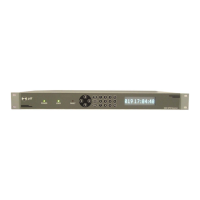
The ptf 3203A as an NTP server becomes the clock
synchronization source for your network. Clients can query the
server to obtain UTC time accurate to a few tens of nanoseconds.
The server can operate in Unicast (point to point), Anycast
(multipoint to point) or Multicast (point to multipoint).
In unicast mode a client sends a directed message to the Ethernet
IP address and SNTP port of the ptf 3203A GlobalTyme.
In anycast, a client broadcasts on the SNTP Multicast address
(224.0.1.1) and looks for an SNTP server to respond. The ptf
3203A GlobalTyme SNTP server will respond to those broadcasts.
Normally the client will set the Time To Live TTL value in the
request to limit it’s hops across routers.
Multicast is optionally on or off at the users setting. In multicast, the
SNTP server will broadcast at 224.0.1.1 the time. Multicast
messages are normally sent at poll intervals from 64 s to 1024 s,
depending on the expected frequency tolerance of the client clocks
and the required accuracy. This poll interval is user settable. The
TTL value in a ptf multicast is set to 1 to limit it to the local network.
For more information on NTP and SNTP see RFC’s 1305 and 2030.
Also the NTP website at http://www.ntp.org/
5.4.6 Simple Network Management Protocol (SNMP)
The ptf 3203A system has a running SNMP agent. Any standard
SNMP client is able to communicate with this agent. The means by
which a client knows how to access data on the agent is through an
SNMP Management Information Base, or MIB.
Below are two visual pictures of the MIBS (what the SNMP
manager views). The first is a query of the information and the
second is the tree structure. When the SNMP option has been
included, the user will be provided with the MIBS, see later.
The provided MIBS files should be compiled and inserted into the
user’s manager. When the users manager queries the network it
will see the ptf 3203A has SNMP and link in the provided MIBS.


 To Next Page
 Loading...