
 Need help?
Do you have a question about the Pulsar dB Series and is the answer not in the manual?
Declares conformity with EU directives for ATEX, EMC, and RoHS for dB series products.
Details ATEX certified versions and special conditions for hazardous area installations.
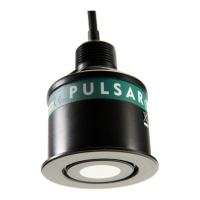
The dB series transducers are designed for demanding process level measurement in both liquid and solid applications. They incorporate the latest in ultrasonic design technology, making them suitable for a wide range of short-range liquid and solid level measurements.
The dB transducers operate by emitting ultrasonic pulses and receiving the reflected echoes to determine the distance to a liquid or solid surface. They are based on a PZT ceramic transducer element with a nominal beam angle of 10° @ -3 dB (depending on the unit). When coupled with the DATEM® signal processing used in PULSAR ultra range level and flow measurement instrumentation, they provide unmatched performance in industrial process level measurement.
All dB transducers include integral temperature compensation to ensure accuracy across varying environmental conditions. They also feature a unique low-energy interface with PULSAR ultra instrumentation, which allows for Intrinsic Safety (Exia) approval. This interface is frequency independent, enabling transducers to be interchanged without re-tuning the drive electronics.
The dB series offers a range of models with varying specifications:
| Model | Range in metres | Blanking Distance | Operating Frequency | Housing diameter | Housing Height |
|---|---|---|---|---|---|
| dBmach3 | 2.5m | 0m | 125kHz | 180 (sunshield) | 205 |
| dB3 | 3m | 0.125m | 125kHz | 78 | 115 |
| dB6 | 6m | 0.3m | 75kHz | 86 | 104 |
| dB10 | 10m | 0.3m | 50kHz | 86 | 104 |
| dB15 | 15m | 0.5m | 40kHz | 86 | 122 |
| dB25 | 25m | 0.6m | 30kHz | 105 | 142 |
| dB40 | 40m | 1.2m | 20kHz | 205 | 223 |
Process Connection: 1" BSP or NPT. Operating Temperature:
Flange Dimensions (EN1092 / BS 4504):
| Size | A | B | C | No. holes |
|---|---|---|---|---|
| 50 | 165 | 19 | 125 | 4-18mm |
| 80 | 200 | 19 | 160 | 8-18mm |
| 100 | 220 | 19 | 180 | 8-18mm |
| 150 | 286 | 19 | 240 | 8-23mm |
| 200 | 337 | 19 | 295 | 12-23mm |
Flange Dimensions (ANSI Class 150):
| Size | A | B | C | No. holes |
|---|---|---|---|---|
| 2 | 165 | 19 | 121 | 4-18mm |
| 3 | 200 | 19 | 152 | 4-18mm |
| 4 | 220 | 19 | 190 | 8-18mm |
| 6 | 286 | 19 | 241 | 8-22mm |
| 8 | 343 | 19 | 298 | 8-22mm |
Electrical Connection: The transducer connects to the PULSAR ultra instrument. The wiring involves:
Installation: The dB transducer should be installed directly above the liquid or solid level, with its axis perpendicular to the surface being measured. Installation can be achieved using the 1" BSP thread on top of the transducer or with the supplied 1" BSP to M20 thread adapter.
For flanged versions, plastic bolts and an insulating gasket between the transducer flange and the process vessel flange are recommended. Bolts should not be fully tightened to avoid acoustic resonance that could increase ring down.
In situations where direct mounting is not possible, the transducer can be suspended from its cable. It is recommended to secure the transducer using a small chain fitted to one of the chain holes on top of the unit.
When installing, avoid aiming the transducer directly at fixed obstructions, as these may mask the required return echo.
Hazardous Area Installation: All dB transducers are ATEX certified for use in hazardous areas, with two different versions:
Accessories:
Routine Inspection: For dB transducers installed in Zones 20, 21 & 22, routine inspection is necessary to prevent the buildup of a dust layer.
Cleaning (Exia version): If the Exia version is used in applications requiring group II category 1, clean only with a damp cloth to avoid electrostatic discharge.
Disposal: Dispose of the transducer and cable in accordance with regional environment regulations for electronic equipment (e.g., WEEE regulations apply within the EU to Directive 2012/19/EU).
 General
| Brand | Pulsar |
|---|---|
| Model | dB Series |
| Category | Transducer |
| Language | English |

 To Next Page