
 Need help?
Do you have a question about the Pyle 5-String Banjo and is the answer not in the manual?
Congratulations on your new Pyle 5-String Banjo! This manual explains maintenance for peak playing form.
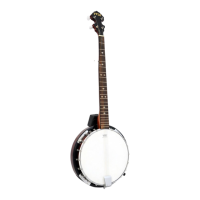
Identifies and labels the key components of the 5-string banjo, including the resonator, neck, and head.
Provides instructions for tuning the banjo using a digital tuner and specific string notes (D, B, G, D, G).
Ensures the tailpiece base is correctly positioned (2-3 mm) relative to the tension hoop for proper tuning.
Details placing the bridge (12-13" from 12th fret) and initial tuning of the banjo strings.
Explains fine-tuning bridge placement using overtone checks for accurate intonation.
Provides guidance on storing the banjo to prevent damage from heat, dampness, or direct sunlight.
Offers instructions on cleaning the banjo and strings, advising against abrasive cleaners.
Lists the key features of the 5-string banjo, including materials and design elements.
Details all the items included in the banjo package, such as strings, picks, and a tuner.
Provides specifications and features of the included clip-on digital guitar tuner.
Lists the technical dimensions, materials, and number of frets for the banjo.
The Pyle 5-String Banjo is a musical instrument designed to provide hours of enjoyment and musical expression for players of all levels. This user manual serves as a comprehensive guide to setting up, tuning, maintaining, and caring for your new banjo, ensuring it remains in peak playing form.
The Pyle 5-String Banjo is a stringed instrument primarily used in folk, bluegrass, and country music. It features a resonator, which amplifies the sound, and a head, which vibrates to produce the instrument's characteristic tone. The banjo is equipped with five strings, each tuned to specific pitches to create melodies and harmonies. The neck includes a fretboard with frets, allowing players to change the pitch of the strings by pressing them down at various points. Tuning pegs and a fifth string tuner are used to adjust the tension of the strings, thereby controlling their pitch. The bridge supports the strings and transfers their vibrations to the head, while the tailpiece anchors the strings at the opposite end. An arm rest provides comfort for the player's arm during extended playing sessions. The banjo is designed to be played by plucking or strumming the strings, producing a bright, resonant sound.
Setting up your Pyle 5-String Banjo correctly is crucial for achieving the highest quality sound. The manual emphasizes that each banjo is meticulously set up before leaving the factory, but variables like temperature changes and playing frequency can affect its original setup over time. Therefore, regular checks, ideally every 5-6 months initially and then twice a year, are recommended.
Tuning the banjo is a fundamental aspect of playing. The manual advises using a digital guitar tuner for precise tuning. The standard tuning for a 5-string banjo is D-B-G-D-G, from the 1st to the 5th string. After the initial tuning, fine-tuning is necessary. The manual also provides instructions for fretting each string to ensure they have the same pitch as the 5th G string at specific fret positions: 1st string on the 5th fret, 2nd string on the 8th fret, 3rd string on the 12th fret, and 4th string on the 17th fret. A "hot tip" for string changes suggests tightening new strings several times after the first tuning and pulling them up from the fingerboard. This action helps stabilize tension on the tailpiece, bridge, nut, and tuning peg, preventing tuning problems.
The manual details the process of tightening the banjo head, a critical step for sound quality. This involves removing thumb screws that hold the resonator to the flange to access the lugs that tighten the head. The lugs should be tightened gradually, a fraction of a turn at a time, moving in a circular pattern to ensure even tension. Once the head is tightened, the resonator is reattached.
Proper tailpiece position is also essential. The base of the tailpiece should be positioned approximately 2-3 mm (5/64" to 1/8") above the tension hoop. An adjusting screw allows for fine-tuning the tension of the strings, which should be tightened only to minimum tension, just enough to prevent looseness. After adjustment, the strings and head should be checked to ensure they maintain their tuning.
Placing and fine-tuning the bridge is another key setup step. On most five-string banjos, the bridge should be positioned 12-13 inches from the twelfth fret. The manual guides the user to identify which end of the bridge goes under the skinny strings, then to place it under the strings and tighten them until the bridge stays in place. The distance between the nut and the twelfth fret should be measured, and this distance should ideally be the same as the distance from the twelfth fret to the bridge. For fine-tuning the bridge placement, the manual describes a method involving holding the left forefinger on the fourth (lowest pitched) string just over the twelfth fret without pressing it down, and plucking it with the right hand to hear the "octave" overtone. This sound is then compared to the sound of the string pressed down just behind the twelfth fret. If the overtone is lower, the bridge should be moved toward the tailpiece; otherwise, it should be moved toward the neck. This "skootching" back and forth may untune the banjo temporarily but is necessary for accurate bridge placement. The manual explains that this process compensates for the slight stretching of the string when pressed down, ensuring accurate intonation. It also notes that the bridge may not appear "straight" after this adjustment, with the part under the skinny strings often ending up closer to the neck than the part under the heavy strings, which is considered normal.
Maintaining your Pyle 5-String Banjo ensures its longevity and consistent performance. The manual provides clear guidelines for storing and cleaning the instrument.
For storage, the banjo should be kept in an environment similar to what its player would find comfortable – not too hot, not too cold, and certainly not wet or damp. It is crucial to keep the instrument clean and free from dust, dirt, and moisture. The manual advises against leaving the banjo near radiators or in windows where direct sunlight can bake it. Similarly, storing it in cold or damp places like cellars, lofts, or garages should be avoided. These precautions help protect the wood and other materials from damage due to extreme temperatures or humidity.
Regular cleaning is also emphasized. After each playing session, the instrument should be wiped over with a lint-free cloth to remove finger marks. The strings can be cleaned using a string cleaning lubricant to maintain their playability and extend their life. From time to time, players may wish to polish their instrument. However, it is essential to ensure that any polish used is suitable for the banjo's finish. The manual stresses the importance of always removing finger and body marks using cleaning cloths and explicitly warns against using abrasive cleaners, as these can remove the plating and damage the instrument's finish. Adhering to these maintenance practices will help preserve the aesthetic and functional quality of your Pyle 5-String Banjo for years to come.
 General
| Type | 5-String Banjo |
|---|---|
| Number of Strings | 5 |
| Body Material | Mahogany |
| Fingerboard Material | Rosewood |
| Number of Frets | 22 |
| Tuning Pegs | Geared |
| Finish | Gloss |
| Resonator | Yes |
| Category | Musical Instrument |
| Bridge Material | Maple |
| Material | Maple, Rosewood |

 To Next Page