
 Need help?
Do you have a question about the QOMOTOP GFP02T and is the answer not in the manual?
Critical safety advice including gas leaks, outdoor use, and CO hazards.
Step-by-step instructions for responding to a gas leak scenario.
Guidelines for safe installation, regular checks, and material placement near the unit.
Details on compliant LP gas cylinders, including overfill prevention and valve protection.
Advisory on potential exposure to lead and carbon monoxide as per California law.
Technical specifications including certification, heat input, fuel type, and gas supply parameters.
Pre-assembly checks for parts and advice on keeping the owner's manual for reference.
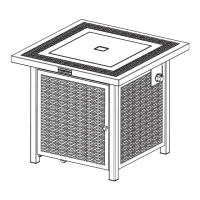
Identification and list of all main parts included in the package for assembly.
Specifies necessary tools not included and the estimated time required for assembly.
Detailed list and visual representation of all hardware components required for assembly.
Instructions for attaching the main legs and the leg with door magnet to the tabletop.
Guidance on attaching the first side panel to the legs using specific bolts.
Mounting the gas valve panel to a side panel and connecting it to the fire bowl.
Securing the already attached side panel A to the legs with additional bolts.
Instructions for attaching the first side panel B to the legs.
Instructions for attaching the second side panel B to the legs.
Attaching cylinder holder poles and locking bolt to the cylinder holder base.
Securing the assembled cylinder holder unit to the fire pit legs.
Installing a protecting wire at the bottom of the fire bowl for safety.
Screwing the door handle onto the fire pit door.
Attaching the door to the front leg assembly using specific bolts.
Placing lava rocks in the burning area and positioning the cover lid when not in use.
Guidance on choosing a location and placing the fire pit on a stable, non-combustible surface.
Instructions for performing a leak test using a soapy solution on gas connections.
Important notes regarding vapor withdrawal from cylinders and hose assembly condition.
Crucial warnings about operating the appliance only after reading instructions and safety precautions.
Mandates outdoor use only, ensuring clear surroundings free of combustibles and good ventilation.
Advises against touching or moving the appliance for at least 45 minutes after use.
Recommends thorough inspection before each use and waiting periods for relighting a hot fire pit.
Detailed steps for safely lighting the gas fire pit burner using the control knob.
Explains normal flame appearance and how to address issues like blue flames or backfiring.
Advises to avoid inhaling fumes from the first use due to manufacturing oils, which dissipate quickly.
Tips for reducing burner noise and checking gas pressure if the flame is small.
Instructions for re-lighting, proper shutdown, and immediate actions in case of gas leakage.
Specifies spacing tolerances, level ground requirement, and avoiding explosive atmospheres.
Indicates primary use for heating outdoor areas and stresses the need for adequate fresh air ventilation.
Recommends using warm soapy water for cleaning and keeping surfaces and openings clear of debris.
Safety precautions during cleaning, especially regarding gas controls and burner elements.
Notes on corrosion in salt-air environments and signs of burner/airway blockage.
Instructions for storing the fire pit indoors during winter, including cylinder removal.
Guidelines for storing the LP gas cylinder outdoors in a well-ventilated area, away from children.
Lists common problems like gas odor, delayed ignition, and ignition failure with their causes and solutions.
Outlines what the manufacturer's limited warranty covers regarding defects in material and workmanship.
Lists items and conditions not covered by the warranty, such as freight charges and misuse.
Provides contact information for customer service regarding questions or concerns about the product.
This document provides comprehensive instructions for the assembly, operation, and maintenance of a 28-inch square gas fire pit, designed for outdoor use. The manual emphasizes safety precautions and proper handling to ensure a long lifespan for the appliance.
The gas fire pit serves as an outdoor heating appliance, primarily used for patios, decks, spas, pools, and other open working areas. It operates on a standard 20 lb (9 kg) LP gas cylinder, providing warmth and ambiance. The unit is designed for vapor withdrawal from the cylinder, which must include a collar to protect its valve. The fire pit features a burner that produces a flame, and a control knob allows users to adjust the heat output. Lava rocks are placed in the burning area to enhance the aesthetic and heat distribution. A cover lid is provided for protection when the fire pit is not in use.
The fire pit is designed for straightforward assembly and operation, though it is recommended that two or more people assist with installation. Before any use, it is crucial to perform a leak test with a soapy solution on all gas connections, especially after connecting a new cylinder or re-assembling the unit. The appliance must always be placed on a firm, level, and non-combustible surface, away from grass or dirt to ensure proper safety venting. Adequate fresh air ventilation is essential, and specific spacing tolerances from combustible materials must be maintained.
To operate the fire pit, users must first ensure the control knob is in the "OFF" position, then fully open the LP cylinder gas valve. The burner is ignited by pressing down and turning the control knob counter-clockwise to the "MIN" position. A clicking noise indicates ignition. If the burner does not light within 5 seconds, the user must turn the knob to "OFF," wait 5 minutes for gas to dissipate, and then repeat the ignition process. Once lit, the heat output can be adjusted between "MIN" and "MAX" using the control knob.
The flame characteristic is typically yellow. If the flame appears blue and very small, it may indicate low gas pressure or an empty cylinder. If flames lift away from the burner, backfire, or produce thick black smoke, the unit must be turned off immediately and serviced by a qualified technician. It is important to avoid covering the flame orifice with lava rocks to prevent ignition failure. After use, the fire pit remains hot for at least 45 minutes, and users are cautioned not to touch or move it during this time.
For safety, the manual strictly prohibits using an open flame to check for leaks, smoking during testing, or testing indoors. A leak check is mandatory whenever the gas cylinder is replaced. Only the pressure regulator supplied with the fire pit should be used, and replacements must be those specified by the manufacturer. The fire pit is for outdoor use only and must never be operated inside a building, garage, or any other enclosed area. Flammable liquids and vapors must be kept clear of the appliance.
To shut down the fire pit, the control knob should be pushed in and turned clockwise to "OFF," followed by turning the LP cylinder gas valve to "OFF" when the appliance is not in use. In the event of a gas leakage, the control knob and LP cylinder valve must both be turned to "OFF," and a 5-minute waiting period is required for gas to dissipate. If the odor persists, the gas supplier should be contacted immediately.
Regular maintenance is crucial for the fire pit's optimal performance and longevity. Exterior surfaces should be kept clean using warm soapy water, avoiding flammable or corrosive cleaning agents. When cleaning, it is important to keep the area around the burner dry; if the gas control is exposed to water, it must be replaced. The appliance area must be kept free and clean from combustible materials, gasoline, flammable vapors, and liquids, ensuring that combustion and ventilation air flow are unobstructed. The ventilation opening(s) of the cylinder enclosure must also be kept clear of debris.
The hose should be checked for cracks or worn sections, and if found, it must be replaced by contacting customer service. At least once a year, the unit should be inspected for spiders, spider webs, or other insects, as these can block airflow and create a dangerous condition. The control compartment, burner, and circulating air passageways must be kept clean. Signs of blockage include the fire pit not reaching the desired temperature, uneven glow, or popping noises. Burner holes can be cleaned using a heavy-duty pipe cleaner, and compressed air can help remove smaller particles.
In salt-air environments, corrosion occurs more quickly, necessitating frequent checks for corroded areas and prompt repairs. Before covering the fire pit, it must be allowed to cool completely. The cylinder should be disconnected and removed before storing the appliance indoors, especially during winter if freezing temperatures are expected. Disconnected cylinders must be stored outdoors in a well-ventilated area, out of reach of children, with threaded valve plugs tightly installed. The fire pit itself should be stored in a dry location, sheltered from direct contact with inclement weather, to maximize its product life. A qualified service person should install, repair, and inspect the fire pit annually.
 General
| Fuel Type | Propane |
|---|---|
| Shape | Square |
| Color | Black |
| Portable | Yes |
| Assembly Required | Yes |
| BTU | 50, 000 BTU |
| Material | Steel |

 To Next Page