This document is a service manual for the Quantel Medical Optimis II ophthalmic laser, specifically the 1064nm laser model. It provides detailed information for technicians regarding the device's function, technical specifications, usage, and maintenance.
Function Description
The Quantel Medical Optimis II is an ophthalmic laser system designed for medical applications, likely in ophthalmology, given the "ophthalmic laser" and "YAG laser" references. The system consists of two main sub-assemblies: a Laser Console and a Laser Head (Slit Lamp). The laser head, which includes a slit lamp, is where the laser is delivered for treatment. The system incorporates various safety features to protect both the user and the patient during operation. It uses a 1064nm laser, and there's also a mention of a 532nm YAG adaptor, suggesting it might support different wavelengths or have an aiming beam at 532nm. The device is designed to deliver precise laser pulses, with energy levels that can be adjusted and monitored.
Important Technical Specifications
- Laser Wavelength: 1064nm.
- Laser Power: Up to 30mJ at 1064nm.
- Aiming Beam: 637nm up to 1mW, which is accessible upon removal of the console cover.
- Power Supply: The main unit includes a power supply/switch/fuse unit, main DC power supply, auxiliary board, interface board, CPU board, high voltage capacitor board, high voltage power supply board, display/keyboard unit, and back panel connectors.
- Input Current: 85 to 264 VAC, 47 to 63 Hz with maximum input current of 1.2A.
- Output: 12VDC or 24VDC, delivering up to 40W.
- Protective Eyewear: Specific Protective Glasses are required, with reference numbers N° 91 - B980 - 1100 OD6 - L5, for the laser wavelength present in the OPTIMIS II.
- Energy Measurement: The system includes an energymeter for measuring laser energy.
- Pulse Modes: The device supports single pulse and multiple pulse (e.g., 2 or 3 pulses) operation, with specific voltage values associated with each.
Usage Features
The Optimis II system is operated via a Laser Console and a Slit Lamp.
- User Interface: The console features a display and keyboard unit, and a joystick pulse button for controlling the laser.
- Safety Interlocks: The system has various safety interlocks, including a room doorswitch, trigger safety, energy safety, shutter safety, joystick safety, knob position safety (energy and focus), slit lamp safety, and room doorswitch. These safeties are activated in normal mode and turn OFF when a safety is activated.
- Service Mode: A dedicated service mode allows technicians to access and adjust internal parameters. This mode is accessed by removing a jumper connector on the CPU board and turning the key to ON. In service mode, the measured energy is displayed, and the energy safeties are not activated.
- Installation: The manual details the installation process, including placing the chinrest, metal shaft, slit lamp, and slit generator axis, as well as connecting various cables (Sub-D 25, Slit Lamp, High Voltage, Ground, Power Supply, Joystick interlink, Remote). A self-test procedure is performed after installation to ensure proper functionality.
- Optical Adjustments: The manual describes procedures for checking and adjusting various optical components, including slit checking, aiming beam checking, YAG and aiming beam checking, focus checking, aiming beam focalization and sharpness, aiming beam centring in the binocular cross, aiming beam superposition on the YAG beam, pin hole adjustment, and focus adjustment of the aiming beam.
Maintenance Features
- Service Manual Focus: This document is explicitly a "Service Manual," indicating its primary purpose is to guide technicians through maintenance and repair.
- Troubleshooting: The "5-3 Defects and Solutions List" provides a comprehensive guide to common error messages (e.g., Energy > 3.0mJ, Error 10, Error 11, Error 12, Error 13, Error 14) and their corresponding explanations and solutions. This includes checking the shutter, adjusting potentiometers, replacing boards, and checking connections.
- Disassembly and Inner Views: Detailed instructions and diagrams are provided for disassembling the laser console and laser head, including removing the auxiliary board, CPU board, interface board, display board and LCD, high voltage power supply, high voltage capacitor board, and slit lamp components. This is crucial for accessing internal parts for repair or replacement.
- Spare Parts: A list of spare parts with their identification and code is provided in section 2-6, covering components from the main unit to individual mirrors and laser diodes.
- Electronic Adjustments: Chapter 7 outlines electronic adjustments for energy safety, energymeter calibration, high voltage calibration, and display contrast adjustment. These procedures involve using a voltmeter and adjusting potentiometers on various boards.
- Fuses Replacement: Chapter 10 details the procedure for replacing fuses located on the rear panel, emphasizing the importance of respecting the way the fuses holder is pointed.
- Warranty Void: A critical warning states that the warranty is void if the laser console and laser head are opened without admission from the Quantel Medical Technical Department, highlighting the need for authorized service.
- Special Training: Special training by Quantel Medical is necessary for technicians to ensure optimum adjustment and maximum reliability of the whole instrument.
- Regular Checks: The manual emphasizes regular checks, such as verifying the laser room access and ensuring the laser beam is directed towards an aperture, to maintain safety and performance.

 Need help?
 General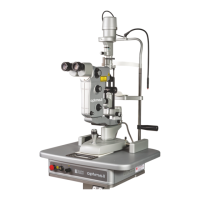

 To Next Page