This document outlines the instructions for use and maintenance of the QPN C1600, QPN C1800, QPN C2500, and QPN C3000 series of dry air compressors. These devices are designed to remove moisture from compressed air, which is crucial for various industrial applications to prevent damage to equipment and ensure product quality.
Function Description
The dry air compressor operates on a refrigeration principle to cool the compressed air, causing moisture to condense and separate. The process begins with the compressed air entering the chiller, where it is directed to a direct-expansion heat exchanger. Here, the air is cooled by a refrigerant circuit, leading to the condensation of water vapor. The condensed water is then expelled through a steam trap, while the dried air continues to the next stage.
The refrigeration circuit utilizes a compressor (1) to circulate the refrigerant. The refrigerant, after being compressed, flows through a condenser (2) where it releases heat and changes phase. It then passes through a filter (7) and a capillary tube (8) before entering the evaporator (3), which is the direct-expansion heat exchanger. In the evaporator, the refrigerant absorbs heat from the compressed air, causing the air to cool and the refrigerant to evaporate. The now gaseous refrigerant returns to the compressor to restart the cycle.
The system incorporates a bypass valve (10) for hot gas, which helps maintain a stable evaporator temperature, preventing freezing and ensuring efficient operation even under varying load conditions. This control mechanism ensures that the dew point temperature remains consistently low, typically between 3°C (37.4°F) and 5°C (41°F), depending on the model and operating conditions.
Important Technical Specifications
The dry air compressors are available in several models, each with specific dimensions, weights, and performance characteristics:
QPN C1600:
- Dimensions (L x W x H): 1020 mm (40.1 in) x 1123 mm (44.2 in) x 1551 mm (61 in)
- Weight: 380 kg (837 lbs)
- Refrigerant: R-404A, with a GWP of 3800. The refrigerant charge is 6.60 kg (14.55 lbs) for 50 Hz models and 9.74 kg (13.06 lbs) for 60 Hz models.
- Nominal Power (W): 1250 W (1.67 hp)
- Max. Pressure: 13 bar (188 psi)
QPN C1800:
- Dimensions (L x W x H): 1020 mm (40.1 in) x 1299 mm (51.1 in) x 1560 mm (61.4 in)
- Weight: 550 kg (1212 lbs)
- Refrigerant: R-404A, with a GWP of 3800. The refrigerant charge is 10.50 kg (23.14 lbs) for 50 Hz models and 9.60 kg (11.28 lbs) for 60 Hz models.
- Nominal Power (W): 2500 W (3.35 hp)
- Max. Pressure: 13 bar (188 psi)
QPN C2500:
- Dimensions (L x W x H): 1020 mm (40.1 in) x 1299 mm (51.1 in) x 1560 mm (61.4 in)
- Weight: 550 kg (1212 lbs)
- Refrigerant: R-404A, with a GWP of 3800. The refrigerant charge is 11.00 kg (24.25 lbs) for 50 Hz models and 17.70 kg (23.1 lbs) for 60 Hz models.
- Nominal Power (W): 2500 W (3.35 hp)
- Max. Pressure: 13 bar (188 psi)
QPN C3000:
- Dimensions (L x W x H): 1020 mm (40.1 in) x 1299 mm (51.1 in) x 1560 mm (61.4 in)
- Weight: 650 kg (1433 lbs)
- Refrigerant: R-404A, with a GWP of 3800. The refrigerant charge is 15.0 kg (33.06 lbs) for 50 Hz models and 17.70 kg (23.1 lbs) for 60 Hz models.
- Nominal Power (W): 2500 W (3.35 hp)
- Max. Pressure: 13 bar (188 psi)
All models are designed for an ambient temperature range of 3°C (37.4°F) to 45°C (113°F) and an inlet air temperature of 3°C (37.4°F) to 55°C (131°F). The working pressure is 13 bar (188 psi).
Usage Features
The dry air compressors are designed for ease of use and safety. Before starting the machine, it is essential to ensure proper electrical connection and compressed air piping. The electrical power supply must match the voltage indicated on the machine data plate, and the earth lead must be efficient. An automatic cut-out device upstream for the machine against overcurrents is mandatory.
The control panel features a digital controller (1) with a display (7) that shows the operating status and any alarms. Indicators for power ON (3), fan ON (4), and compressor ON (5) are present. The display can show the PDP temperature (6) in either °C or °F.
Starting Up:
- Remove eventual caps on the drier inlet and outlet.
- Connect the compressed air piping.
- Connect the condensate drainage system.
- Connect the power supply.
- Start the system; the compressor starts running, and the air is free of condensate only after about two hours.
- If the drier is switched off, wait at least 5 minutes before restarting to allow the pressure to balance.
Safety Features:
- Electrical Safety: The machine must be connected to an efficient earth lead. All electrical work must be carried out by professionally skilled personnel.
- Pressure Safety: The system includes pressure switches for high and low pressure, ensuring safe operation within specified limits.
- Mechanical Safety: Cooling fan shields (1) and general shields (2) are in place to prevent accidental contact with moving parts.
- Refrigerant Safety: The refrigerant used, R-404A, is a greenhouse gas. Any work involving the refrigerant circuit must be performed by qualified personnel.
- Danger Signals: The manual highlights various risks, including dangerous electrical voltage, hot parts, high pressure, and rotating fans, with corresponding warning symbols.
Maintenance Features
Regular maintenance is crucial for the longevity and efficient operation of the dry air compressor. The maintenance schedule is divided into weekly, monthly, and annual tasks.
Weekly Maintenance:
- Condensate Drain: Clean the filter of the steam trap (Ref. 10). This involves closing the inlet valve, opening the drain valve, and cleaning the filter.
Monthly Maintenance:
- Condenser: Clean the condenser fins to remove eventual dust (Ref. 10). This can be done using compressed air.
- Automatic Condensate Discharger Filter: Clean the filter of the steam trap (Ref. 10). This procedure is similar to the weekly cleaning but may involve removing the stopper (Ref. 6) and cleaning the filter with a jet of air.
Annual Maintenance:
- Condenser: The condenser must be cleaned every month, but a thorough annual cleaning is recommended.
- General Check: A comprehensive check of all components, including the refrigerant circuit, electrical connections, and safety devices, should be performed by qualified personnel.
Troubleshooting and Emergency Remedies:
The manual provides a detailed troubleshooting guide for common faults, along with possible causes and observations.
- No compressed air passes through the dryer outlet: Possible causes include frozen pipes or a broken/out-of-calibration bypass valve. Remedies include checking the evaporator temperature, cleaning the condensate drain, and checking the flow rate of treated air.
- Presence of condensate in the pipings: This could be due to the condensate separator not working correctly or the dryer operating outside its rating. Remedies include cleaning the condensate drain, checking the air temperature, and verifying the dryer's operating conditions.
- Compressor head is very hot (>55°C - 131°F): Possible causes include a lack of refrigerant or a dirty cooling circuit. Remedies involve checking for refrigerant leaks and cleaning the condenser.
- Motor cuts out on overload: This could be due to a dirty condenser, low voltage, or a faulty thermostatic protection. Remedies include cleaning the condenser, checking the power supply, and resetting the thermostatic protection.
- EE Alarm: This indicates internal EPROM errors. If this warning appears, the dryer will stop running. The error can be reset by pressing one of the four buttons of the controller. If the problem persists, contact technical support.
- SE Alarm: After 4000 hours of operation, the controller will issue an "SE" warning, indicating that maintenance is due. The manual provides a step-by-step guide to reset this maintenance warning.
Bypass Valve for Hot Gas:
The bypass valves are factory-calibrated and generally do not require any adjustment. However, if adjustment is necessary, it should be performed by qualified personnel. The rated values for the bypass valve are provided in the manual, indicating the evaporating temperature and pressure for R404A refrigerant.
All maintenance and repair operations, especially those involving the electrical panel or refrigerant circuit, must be carried out by professionally skilled personnel to ensure safety and compliance with regulations.

 Need help?
 General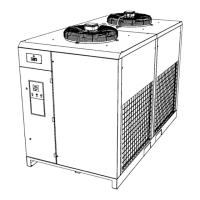

 To Next Page