Need help?
Do you have a question about the Quincy lab GC Series and is the answer not in the manual?
Details interior/exterior dimensions, weight, and electrical specs for oven models.
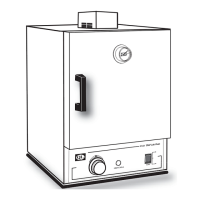
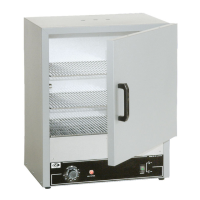
Describes the general construction materials and components of the lab ovens.
Emphasizes the importance of understanding operational guidelines and safety measures.
Provides initial steps for operating the oven, including thermometer placement and basic control usage.
Illustrates proper shelf placement and spacing for optimal air flow and heating.
Shows how incorrect loading can impede air circulation and affect heating uniformity.
Details the procedure for calibrating the oven's temperature control dial for accuracy.
Outlines the warranty terms and coverage for the Quincy Lab oven.
The Quincy Lab GC Series Lab Ovens are designed for laboratory use, providing a controlled heated environment for various applications such as drying, baking, and conditioning. These ovens operate through natural convection, ensuring uniform heating within the chamber. They are approved by Underwriters Laboratories (UL/CUL) for both United States and Canadian laboratory equipment standards, complying with UL Standard 61010-1 and IEC 61010-1.
The GC Series Lab Ovens function by generating heat within an insulated chamber, allowing users to maintain a stable temperature for their samples or materials. The natural convection design means that heated air rises, circulates within the chamber, and then descends as it cools, creating a continuous flow without the need for a fan. This gentle air movement is suitable for applications where forced air might disturb samples or create uneven drying. The ovens are equipped with a thermostat control that allows users to set and maintain a desired temperature, with a heat-cycle light indicating when the heaters are active. Exhaust ports at the top of the unit facilitate the expulsion of heated air, fumes, or moisture, which is crucial for effective drying and maintaining internal air quality. These ports should remain open for optimal performance and can also serve as access points for external temperature probes to verify chamber or content temperature. The ovens are designed to operate at temperatures ranging from ambient +25°F/C up to 450°F/232°C, with a typical temperature stability of +/- 6°F/3°C.
The GC Series Lab Ovens are designed for straightforward setup and operation. Upon unboxing, users will find the oven, adjustable chrome wire shelves, shelf brackets, a glass thermometer, and a rubber thermometer grommet. For initial setup, the unit should be placed in a clean, unobstructed location, ensuring a minimum of 4 inches of airspace around the unit and 18 inches above it to allow for proper air circulation and heat dissipation. The oven must be plugged into a grounded outlet rated for the unit's specified voltage, ideally on a dedicated circuit.
Shelf installation is simple: the ends of the wire shelf brackets are inserted into corresponding holes on the inner sides of the oven, pushed until the first bends are against the wall, and then rotated down. The shelf is then placed on these brackets.
Operating the oven involves a few key steps. The supplied glass thermometer should be inserted through the rubber grommet and placed into one of the top ports, extending at least 2 inches into the oven chamber for accurate temperature monitoring.
For the 10GC model, the ON/OFF power switch is turned to the ON position, and the thermostat control knob is rotated clockwise to a desired setting (e.g., around '8'). The heat-cycle light will illuminate, indicating active heating. Once the thermometer reaches the target temperature, the knob is slowly rotated counter-clockwise until the heat-cycle light goes out. The thermostat will then automatically cycle the heaters to maintain the set temperature. Turning the oven off with the ON/OFF switch saves the temperature setting for future use.
For 20GC, 30GC, and 40GC models, a dual-range "quick-set" knob dial simplifies temperature setting. To set the temperature in Fahrenheit, the knob is turned clockwise until the white triangle aligns with the desired number on the knob. For Centigrade, the knob is turned clockwise until the white triangle aligns with the desired "°C" marking on the control panel. The "quick-set" dial helps achieve a temperature close to the target quickly, though minor adjustments may be needed for precise calibration using the thermometer.
Chamber loading is critical for optimal performance. To ensure proper air circulation and temperature uniformity, articles should be spaced on shelves, staggered in a "V" formation, and kept away from the walls, especially on the lower shelf. Overloading the oven or using large solid trays or foil can restrict airflow, leading to non-uniform heating and longer processing times. For best results with a single item, it should be centered in the oven chamber. The manual explicitly warns against using the oven with flammable liquids or gases.
A crucial safety feature is the internal safety "snap disc" reset. If the unit exceeds its maximum temperature, this disc will cut power. To reset it, the unit must be unplugged, laid on its back, the bottom cover removed, and the button on the round "snap disc" pushed in.
The GC Series Lab Ovens are designed to be largely maintenance-free, but periodic checks and cleaning are essential for operational safety and accuracy. Users should regularly inspect the rear air intake vents for dirt or dust buildup and ensure that all intake and exit ports remain clear of obstructions.
Annually, the actual oven chamber temperature should be verified against a known accurate temperature measurement device. If the chamber temperature deviates by more than +/- 15°F (8°C) from the indicated dial setting, calibration is necessary. Calibration should ideally be performed at the most frequently used temperature.
To calibrate the temperature dial:
For general cleaning, both exterior and interior surfaces can be wiped with a damp cloth or an all-purpose cleaner. Commercial oven cleaners should be avoided.
The oven comes with a limited warranty: eighteen months from the date of shipment for the instrument, and a three-year warranty on the heating element. This covers parts and labor (labor at the factory only) and shipping costs for replacement parts.
 General
| Category | Laboratory Equipment |
|---|---|
| Manufacturer | Quincy Lab |
| Model | GC Series |
| Temperature Control | Digital |
| Shelves | 2 |
| Capacity | 1.4 cu. ft. to 9.4 cu. ft. (depending on model) |

 To Next Page