This document serves as an Instruction and Maintenance Manual for a series of dryers, specifically models QPNC354 (E11), QPNC424 (E12), QPNC530 (E13), and QPNC636 (E14), which utilize R410A refrigerant. The manual is divided into two main parts: Part A provides information for the user, and Part B is reserved for technically skilled personnel.
Function Description:
The dryer is a chilling machine designed for industrial use, employing direct expansion and a dry evaporator to remove water vapor from compressed air. The air to be dried passes through a heat exchanger where water vapor condenses, forming condensate that is then collected in a separator and discharged through a steam trap. The operation is fully automatic.
The refrigeration circuit involves a compressor (1) sucking gaseous refrigerant from the evaporator (4) and pumping it to the condenser (2) for condensation, often aided by a fan (3). The condensed refrigerant then passes through a dewatering filter (8), expands through a capillary tube (7), and returns to the evaporator to produce a refrigerating effect. This process cools the compressed air, causing the refrigerant to evaporate and return to the compressor. A bypass system, controlled by a hot gas bypass valve (9), adjusts the refrigerating capacity to the cooling load, maintaining a constant refrigerant pressure in the evaporator and preventing the dew point from dropping below 0°C to avoid freezing.
Important Technical Specifications:
The dryers operate with R410A refrigerant, which has a GWP100 of 2088 (according to EN-378-1).
- Models and Weights:
- QPNC354: 145 kg (320 lb)
- QPNC424: 158 kg (348 lb)
- QPNC530: 165 kg (368 lb)
- QPNC636: 164 kg (362 lb)
- Refrigerant Charge (R410A):
- QPNC354/424: 1.5 kg (3.31 lb)
- QPNC530: 1.85 kg (4.08 lb)
- QPNC636: 1.95 kg (4.3 lb)
- Nominal Power (50 Hz / 60 Hz):
- QPNC354: 1389 W (2.8 HP) / 2090 W (0.281 HP)
- QPNC424/530: 1429 W (3.27 HP) / 2440 W (1.045 HP)
- QPNC636: 1870 W (4.16 HP) / 3100 W (1.48 HP)
- Max Working Pressure: 14 bar (203 psi) for all models.
- Dimensions (all models):
- Length (L): 805 mm (31.7 in)
- Width (W): 1040 mm (41 in)
- Height (H): 962 mm (37.87 in)
- Reference Conditions (50 Hz / 60 Hz):
- Ambient temperature: 25°C / 38°C (+100°F)
- Inlet air temperature: 35°C / 38°C (+100°F)
- Working pressure: 7 bar / 7 bar (101.5 psi)
- Limit Conditions (50 Hz / 60 Hz):
- Max. ambient temperature: 45°C / 45°C (113°F)
- Min. ambient temperature: 3°C / 3°C (37.4°F)
- Max. inlet air temperature: 55°C / 55°C (131°F)
- Max. working pressure: 14 bar / 14 bar (203 psi)
- Evaporating Temperature (R410A): 0-1°C (32-33.8°F) at ambient temperature of 20°C (68°F).
- Evaporating Pressure (R410A): 7.0-7.2 bar (101.5-104.4 psi) at ambient temperature of 20°C (68°F).
Usage Features:
- Intended Use: Designed exclusively for drying compressed air for industrial applications. Not suitable for premises with fire/explosion risk, or for producing breathable air or air in direct contact with foodstuffs unless filtered appropriately.
- Installation: Requires sufficient space for maintenance (minimum 1.5m or 59 inches from the control panel). An automatic cut-out device upstream with a differential device is required for electrical connection. A manual interception valve must be fitted between the dryer and the compressed air network. Proper pre-filters are essential at the air inlet.
- Digital Controller: Features an intuitive front panel with icons for Alarm, Refrigerant Compressor, and Fan status. An Alarm LED indicates issues. Buttons are provided for snooze/reset, SET, UP, DOWN, and menu navigation.
- Remote Start/Stop Function: The machine can be remotely controlled via a potential-free contact, provided the main switch is ON.
- Freeze Protection Function: The digital controller automatically switches off the refrigerant compressor if the dewpoint temperature drops below -2°C / 28.4°F for more than 2 minutes (L2 Alarms).
- Automatic Cut Out of Refrigerant Compressor: The controller stops the compressor if the discharge refrigerant temperature exceeds a manufacturer-set limit to prevent further damage.
- Resetting the Dryer: After a compressor stop, the dryer can be reset by pressing button 7. It restarts when the dewpoint temperature is above -2°C / 28.4°F and 30 seconds have passed since the compressor stop.
- Silent Alarm Function: Alarms can be snoozed by pressing button 5.
- Discharge Temperature Visualization: The digital controller allows users to view the discharge refrigerant compressor temperature.
Maintenance Features:
- Safety Precautions: Before any maintenance, switch off the electric power supply and discharge residual pressure. All electrical work must be performed by professionally skilled personnel.
- Maintenance Schedule:
- Every week: Brush/blow off the finned surface of the condenser.
- Every 2000 hours / 1 year: Clean the filter of the automatic condensate drain.
- Every 4000 hours / 2 years: Replace the filter of the automatic condensate drain (2902016102) and replace the drain kit (2200902017).
- Cleaning the Automatic Condenswater Discharger Filter: Involves closing the cock, releasing pressure via the "TEST" pushbutton, switching off the machine, and then cleaning the filter with a jet of air from inside to outside.
- Cleaning the Condenser: Must be cleaned monthly by switching off the machine, turning off the supply, and cleaning the condenser fins with compressed air (DO NOT use water or solvents).
- Trouble-shooting and Emergency Remedies: The manual provides a detailed table of fault symptoms, possible causes, and observations/remedies. Operations marked with a specific symbol must be carried out by professionally skilled personnel.
- Digital Controller Maintenance: The controller indicates maintenance required (SE alarm) and internal EPROM errors. Maintenance alarms can be reset through a specific sequence on the digital controller. The service interval can also be set via the controller.
- Scrapping: When scrapping, the machine must be dismantled into parts of the same material and disposed of according to local regulations, with strict adherence to regulations for disposing of old oil, polluting materials, and insulating foam.

 Need help?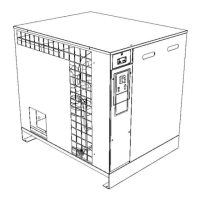

 To Next Page
 General