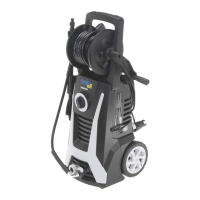
This document is an operator's manual for a gasoline pressure washer, designed to guide users through its assembly, operation, and maintenance. The manual emphasizes safety precautions and proper usage to ensure reliable service and prevent injury or damage.
Function Description
The gasoline pressure washer is a powerful cleaning tool designed for residential use. Its primary function is to remove dirt, mold, and various stains from a variety of surfaces using a high-pressure stream of water. It is particularly effective for cleaning house siding, decks, garage floors, brick patios, and cement walkways. Beyond these common household applications, the unit can also be used to clean vehicles such as cars, motorcycles, boats, and RVs, as well as outdoor furniture, lawn equipment, and grills. The device utilizes a gasoline engine to power a pump that generates the high-pressure water stream, making it suitable for tasks where electrical power might not be readily available or convenient. The inclusion of quick-connect nozzles allows for versatile cleaning applications, adapting the spray pattern and intensity to different cleaning needs. The system is designed to be compliant with environmental protection agency standards, indicating a focus on responsible operation.
Usage Features
The pressure washer is designed with several features to enhance its usability and versatility.
- Assembly: The manual provides detailed instructions for assembling the unit, including attaching the foot assembly, installing the handle, securing upper and lower gun hooks, and attaching an accessory hook. It also covers the attachment of the spray gun and the connection of both the garden hose to the water inlet and the high-pressure hose to the pump and spray wand. Clear diagrams accompany these steps to facilitate easy setup.
- Engine Oil and Fuel Management: Before initial use, users must add engine oil, with specific instructions on how to check and fill the oil reservoir to the correct level. The manual also guides users on adding unleaded gasoline, emphasizing proper ventilation and preventing overfilling to avoid spillage and expansion.
- Starting and Stopping: The operation section outlines a pre-operation checklist to ensure all components are ready and safe for use. Starting the pressure washer involves a sequence of steps: placing it on a level surface, turning on the water supply, purging air from the pump, attaching the wand/lance, turning the fuel valve to "ON," setting the choke lever, turning the engine switch to "ON," and then pulling the recoil handle. The manual advises releasing pressure after failed start attempts to reduce back pressure. Stopping the unit involves turning off the engine switch, fuel valve, and water supply, followed by squeezing the trigger to release all water pressure.
- Spray Gun Operation: The spray gun features a locking trigger mechanism for safety. Users can apply or remove the safety lock by flipping a tab behind the trigger. Pulling the trigger initiates water flow, and releasing it stops the flow.
- Nozzle System: The pressure washer comes with a set of quick-connect nozzles, each designed for different applications. Users can easily connect or disconnect spray tips by pulling back on the quick-connect collar. The manual suggests specific nozzles for general cleaning (40°), stripping, spot cleaning, blasting, and reaching high areas (15°), and for applying detergent (black soap nozzle). It cautions users to exercise extreme caution when using high-intensity nozzles due to the powerful spray.
- Detergent Application: The unit supports the application of pressure washer safe detergents. Users are instructed to rinse the surface with cool water first, prepare the detergent according to the manufacturer's directions, and then spray the detergent using long, even, overlapping strokes. A setting time of about 3 minutes is recommended before rinsing, with a warning not to let the detergent dry on the surface. After use, the system should be flushed with water, and the nozzle soaked in clean water to remove detergent residue.
- Mobility: The pressure washer is designed for easy movement. To relocate the unit, users should turn it off, tilt it onto its wheels for balance, and then roll it to the desired location.
Maintenance Features
The manual provides a comprehensive maintenance schedule and instructions to prolong the life of the pressure washer and ensure optimal performance.
- Safety First: Before any inspection or servicing, the manual stresses the importance of turning off the engine, ensuring no parts are moving, and disconnecting the spark plug wire to prevent accidental starts.
- Pre-Operation Checks: Before each use, users are advised to check engine oil and fuel levels, inspect the air filter for cleanliness, remove any debris from the unit, check the water inlet screen for damage or clogs, and inspect the high-pressure hose for damage. Running the garden hose briefly to flush debris is also recommended.
- Debris Removal: Regular cleaning of debris around the muffler, cleaning system, and controls is essential. A damp cloth or soft bristle brush can be used for exterior surfaces.
- After Each Use: Post-operation maintenance includes shutting off the engine and water supply, releasing pressure from the spray gun, disconnecting and draining water from the high-pressure hose, spray gun, and nozzle, and emptying water from the pump by pulling the recoil starter. Storing the unit in a clean, dry, frost-free area is crucial, and using a pressure washer pump conditioner is recommended.
- Engine Oil Changes: The manual specifies changing the engine oil after the first 5 hours of use, and then annually (or more often in dirty/dusty conditions). It provides detailed steps for draining old oil and refilling with new oil, emphasizing that oil drains better when the engine is warm.
- Water Inlet Screen: The water inlet screen should be checked and cleaned after each use to prevent clogs.
- Detergent Siphoning Tube: This tube needs regular inspection for clogs, leaks, or tears, and should be replaced if damaged. It's important to ensure it fits tightly to the pump fitting.
- High Pressure Hose: The high-pressure hose should be inspected for cuts, bulges, or leaks after each use. Any damage necessitates immediate replacement with an identical part, as repairs are not recommended. Couplings should also be checked for damage.
- Spray Gun: Users should ensure the spray gun is securely connected and that the safety mechanism and trigger springs function correctly.
- Spray Nozzle Cleaning: If a pulsing sensation occurs, the spray nozzle may be dirty or clogged. The manual provides steps to clean the nozzle, including removing it, using a nozzle cleaner or paper clip to dislodge foreign materials, and back-flushing with a garden hose.
- Spark Plug Maintenance: Annually (or every 100 hours of use), the spark plug should be checked. This involves disconnecting the wire, cleaning the area, cleaning carbon deposits, checking and adjusting the electrode gap, reinstalling, and reconnecting the wire. Worn spark plugs should be replaced with equivalent parts.
- Air Filter Maintenance: The air filter should be checked and cleaned annually (or every 50 hours of use). Instructions include removing the cover, carefully pulling out the filter, tapping or blowing out dirt, and reinstalling it to ensure a proper seal.
- Repairing Leaking Connections: For leaks, the manual suggests purchasing O-Ring/Maintenance kits from an authorized service center and following their instructions.
- Storage: For storage longer than 30 days, specific procedures are outlined: adding fuel stabilizer, running the engine briefly to circulate it, adding PumpSaver to protect the pump, emptying all fluids from hoses and pump, disconnecting and cleaning the spark plug (leaving it disconnected), cleaning the air filter, covering the unit, and storing it in a frost-free area.
- Troubleshooting: A troubleshooting guide helps users diagnose and resolve common issues related to the engine not starting, hard starting, lack of power, quitting during operation, loss of power under load, weak water pressure, detergent not mixing, or inconsistent pump pressure. This section provides potential causes and corresponding solutions, often directing users to contact a service center for more complex problems.

 Need help?
 General

 To Next Page