INSTRUCTIONS
STEALTH STL360 INSTALLATION
RAB Lighting is committed to creating high-quality, a ordable, well-designed and energy-e cient LED lighting and controls that make it easy for electricians to install
and end users to save energy. We’d love to hear your comments. Please call the Marketing Department at 888-RAB-1000 or email: marketing@rablighting.com
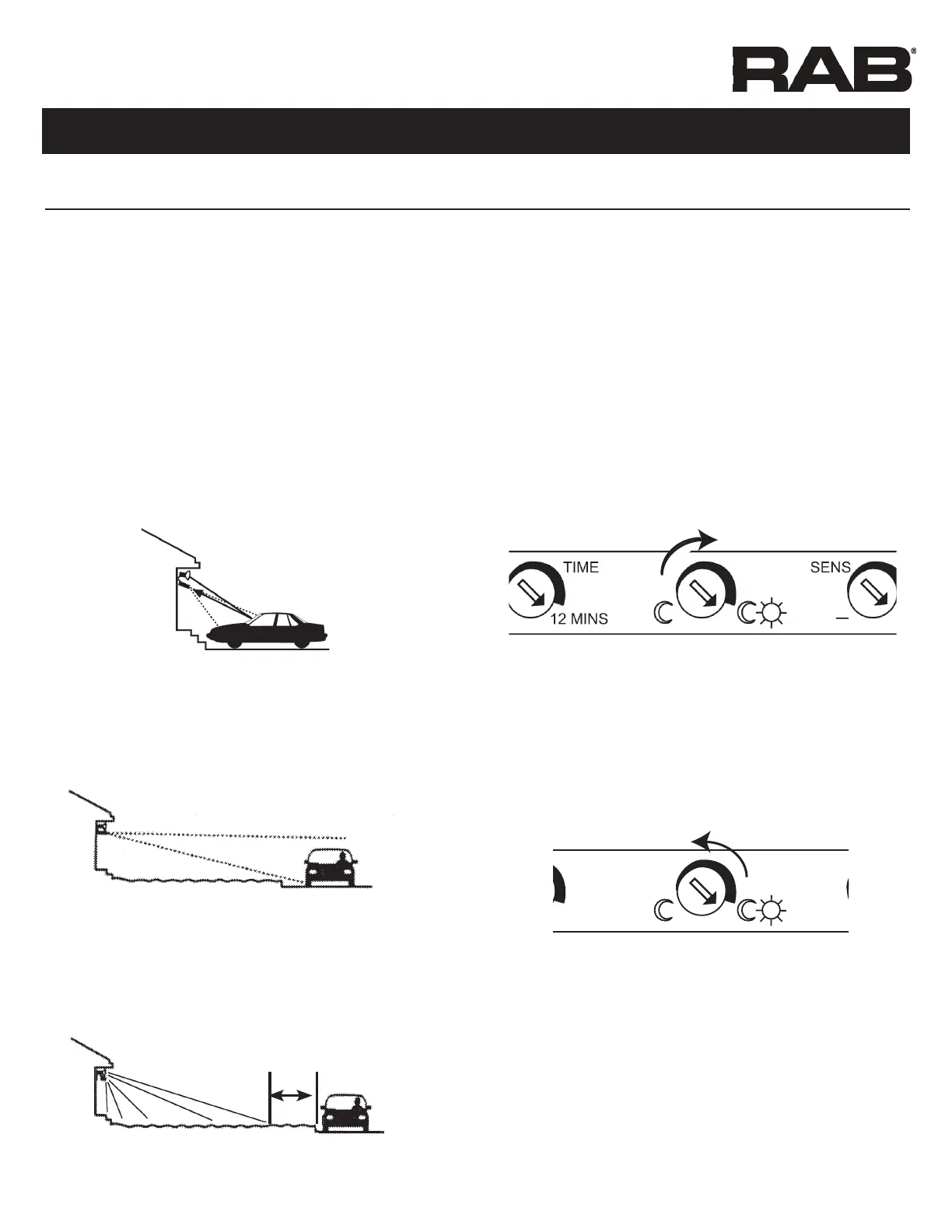
20'
safety zone
TROUBLESHOOTING (cont’d)
Lights Turn On and O Inappropriately (cont’d)
Lights Do Not Turn On.
1. Check that lamps and xtures work. Compare wiring to the
wiring diagram in this manual. Check that the power is on.
2. If installing during daylight, LED will go into automatic mode
after warm up period and will not work during daylight if
the photocell is turned to the night only position (MOON
symbol).
If you require a test mode, turn time setting to 5 seconds
and turn the power o at least 10 seconds and back on
again.
If you require the sensor to operate both day and night,
turn the SUN/MOON control knob clockwise to the sun
and moon symbol as shown.
3. Check that lights from another source, such as adjacent
porch lights, garden lights or street lights are not in the
sensor’s view. The sensor’s photocell may detect the light
and deactivate “daylight”.
If you desire the sensor to operate in higher ambient light
levels, turn the SUN/MOON control knob counter clockwise
toward the sun symbol as shown.
4. Was sensor wired hot? If so circuitry may have been
damaged.
TIME
1 8 HRS 5 SECS 12 MINS – +
EVENING
TIMER
SENS
1. Make sure that the sensor is installed on its own dedicated
circuit, free of motor loads such as HVAC equipment, kitchen
appliances or garage door openers.
2. It is not recommended to wire sensors in parallel.
More than one sensor wired together makes them di cult to
troubleshoot. Disconnect multiple sensors and test separately.
3. Keep all people completely out of the detection pattern to
make sure the sensor is not detecting them.
4. Make sure sensor is located below and as far as possible from
its lamps. Heat from the lamps may trigger the sensor.
Solution:
Move sensor below and away from the lamps as shown.
5. Make sure lights are not re ecting back into sensor. Check for
white or re ective surfaces close to the sensor.
Solution: Aim sensor away from re ective
objects, or move the objects and lower sensitivity.
6. Make sure sensor is not aimed within 20 feet of a road or
sidewalk. Passing cars will activate sensor.
Solution: A 20 foot safety zone and reduced sensitivity are
recommended to avoid activation from passing cars.


 To Next Page
 Loading...