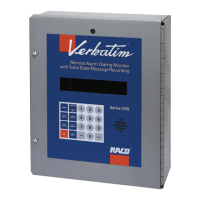
Verbatim Floobydust
H-16 Verbatim Owner's Manual
H.10 Calling a Pager
H.10.1 Introduction
It has become fairly common to have the autodialer call a pager system with an
alarm call. The dialer is well equipped to handle many of the current pager
protocols, and an overall understanding of the sequence of events will make the
required programming go smoother.
Typically, a call to the pager is placed. After a short period (usually 5-12
seconds), the pager answers then gives a beep or a short burst of beeps. This is
the signal to begin entering the number you want to be received and displayed
by the beeper. When the information is complete, the pager terminal will hang
up.
Note:
RACO strongly recommends that you program other personnel phone
numbers at the appropriate place in the dialing list. This is to insure that if for
some reason the pager system cannot be activated, you will get a timely
warning from your autodialer.
H.10.2 General Programming Considerations
In most cases, the entire pager calling sequence is handled within the dialing
string of the Verbatim. That is, it is all part of the phone number. The unit will
handle up to 60 digits, including any timing delays you insert. The dialer must
be programmed for touch tone dialing (program code 9011), as a pager terminal
will not recognize pulse dialing.
Numeric Pager Support
Support for Numeric Pagers is comprised of a number of Verbatim autodialer
features:
l Ability to add delays into a phone number string
Often needed to pause after dialing the pager system's digits and emitting
the caller's ID digits in the phone string.
l Ability to add DTMF # (or DTMF*) into a phone number string
Often needed as a terminator character to inform the paging system that
the last digit has been entered.
l Ability to add a pause for tone detect anywhere in the phone number
string
Sometimes used to detect the paging system's beep(s) heard after it
answers.


 To Next Page
 Loading...