Analog Signal Input
B-4 Verbatim Owner's Manual
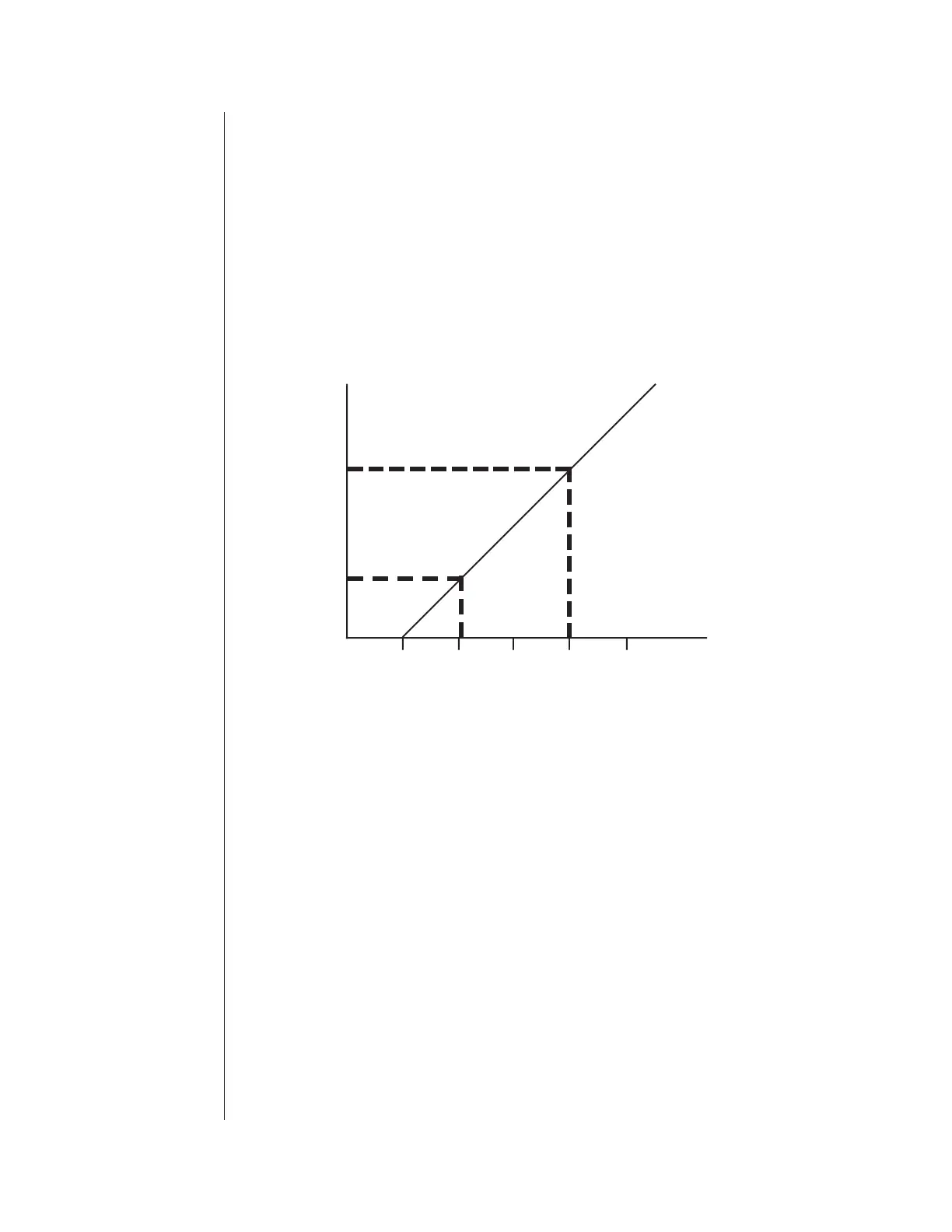
where m is the gain and b is the zero crossing point or Input (ma -> offset.
The gain may be calculated from: m=(y2-y1)/x2-x1)
where x1, y1 is one coordinate pair on the graph and x2, y2 is the other.
Therefore, when you have chosen to enter non-default coordinates you are in
fact setting the gain factor. This gain factor is taken along with the input signal
type you have chosen which will define both the gain and offset.
Notice that each of the two points requires two separate coordinate pieces of
information to define: the signal level and the corresponding water level. With
two such points defined, an entire line or linear equation is defined, so that
given any new signal level, we could use the graph to “look up” the
corresponding water level. In operation, the Verbatim autodialer measures the
signal level presented to it, and then calculates the corresponding physical
value, all based on the line or linear equation defined by your entry of the high
end and low end scaling information whether done by the System Specification
Method or the Real World Method.
B.1.5 Additional Perspective on Scaling Factors
Analog Math
It may be useful, in comprehending the process of establishing the scaling
factors, to visualize a graph which relates the water level in a tank to the input
from a 4-20 ma transducer. To establish the relationship on such a graph, it is
necessary to define two separate points, or coordinate pairs ideally at two
widely separated points on the graph. For such a linear relationship any point on
the “reading” (Y) may be calculated from the formula:
y = mx + b
0
4
8
12
16
20
50
10
Feet
mA


 To Next Page
 Loading...