EasyManua.ls Logo

RADIOMETER TCM3 - Page 65

RADIOMETER TCM3
145 pages
Print Icon
To Next Page IconTo Next Page
To Previous Page IconTo Previous Page
Loading...
TCM3
and
TCM30
Service
Manual
2.
TCM3
Analog
PCB,
continued
Electrode
Input/
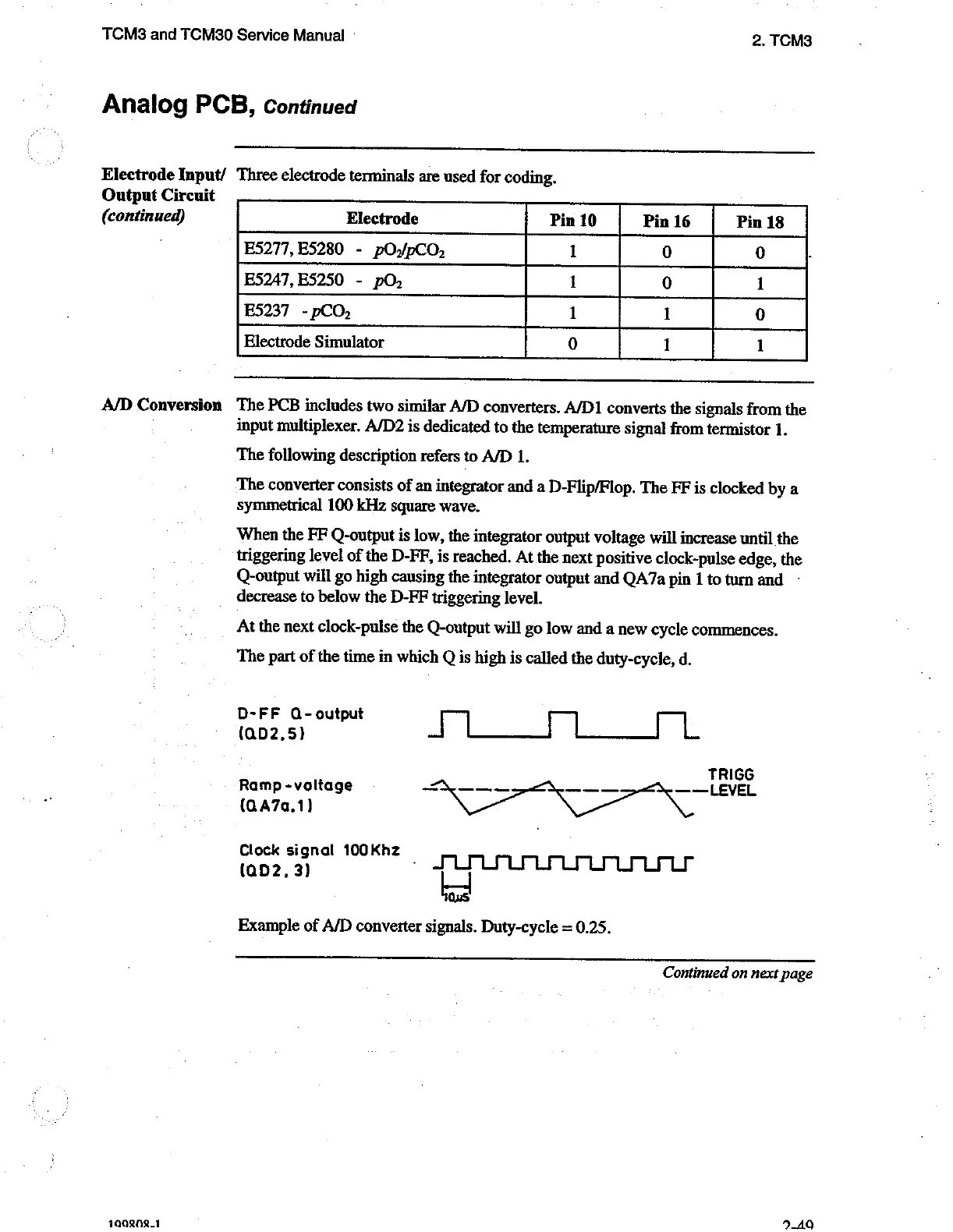
Three
electrode
terminals
are
used
for
coding,
Output
Circuit
(continued)
Electrode
Pin
10
Pin
16
Pin
18
E5277,
E5280
-
pO./pCO,
1
0
0
E5247,
E5250
-
pO.
1
0
1
E5237
-
pCO,
1
1
0
Electrode
Simulator
0
1
1
A/D
Conversion
The
PCB
includes
two
similar
A/D
converters.
A/D1
converts
the
signals
from
the
100RNR.1
input
multiplexer.
A/D2
is
dedicated
to
the
temperature
signal
from
termistor
1.
The
following
description
refers
to
A/D
1.
The
converter
consists
of
an
integrator
and
a
D-Flip/Flop.
The
FF
is
clocked
bya
symmetrical
100
kHz
square
wave.
When
the
FF
Q-output
is
low,
the
integrator
output
voltage
will
increase
until
the
triggering
level
of
the
D-FF,
is
reached.
At
the
next
positive
clock-pulse
edge,
the
Q-output
will
go
high
causing
the
integrator
output
and
QA7a
pin
1
to
tum
and
-
decrease
to
below
the
D-FF
triggering
level.
At
the
next
clock-pulse
the
Q-output
will
go
low
and
a
new
cycle
commences.
‘The
part
of
the
time
in
which
Q
is
high
is
called
the
duty-cycle,
d.
D-FF
Q-
output
Γη
Г]
Г]
(002.5)
TRIGG
Ramp
-voltage
SZ
LEVEL
(aA7a.1]
Clock
signal
100Khz
(002,3)
'
D
Example
of
A/D
converter
signals.
Duty-cycle
=
0.25.
Continued
on
next
page
92-40

Related product manuals