Need help?
Do you have a question about the RADLEY 1345-000 and is the answer not in the manual?
Contact information for customer support and technical help.
Mandatory use of eye, hearing, and dust protection during operation.
Essential safety rules for tool usage, area cleanliness, and attire.
Critical warnings regarding electrical connections, repairs, and qualified personnel.
Detailed safety guidelines for using the scroll saw, including guards and workpiece handling.
Interpretation of various safety symbols found on the tool and manual.
Requirements for power source, circuit, and proper grounding for safe operation.
Guidance on selecting the correct gauge and type of extension cord.
Instructions for securely fastening the scroll saw to a workbench or stand.
Procedure for correctly installing blades, ensuring proper tooth direction.
Steps for installing pinless/pin-end blades and adjusting tension.
Information on storage, sawdust port, bevel stops, and blade guard foot adjustment.
How to use the dust blower, speed knob, on/off switch, and blade guard.
Fundamental cutting techniques and how to adjust the bevel angle.
Instructions for interior cuts and safe transportation of the saw.
Advice on cleaning and maintaining the work table for smooth operation.
Guidelines for motor servicing and power cord replacement.
The Radley 16" Variable Speed Scroll Saw is a power tool designed for precision cutting in wood and wood-like products. It is intended for indoor use in dry conditions and comes with a 3-year limited warranty on the tool itself, with a 2-year warranty for battery and charger if applicable (though this model is corded). The warranty covers defects in material or workmanship but excludes normal wear and tear, abuse, misuse, or commercial/rental use.
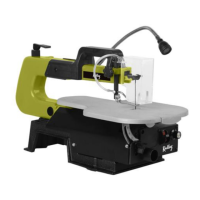
The scroll saw is primarily used for cutting curves and intricate designs in various materials. It features a variable speed control, allowing the user to adjust the blade stroke speed to match the material and desired cut. The saw is equipped with a blade blower to clear sawdust from the cutting line, enhancing visibility. For safety, it includes a removable safety key for the ON/OFF switch, preventing unauthorized use. The table can be tilted up to 45 degrees for bevel cuts, expanding its versatility. It supports both pinned-end and plain-end blades, offering flexibility in blade choice. Interior cuts are possible by drilling a pilot hole and threading the blade through the workpiece.
The scroll saw is designed for user convenience and safety. It should be securely fastened to a sturdy stand, workbench, or plywood to prevent movement during operation. The blade tension release lever allows for quick blade changes and tension adjustments. An upper blade holder locking knob and a blade and bevel locking knob ensure secure positioning of the blade and table. The flexible LED light illuminates the work area for better visibility. A sawdust vacuum port (1-1/4" or 32mm) is integrated for connecting a vacuum accessory to manage dust. Blade storage is provided on the right rear side of the saw body for convenience. The tool features a carrying handle for easy transportation. Bevel cuts up to 45 degrees to the left are possible by adjusting the table tilt. The blade guard foot is adjustable to rest slightly above the workpiece, helping to prevent excessive lifting.
Regular maintenance is crucial for optimal performance and longevity. The work table should be occasionally coated with paste wax to allow wood to glide smoothly. The sawdust extraction port should be kept clear, and any excessive sawdust buildup inside the base should be removed using a wet/dry vacuum or manually. The power cord should be inspected periodically for wear or damage and replaced by an authorized electrician if necessary. The motor bearings should not be oiled, and internal motor parts should not be serviced by the user. Cutting tools should be kept sharp and clean. The manual provides a troubleshooting guide for common issues such as breaking blades, motor not running, excess vibration, and blade run out, offering probable causes and suggested remedies. For electrical connections and repairs, a qualified electrician is required. All adjustments or repairs must be done with the machine disconnected from the power source.

 To Next Page
 General