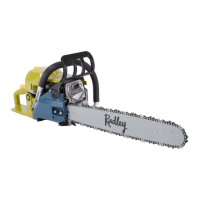
This document is the owner's manual for the Radley 20" 52cc Chainsaw, model number 5240-174. It provides comprehensive information on the chainsaw's specifications, safe operation, maintenance, and troubleshooting.
Function Description
The Radley 20" 52cc Chainsaw is a gasoline-powered tool designed for cutting trees, branches, and lumber. It is intended for household use and is not suitable for commercial or rental purposes. The chainsaw features a 2-stroke engine that requires a specific fuel mixture of gasoline and two-stroke engine oil. It is equipped with a guide bar and saw chain for cutting, and includes safety features such as a chain brake to prevent kickback.
Important Technical Specifications
- Displacement: 52 cc/cm3
- Max. Output: 2.0 kW / 8500 RPM
- Fuel Type: Gas to oil (two-cycle) 50:1 mixture
- Fuel Tank Capacity: 18 ozs. / 530 ml
- Chain Oil Type: Motor oil
- Oil Tank Capacity: 8½ ozs. / 250 ml
- Carburetor: 2133
- Ignition System: C.D.I.
- Spark Plug: RCJ6Y
- Oil Feeding System: Automatic pump with adjuster
- Chain Type: .325 .058x76DL
- Weight: 18 lb / 8.2 kg
- Guide Bar Type: BU20-76-5812P
- Size: 20" / 51 cm
- Gauge: 0.058" / 1.5 mm
- Warranty: 3-year limited warranty on the tool, covering defects in material or workmanship. Expendable parts (blades, brushes, belts, light bulbs, batteries) are not covered. The warranty is void for commercial or rental use, abuse, misuse, or careless handling.
Usage Features
The manual emphasizes safe operation and provides detailed instructions for various aspects of using the chainsaw:
- General Safety Warnings: Operators must read and understand all safety instructions before use. Key warnings include keeping the work area clean and well-lit, using only identical replacement parts for servicing, keeping children, bystanders, and pets away, dressing properly (no loose clothing or jewelry, wear protective covering for long hair, rubber gloves, non-slip footwear), no smoking, not for use by children, and ensuring the fuel cap is tightly closed. It also warns about toxic exhaust fumes (never run indoors), moving parts (keep hands/feet away), wearing personal protective equipment (safety glasses/goggles, ear protection, face/dust mask), not forcing the tool, storing idle tools indoors, maintaining the chainsaw with care, and using the right tool for the job.
- Specific Safety Rules: Always keep body parts away from the saw chain when operating. Hold the chainsaw with the right hand on the rear handle and the left hand on the front handle. Hold by insulated gripping surfaces. Wear safety glasses, hearing protection, and other protective equipment for head, hands, legs, and feet. Do not operate in a tree. Maintain proper footing on fixed, secure, and level surfaces. Be alert for springback when cutting limbs under tension. Use extreme caution with brush and saplings. Carry the chainsaw by the front handle, switched off, and with the guide bar cover fitted.
- Kickback Prevention: Avoid guide bar tip contact with objects. Maintain proper chain lubrication and tension. Keep handles dry, clean, and free from oil/grease. Cut wood only. Maintain a firm grip with both hands, positioning the body and arm to resist kickback forces. Do not overreach or cut above shoulder height. Use only manufacturer-specified replacement bars and chains. Follow sharpening and maintenance instructions for the saw chain.
- Starting the Engine: Fill fuel and chain oil tanks. For cold starts, move the front hand guard fully rearward to unlock the chain brake, press the primer bulb 10 times, set the switch to ON, pull out the choke knob to the second-stage position, and pull the starter rope vigorously. After ignition, push in the choke knob and pull the starter again. Allow the engine to warm up.
- Checking Oil Supply: After starting, run the chain at medium speed to check if chain oil scatters.
- Adjusting the Carburetor: Instructions are provided for fine-tuning the H and L needle jets and the idle adjusting screw, ensuring clean air/fuel filters and properly mixed fuel.
- Chain Brake: To release, pull the front guard up until a "click" is heard. The chain brake must be checked before each use by running the saw at full throttle for 1-2 seconds and pushing the front hand guard forward; the chain should stop immediately.
- Sawing Techniques: Apply only light pressure at full throttle. If the chain gets caught, use a wedge or lever. Warnings about springback and falling dead branches are included.
- Cutting a Tree: Instructions cover deciding the fall direction, clearing the area, arranging a foothold and retreat path, making a notch cut (one-third the trunk width) in the fall direction, and then cutting from the opposite side slightly higher than the notch bottom.
- Bucking and Limbing: Emphasizes stable footing and avoiding standing on logs. Provides specific techniques for logs on the ground (saw halfway, roll, cut from opposite side) and logs hanging off the ground (saw up from bottom one-third, finish from top, or vice versa depending on tension). For fallen trees, check limb bend and cut from the bent side first. For standing trees, cut up from the bottom and finish down from the top.
Maintenance Features
The manual outlines regular maintenance procedures to ensure optimal performance and safety:
- Maintenance After Each Use:
- Air Filter: Split the cleaner into halves, brush with gasoline, or blow from the inside with compressed air.
- Oil Port: Dismount the guide bar and check for clogging.
- Chain Bar: When dismounted, remove sawdust from the bar groove and oiling port. Grease the nose sprocket from the feeding port.
- Periodic Maintenance:
- Cylinder Fins: Periodically check and clean dust clogging between fins after removing the air cleaner and cylinder cover. Block the air intake hole during cleaning.
- Fuel Filter: Use a wire hook to remove the filter from the filler port, disassemble, and wash with gasoline. Prevent filters or dust from entering the suction pipe.
- Oil Tank: Use a wire hook to remove the oil filter, clean with gasoline, and ensure it's placed in the front right corner when reinserting. Clean dirt from the tank.
- Spark Plug: Clean electrodes with a wire brush and reset the gap to 0.6-0.7 mm.
- Sprocket: Check for cracks and excessive wear. Replace if worn. Never fit a new chain on a worn sprocket or a worn chain on a new sprocket.
- Maintenance of Saw Chain and Guide Bar:
- Saw Chain Sharpening: Sharpen when sawdust becomes powder-like, extra force is needed, the cut is not straight, vibration increases, or fuel consumption increases. Ensure the chain is held securely and the engine is stopped. Use a round file of proper size, pushing straight forward. Check the depth gauge and file to the proper level. Round off the front edge of the depth gauge to reduce kickback risk. Ensure all cutters have the same length and edge angles.
- Guide Bar: Reverse the bar occasionally to prevent partial wear.
Troubleshooting
The manual includes a troubleshooting section for common issues:
- Starting Failure:
- Possible Cause: Water or substandard fuel mixture, engine flooding, faulty spark plug.
- Solution: Replace fuel, remove and dry spark plug (then pull starter without choke), or replace spark plug.
- Lack of Power/Poor Acceleration/Rough Idling:
- Possible Cause: Water or substandard fuel mixture, clogged air/fuel filter, inadequate carburetor adjustment.
- Solution: Replace fuel, clean filters, or readjust jet needles.
- Oil Does Not Come Out:
- Possible Cause: Substandard oil quality, clogged oil passage/ports.
- Solution: Replace with new oil, clean passage/ports.
The manual also includes a detailed exploded view and parts list with key numbers, part numbers, part names, and quantities for easy identification and ordering of replacement components. Customer support information (toll-free helpline) is provided for technical questions, replacement parts, or missing parts.


 To Next Page
 General