DRIVING
7
DRIVING
IGNITION ON AND ENGINE STARTING
Diesel engine starting
In extreme low temperatures, the glow plug warning lamp
may illuminate with a delay of up to 12 seconds between
the START/STOP button being pressed and the engine
cranking.
Make sure that the appropriate foot pedal remains
pressed. DO NOT press the START/STOP button again,
as the cranking time will be increased.
See page 2, item 6.
1. Steering wheel control: Use to scroll up or down
through the menu to the feature you want to disable/
enable.
2. Vehicle Information menu: The following features
can be adjusted:
•
Driver Assistance.
•
Trip Computer.
•
Display Settings.
•
Vehicle Settings.
•
Vehicle Information.
•
Head-Up Display.
INSTRUMENT PANEL MENU
WARNING AND INFORMATION LAMPS
The following lamps may illuminate in the Instrument panel during normal driving to indicate that a related system or
feature is operating. If any other warning lamp illuminates, refer to the Owner’s Handbook. DO NOT ignore warning lamps.
INTELLIGENT STOP/START
To activate an automatic engine stop:
For an automatic transmission, apply sufficient brake pressure to make sure
the vehicle is stationary.
For a manual transmission, stop the vehicle, select neutral and fully release
the clutch.
A green icon will illuminate in the Instrument panel.
The engine will restart when the brake pedal is released, a
drive gear is selected, or for manual transmission, the clutch
is pressed.
See page 2, item 10.
TRANSMISSION
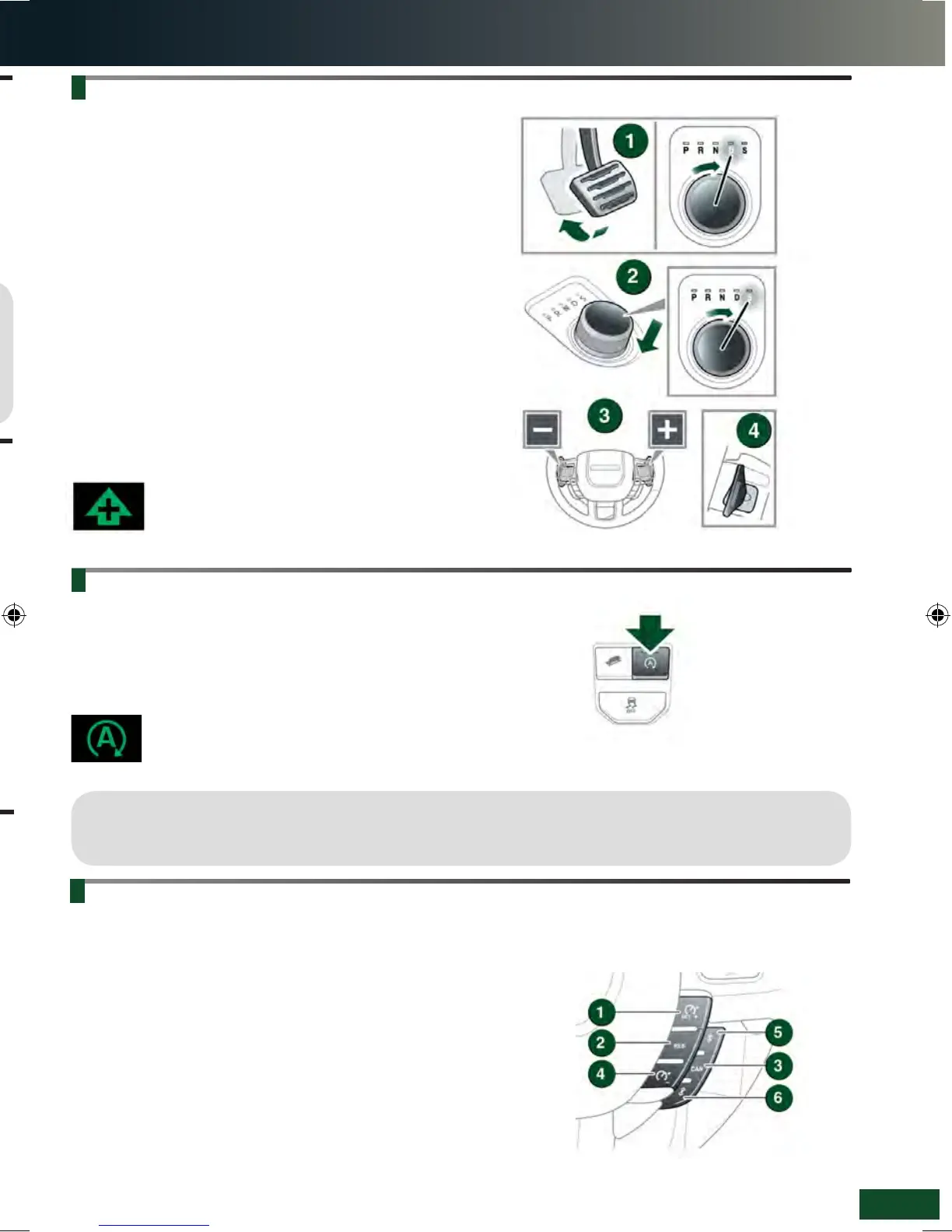
Gear selections can be made with either the rotary selector or
with the selector paddles. The rotary gear selector elevates from
the console at engine start-up.
1. With the engine running and transmission P selected, press
the brake pedal. Rotate the selector to R or D.
2. Sport mode: This is an automatic gear change mode,
however, change points are modified to make full use of
engine power. Press the selector down and rotate to S. The
indicator alongside the selector illuminates.
3. Commandshift mode: This is an alternative to the
automatic modes and is effective when rapid acceleration
and engine braking are required. With S selected, use the
left gear shift paddle (-) for downshifts and the right gear
shift paddle (+) for upshifts.
4. With either paddle, pull it towards the steering wheel and
release, to make a gear change.
The Message centre displays the selected gear.
Gear shift indicator
When manually selecting a gear, the indicator
illuminates briefly in the Instrument panel at the
recommended point for a gear shift (upshift).
ADAPTIVE CRUISE CONTROL (ACC)
See page 2, items 19 and 20.
See page 2, items 3 and 4.
1. Press to activate ACC and to set a speed. Press briefly to increase
the speed in 2 km/h (1 mph) steps.
2. Press to resume the previous set speed retained in the memory.
Set speeds are cleared at ignition off.
3. Pull to suspend ACC but retain the set speed in the memory.
4. Press to decrease the set speed. Press briefly to decrease the speed
in 2 km/h (1 mph) steps.
5. Pull to decrease the Follow mode gap.
6. Pull to increase the Follow mode gap.
Operating note
When the vehicle comes to a stop, make sure that your feet do not touch the clutch or accelerator pedals.
Inadvertent pressure will prevent the engine from stopping.
To switch off, press the
Intelligent stop/start
switch. The LED icon
will extinguish while
Intelligent stop/start is
deactivated.
The ACC system is designed to maintain a gap to the vehicle ahead or a set road speed, if there is no slower vehicle
ahead. A speed may be set between 32 km/h (20 mph) and 180 km/h (112 mph).
Smart key removal from the vehicle
If Intelligent stop/start is disabled, the engine
continues to run, even if the Smart key is removed
from the vehicle. However, if the engine is stopped,
it cannot be restarted until the Smart key is returned
to the vehicle.
Airbag system fault.
Adaptive Front lighting
System (AFS) fault.
Low fuel level.
Adaptive Cruise Control
(ACC) is in Follow mode.
One or more tyres are
under-inflated.
LRL219560161 NLI.indd 7 28/04/2015 13:50:30


 To Next Page
 Loading...