EasyManua.ls Logo

Ranger Products DST-1500 - User Manual

Ranger Products DST-1500
20 pages
Print Icon
To Next Page IconTo Next Page
Loading...
Forward this manual to all operators.
Failure to operate this equipment as
directed may cause injury or death.
MODEL
DST-1500
WHEEL BALANCER
INSTALLATION AND OPERATION MANUAL
SHIPPING DAMAGE CLAIMS
When this equipment is shipped, title passes to the
purchaser upon receipt from the carrier.
Consequently, claims for the material damaged in
shipment must be made by the purchaser against the
transportation company at the time shipment is
received.
BE SAFE
Your new Ranger balancer was designed and
built with safety in mind. However, your overall
safety can be increased by proper training and
thoughtful operation on the part of the operator.
DO NOT operate or repair this equipment
without reading this manual and the important
safety instructions shown inside.
1645 Lemonwood Dr.
Santa Paula, CA 93060, USA
Tel: 1-805-933-9970
Fax: 1-805-933-9160
FOR BALANCING
AUTOMOBILE
AND LIGHT TRUCK
TIRES / WHEELS
Keep this operation manual near the
machine at all times. Make sure that
ALL
USERS read this manual .
Question and Answer IconNeed help?

Do you have a question about the Ranger Products DST-1500 and is the answer not in the manual?

Overview

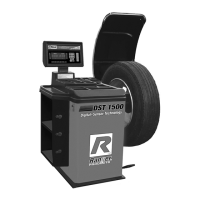
The Ranger DST-1500 Wheel Balancer is a microprocessor-based computer balancer designed for balancing automobile and light truck tires and wheels. It detects imbalance in two correction planes (inner and outer flanges of the wheel) where corrective weights can be applied. The machine offers various balancing modes, including DYNAMIC, STATIC, and ALLOY, which adjust the location of these planes to suit different wheel types and balancing requirements.

Function Description

The primary function of the DST-1500 is to identify and correct imbalances in wheels. When a wheel is spun, the balancer's sensors detect any present imbalance. The computer then calculates the precise weight needed and its exact location for application. The required weight is displayed on the control panel, and weight positioning lights guide the operator to the top-dead-center application location for both inner and outer planes of the wheel.

The balancer utilizes three key data measurements for accurate balancing:

  • A-Offset Measurement: This is the distance from the side of the balancer to the inner edge of the wheel, determining the location of the inner plane for Dynamic and/or Alloy balancing. It is measured by pulling out the distance gauge and holding it against the wheel flange.
  • B-Width Measurement: This refers to the width of the wheel at its inner edges, measured using calipers. This data helps the computer determine the location of the outer plane for Dynamic and/or Alloy balancing.
  • D-Diameter Measurement: This is the diameter of the wheel at the rim flanges, which can be read from the tire sidewall. This measurement informs the computer how far from the hub's center the weights should be applied.

The DST-1500 features a dual voltage motor (110V/220V) with a dual-phase power system, allowing for flexible electrical hook-up. It also includes an auto-hood start feature, where lowering the hood initiates the spin cycle automatically, enhancing operational efficiency.

Usage Features

The DST-1500 offers several features to facilitate ease of use and accuracy:

  • Mounting Methods: The balancer supports various wheel mounting methods, including rear cone mounting for most original equipment and steel wheels, front cone mounting for wheels where the inner surface is not suitable for centering, and an alternate mounting method for wheels with protruding outer hubs. Proper mounting is crucial for secure operation, accurate displays, and preventing damage to the wheel. The hub nut must engage the arbor threads for at least four full turns and be firmly tightened.
  • Control Panel and Display: The control panel provides clear weight readings and information display windows for both inner and outer planes. Indicator lights assist in positioning weights. Special function keys allow operators to select different balancing modes (DYNAMIC, STATIC, ALLOY), switch between GRAM and OUNCE weight units, and MM and INCH measurement units for wheel width and diameter.
  • Spin Modes:
    • DYNAMIC, AL1, AL3, AL4: These modes are used for balancing standard steel or alloy wheels using clip-on weights (DYNAMIC) or stick-on weights (AL1, AL3, AL4) at various inner and outer plane configurations. After a spin, the operator turns the wheel by hand until indicator lights illuminate, signifying the correct weight application position at top-dead-center.
    • AL2: This mode uses stick-on weights mounted to the inner and center planes of the wheel.
    • STATIC: This mode is used when visible weights on the outer edges or plane of the wheel are not desired. It's considered less accurate than dynamic balancing.
  • Self-Calibration Procedure: The balancer includes a CAL button for self-calibration, which is recommended every 30 days to maintain precision. This procedure involves spinning a wheel with and without a known weight to ensure accurate readings.
  • Identifying Remaining Weight: After balancing, if the display shows 0--0, the wheel is balanced within 5 grams. The CUT button can be pressed to display any residual weight readings (less than 5 grams) on each side.
  • Safety Features: The machine emphasizes operator safety with warnings about proper protective equipment (goggles, safety glasses, protective clothing, safety toe footwear, gloves, back belts, hearing protection). It also includes a SHAFT RESTRAINT PEDAL for immediate shutdown of rotation in emergencies, as the STOP button is not an emergency stop.

Maintenance Features

Regular maintenance is essential for the DST-1500's longevity and accuracy:

  • Daily Maintenance: Clean and inspect the shaft, cones, and hub-nut. Lubricate the shaft threads and hub-nut with light machine oil.
  • Monthly Maintenance: Clean the entire machine, inspect membrane switches for damage, and perform the self-calibration procedure. Replace any damaged parts.
  • Yearly Maintenance: Remove the cover and thoroughly clean the machine with a light-duty utility vacuum cleaner. Clean the fan, motor, and sensors to remove dust build-up.
  • Belt Adjustment: If the belt begins to slip, the tension can be adjusted by loosening the four motor mounting bolts, adjusting the motor's location to increase tension, and then retightening the bolts.
  • General Care: Operators are advised not to use harsh solvents to clean the display or control board, nor compressed air or water on any component. A hammer should never be used to tighten or loosen the hub-nut.

Ranger Products DST-1500 Specifications

General IconGeneral
Accuracy±1 g
Rim Diameter10" - 24"
Rim Width1.5" - 20"
Max. Wheel Weight150 lbs
Power Supply110V
Balancing ModesStatic, Dynamic
Dimensions24"