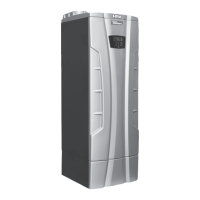
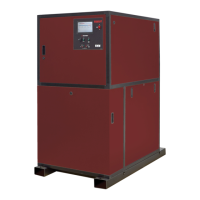
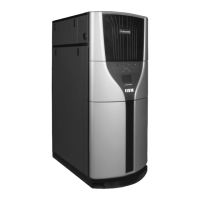
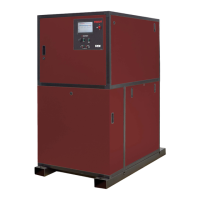
Finned copper tube gas boilers & water heaters – Boiler Manual
24
Table 15
Pressure Switch Control, D300-D2100 – DB300 On/Off Only
Stage Pressure Switch Mode
1 Low Fire
2 High Fire
Table 16 Pressure Switch Control, D1050-D2100
Stage Pressure Switch Mode
1 Left Low Fire N/A
1
2 Left Low Fire Right Low Fire
3 Left High Fire Right Low Fire
4 Left High Fire Right High Fire
1- At Stage 1, the right main valve will be energized.
Table 17
Low Air Condition Action, D400-D2100 – DB300 On/Off Only
Stage Control Action
1 No Power to Ignition Mode
2 No Power to Ignition Mode
Table 18 Low Air Condition Action, D1050-D2100
Stage Left Side Right Side
1
No Power to
Ignition Module
N/A
2
No Power to
Ignition Module
No Power to
Right Valve
3
No Power to
Ignition Module
Low
Right Valve
4
No Power to
Ignition Module
High
Right Valve
OPERATION SEQUENCE, ON/OFF D300
Refer to the included connection and wiring diagrams
for further control system information.
e stage controller will cycle up or down independent of the ame
sense module FSM. Stage switch 2 does not apply for on/o
operation.
POWER ON:
Demand for Heat:
1. The stage controller begins 50 second timing cycle before
energizing Stage 1.
2. When the timing cycle ends, stage switch 1 closes, energizing
the 24 volt limit circuit, the pump time delay relay TDR4 and
the pump terminals on the “Line Voltage Terminal Strip”.
3. e system checks limits and will not start if any limits are open.
Prepurge:
1. Prepurge timer TDR1 energizes. A 40 second delay on make
(DOM) timing cycle begins.
2. Relay K4 energizes. Normally open (N.O.) contact “K4-1” closes
sending power through the normally closed (N.C.) contact of
“K2-1” and energizing the blower at low speed. N.O. contact
“K4-3” is also closed energizing the optional power venter which
spools up closing its interlock. “Power Vent” indicator on. Stage
delay timer T3 also energizes. A 10 second delay on make timing
cycle begins. At the stage delay timer T3 also energizes. A 10
second delay on make timing cycle begins. At the end of this
timing cycle relay K2 energizes. e normally closed (N.C.)
contact of“K2-1” opens and the normally open (N.O.) contact
closes. e blower changes from low to high speed. Prepurge
continues.
3. e “low air” indicator will remain on as the blower spools up
to speed building enough pressure to make contact on the air
pressure switch. e “low air” indicator will turn o and the
“prepurge” indicator will turn on when the blower makes full
pressure.
4. Prepurge complete. Prepurge timer TDR1 times out. e
“TDR1-1” N.C. contact opens, turning o the “prepurge”
indicator. e “TDR1-1” N.O. contact closes, energizing the
ame sense module with 24 volt power.
Pilot Ignition Trial:
1. FSM energizes the pilot valve from the “PV” terminal to the
“MV” terminal of the pilot valve. The “PV” terminal also
energizes the “pilot” indicator.
2. FSM also energizes K7. e normally open contact of “K7-1”
closes, energizing the ignition spark for a 10 second ignition
trial. When the pilot ame has been proven the main valve will
open and the boiler will run until heat demand is satised.
3. If pilot ignition is not detected FSM will shut o power to “PV”
for 5 minutes pending a retry, the “pilot” light will turn o. Aer
5 minutes FSM will aempt to light the pilot with another 10
second ignition trial. If the pilot fails to light on the retry the
alarm contacts in FSM will close and there will be a 10 minute
shut down followed by a 10 second ignition trial. e contacts
will open and the unit will cycle back to the 5 minute shut
down period followed by the 10 second ignition trial. e unit
will continue trying for ignition following this alternating
sequence until the pilot lights or the call for heat is satised.
4. If main ame is established and then fails, FSM will shut o
the pilot and main valves. FSM will then retry as described
above.
5. Turning power o then on again will reset FSM to the beginning
of the ignition cycle.
Main Burner:
1. FSM energizes the main valve from the “MV” terminal direct
to the “LO” an “HI” terminals of the main valve. e “main
burner” indicator turns on. e shuto valve, opens via action
of relay K1 from the N.O. contact “K1-1”. e “PV” terminal
remains energized, the “pilot” indicator remains on.
2. e boiler is now operating on main ame.


 To Next Page
 Loading...