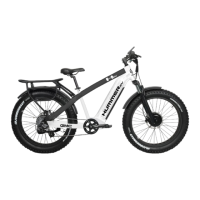
The 2023 RECON HUMMER EV AWD E-BIKE is an electric bicycle designed for off-road use, offering a blend of power, safety, and user-friendly features. This owner's manual provides comprehensive guidance for assembly, operation, and maintenance, ensuring a safe and enjoyable riding experience for adult operators aged 18 or older.
Function Description
The RECON HUMMER EV AWD E-BIKE functions as a powerful electric bicycle with all-wheel drive capabilities, designed to navigate various terrains, including loose dirt, obstacles, sand, and snow. It features two 750W hub motors, providing robust assistance for both front and rear wheels. The bike is equipped with a thumb throttle for immediate power delivery and a pedal-assist system (PAS) that augments the rider's pedaling effort. A color LCD display screen provides essential riding information, including current time, battery level, speed, wattage output, trip counter, odometer, and current PAS level. The e-bike offers three distinct driving modes: Traction Mode (front-wheel drive), Adrenaline Mode (all-wheel drive), and Cruise Mode (rear-wheel drive), allowing riders to adapt to different conditions and preferences. For safety, it includes a walk mode, which moves the bike slowly when the rider is walking alongside it. The e-bike's internal controller incorporates a charge overload protection system, automatically cutting power if the bike is overloaded or the battery becomes too hot, and restoring it when conditions return to normal.
Usage Features
The e-bike emphasizes ease of use and adaptability. Assembly instructions are detailed, covering everything from unboxing to handlebar, front tire, pedal, and optional fender/headlight installation. The handlebar stem is adjustable, and the display screen can be rotated for optimal viewing. The seatpost height and position are also adjustable to ensure a comfortable and safe riding posture for various riders.
For operation, the bike is turned on by pressing and holding the POWER button on the handlebar. PAS levels can be adjusted using the "+" and "-" buttons, with a recommendation to start at lower levels until comfortable. The three riding modes are selected via a red button below the thumb throttle, providing versatility for different riding scenarios. The headlight can be toggled on/off by holding the "+" button. The walk mode is activated by holding the "-" button while standing next to the bike and deactivated by engaging a brake lever or pressing the "-" button again.
The manual provides crucial riding tips, such as using pedals and PAS frequently, especially for start-ups and hill climbs, to maximize range and battery output. It advises against sudden throttle engagement to prevent battery consumption and potential damage to the electrical system. Engaging the brake levers immediately cuts power from the motors, enhancing safety.
Parameter changes, such as brightness, auto-off settings, assist modes, and speed limit, can be configured through the display settings. The manual stresses the rider's responsibility to understand and comply with all local, state, and federal regulations, particularly regarding speed limits.
Maintenance Features
Proper maintenance is critical for the e-bike's longevity and safe operation. The manual outlines a comprehensive maintenance schedule, including checks before the first ride, before every ride (or every 20-30 miles), after every ride, and monthly maintenance.
Before the first ride, riders should ensure handlebars are free from cable interference, pedals are securely tightened, and brakes are functional. The seat height and handlebar stem should also be properly secured.
Before every ride, it's essential to check tire pressure and tread wear, inspect brakes for adequate power and pad remaining, ensure wheels are straight and spokes are tight, and verify chain tension and lubrication. The battery should also be checked for charge and any damage.
After every ride, the bike should be cleaned of dirt and debris, dried if wet, and stored in a dry, temperature-controlled location. The battery should also be charged in a similar environment.
Monthly maintenance includes checking the frame for any dents, cracks, or chips, cleaning and lubricating the drivetrain and chain, and inspecting the cassette, derailleur, and brake pads for wear. The manual explicitly warns against riding the bike with a cracked frame or worn brake pads due to the increased risk of serious injury or death.
Battery care is detailed, emphasizing the use of the supplied charger only and storing the battery at a 50-75% charge level for long-term storage. It advises against leaving the battery on the charger indefinitely, submerging it in water, or attempting to disassemble it. Charging should occur indoors, in dry conditions, and away from direct sunlight, with regular checks of the charger, cables, and battery for damage.
Cleaning tips include avoiding high-pressure water jets to prevent water infiltration into the electrical system and battery. Painted surfaces should be cleaned with a neutral product and wiped dry. Lubrication should be applied to the chain and mechanical parts, but never to brake rotors, pads, levers, tires, rims, battery, or controller.
The manual also includes a troubleshooting guide for various error codes that may appear on the display, directing users to check specific components or contact RECON Customer Service for assistance.


 To Next Page
 General