The Red Rock Ceramic Kamado Pellet Grill, Model KP190124S, is an outdoor cooking appliance designed for smoking, grilling, and searing food using wood pellets as fuel. This owner's manual provides comprehensive instructions for safe assembly, operation, and maintenance, emphasizing the importance of adhering to safety warnings to prevent property damage, bodily injury, or even death.
Function Description
The Red Rock Ceramic Kamado Pellet Grill operates by feeding cooking-grade wood pellets into a fire pot via an auger, where they are ignited by a hot rod. A blower fan supplies air to maintain combustion, and a temperature controller allows users to set and maintain desired cooking temperatures. The ceramic construction of the kamado grill provides excellent heat retention and even cooking.
The grill features a control panel with an LCD screen that displays the actual temperature and allows for setting the desired temperature. It also includes ports for meat probes, enabling precise monitoring of internal food temperatures. The temperature dial offers a range of settings suitable for various cooking methods: 180°F to 250°F for slow cooking/smoking, 300°F to 450°F for grilling, and 470°F to 500°F for searing.
Usage Features
Assembly and Initial Setup: The manual provides detailed assembly instructions, recommending two people for the process. It outlines steps for attaching legs, casters (two with locks for stability), the grill body, chimney, lid handle, and side shelf. Before initial use, the grill requires a "breaking-in" process to ensure the auger is fully loaded with pellets and to burn off any manufacturing residues. This involves an "Initial Lighting Instruction" sequence where the user fills the pellet hopper, turns on the grill to 180°F with the lid open, waits for pellets to ignite, and then cures the grill at 400°F for 45 minutes with the lid closed.
Operation:
- Pellet Fuel: Only cooking-grade wood pellets should be used. Heating-grade pellets are unsafe for cooking. Pellets should be stored in a dry location, away from heat.
- Preheating: It is recommended to preheat the grill for 15-20 minutes with the lid closed to reach the desired cooking temperature, especially for searing (allowing the controller to reach 550°F and then waiting an additional 15 minutes).
- Temperature Control: The temperature is set using a control knob. Users can tap the knob, rotate to the desired temperature, and tap again to confirm. The auger cycles on and off to maintain the set temperature, and the ceramic body helps stabilize heat.
- Cooking: Food is placed on the cooking grate with the hood closed until the desired internal temperature is reached. The manual emphasizes using a meat thermometer for food safety and provides recommended minimum internal temperatures for various food items (chops, ground meat, pork, poultry, roasts, seafood, vegetables).
- Smoke Flavor: While pellet grills provide smoke flavor, the manual notes that smoke may not be visible 100% of the time, but flavor is still imparted.
- Meat Probes: The grill supports meat probes, which plug into the control panel, allowing users to monitor the internal temperature of their food on the LCD display.
- Turning Off: For higher temperature settings, it's recommended to turn the grill down to 200°F for about 15 minutes before turning it off. This allows the grill to go through a cool-down process, preventing fire from burning back into the auger tube and pellet hopper. The auto cool-down feature keeps the fan running for 15 minutes after the control knob is pushed and held to "OFF."
- Troubleshooting: The manual includes a troubleshooting section for common issues like the LCD screen not lighting up, the grill not getting hot enough, pellets not lighting, the grill getting too hot, smoke coming out of the pellet hopper, and temperature fluctuations.
Safety Features:
- Clearances: Maintain at least 60 inches (152.4 cm) clearance from combustible materials on all sides and back. Do not use on wood decks or under overhangs.
- Electrical Safety: Use only a properly-grounded GFCI (Ground Fault Circuit Interrupter) household circuit and a CSA or UL approved 3-prong grounded outdoor extension cord rated for at least 7-10 Amps. Keep cord connections dry and off the ground.
- Fire Safety: In case of fire, turn the controller "OFF," unplug the grill, and allow the fire to burn out naturally. Do not use water to extinguish grease fires. Keep a fire extinguisher suitable for electric products on hand. Never add cooking pellets to a hot fire pot by hand.
- Creosote Management: Regular inspection and removal of creosote buildup in the grease duct and exhaust hood are necessary to reduce fire risk.
- Unattended Operation: Never leave the appliance unattended while hot or in operation. Keep children, clothing, and furniture away.
- Hot Surfaces: All surfaces are hot during and after use. Use handles, knobs, oven mitts/gloves, and long, sturdy cooking tools.
- Carbon Monoxide Warning: The manual includes a California Proposition 65 warning regarding carbon monoxide and advises users to be aware of symptoms of poisoning. The grill is for outdoor use only and should not be used indoors or in enclosed areas.
Maintenance Features
Regular Cleaning:
- Ash Disposal: Ashes should be placed in a metal container with a tight-fitting lid, on a non-combustible surface, away from other combustible materials, until thoroughly cooled. Before each use, check for ash buildup in the fire pot and remove it, preferably with a vacuum cleaner.
- Grill Body: Clean the inside and outside of the grill by wiping with a damp cloth. Apply a light coat of vegetable oil or spray to the interior to prevent rusting. Never paint the interior surface.
- Cooking Grate, Grease Tray, Heat Baffle: Wash these components with hot, soapy water, rinse, and dry. Lightly coat the cooking grill with vegetable oil or spray. Periodically remove these parts to clean ash from around the fire pot, ensuring the grill is cold first.
- Hopper Clean-Out: If the grill will be stored for an extended period, remove unused pellets from the hopper by unscrewing a knob and pulling out the Hopper Clean-Out door. Store pellets in a dry location.
Periodic Checks:
- Hardware: Tighten all nuts, bolts, and screws at least twice a year or after extended storage periods.
- Cord and Plug: After storage, inspect the temperature controller and power cord for abrasion, wear, cuts, or damage.
- Combustible Materials: Keep the appliance free and clear of combustible materials, gasoline, and other flammable vapors and liquids.
Storage:
- Outdoor Storage: If storing outdoors, close the wood pellet lid and cover the grill with a protective cover. Ensure water does not get into the pellet hopper, as wet pellets can expand and jam the auger.
- Movement: Never move the grill when it is hot or when objects are on the cooking surfaces.

 Need help?
 General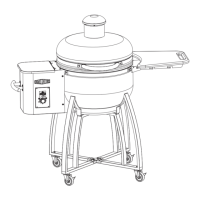

 To Next Page