196
Chapter 9
Towing
Overview
This chapter covers towing basics including
equipment, maintenance, and techniques of using
a trailer. Check with state and local agencies for
detailed information on required equipment, safety
issues, and licensing.
BEFORE TOWING
Before towing your boat, be sure to check the air
pressure of your tires for the recommended inflation
rating. Also, be certain that your tow vehicle is in
good working order.
Install bimini top in its boot before towing. Also,
remove and store cockpit and bow cover. Store
cockpit carpet along with cockpit/mooring/bow
covers in ski locker.
This can make it especially difficult to drive safely,
as the hitch may be in danger of striking the road.
Also, this situation can be caused by worn vehicle
rear shock absorbers. One option is to install a set
of air shocks which will assist in supporting the load.
As a rule of thumb 5 to 7 percent of the total trailer
load should be on the trailer tongue.
Check all lights to ensure they all work properly. You
may find it helpful at ask someone to check your
turn signals, brake lights, and towing lights while
you remain in the vehicle. Be certain that the trailer
winch cable is securely attached to the boat’s bow
eye and the cable lock is engaged.
Make sure the bow of the boat is snug against the
bow stop at the winch stand.
It is a good idea to tie another line or secure an
extra cable to the winch stand and boat bow eye
as a backup system.
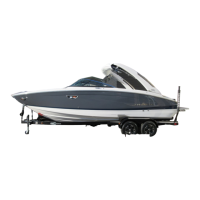
Be certain that your trailer is of rated capacity for the
size and weight of your boat, including the weight
for all fuel, water and gear. Your authorized Regal
dealer can advise you on the proper trailer capacity
and tongue weight ( the weight exerted on the rear
of your vehicle).
Never use a bumper mounted trailer hitch. Always
use a bolted or welded frame-mounted hitch,
class 2 or 3. Consult your Regal dealer for more
information.
Should your trailer be equipped with surge brakes,
that is brakes on the trailer that cut in with a very
slight delay when your brakes are applied, be sure
to follow recommended service and maintenance
instructions. Be sure that the trailer master cylinder
is filled with the recommended fluid before towing
your boat. Inspect the trailer brake lines for any
leakage. Also, if you notice brake fluid on the inside
of the tires, you may have a wheel cylinder leaking.
Consult a professional.
Never place your hands between the trailer hitch
coupling and the hitch ball on your towing vehicle
while hooking up. Be sure the tongue jack is in the
full up position before departure. Be certain safety
chains are crisscrossed and secured; do not allow
them to drag on the road.


 To Next Page
 Loading...