Application | Acclimatization phase
First steps - Tips for acclimatization and use
Please give yourself and your pet some time to get used to this new kind of deep
relaxation.
Please use RelaxoPet
©
PRO only in stressful situations until the period of acclimatization
has occurred, because birds need more time to reduce the stress hormone cortisol than
human.
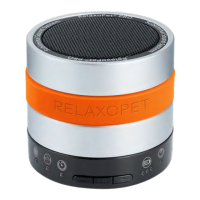
In the acclimatization phase, it is ideal to position the RelaxoPet
©
PRO close to your bird‘s
comfort zone and behave normaly and calmly towards the bird. Avoid additional beha-
vioral corrections during the rst sounding intervals.
Select the audible mode in preset volume during the acclimatization phase. In the fac-
tory setting, the NOISE MOTION and TIMER functions are switched off (switch on the right)
and can be used after the acclimatization phase. The acclimatization phase can also be
carried out at night.
Usually 4-5 days are enough to get used to it. During this time, „disturbing noises“ such as
TV or radio should be avoided. Depending on the stress level of the bird, the acclimatiza-
tion time can be extended.
Never start the sonication in direct connection with one for the bird exciting
experience / event (exception: thunderstorms / reworks), as this will cause unwanted
conditioning or existing problems may possibly amplify.
Terminate the sonication at the least 30 minutes before active cooperation with your pet.
Do not start immediately after a deep relaxation phase with RelaxoPet
©
PRO with activi-
ties with birds such as ight- or singing training.
Please note, that RelaxoPet
©
PRO, with its specially developed audible sound carriers,
can also trigger a calming and deep-relaxation state in humans.
RelaxoPet
©
PRO does not serve as a substitute for an animal-friendly education and
keeping of animals.
8


 To Next Page
 Loading...