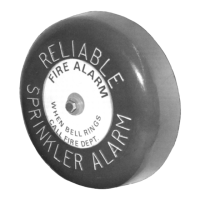
Maintenance
1. Sprinkler System – See NFPA 25 pamphlet –
Inspection Testing and Maintenance of Sprinkler
Systems.
2. Strainer – Refer to respective alarm, dry pipe or
deluge valve bulletins.
A ¾
″ (20mm) strainer is located in the alarm line.
Periodic removal and cleaning of the strainer will
eliminate accumulation of trash and scale which
can impair the flow of water, thereby preventing
proper operation of the sprinkler alarm.
3. Clean-out – The Clean-out Plug (98604402) in the
water motor should be removed periodically to
remove any accumulation of trash and scale that may
have passed through the strainer.
4. Bearings – These are nylon and do not require
lubrication.
Inspection
1. Check inside of gong for accumulation of trash,
nests, etc.
2. Be sure the gong bolt (91106601) is secure.
3.
Be sure that the ¾
″ (20mm) strainer is clean.
Note: See “Maintenance.”
4. False alarms – Refer to Alarm Valve Bulletins 407
or 408.
Testing
1. Alarm Valve Installations
Refer to Alarm Valve Bulletins 407, 408 or 409.
The mechanical sprinkler alarm may be tested without
disturbing the alarm valve by opening the alarm test valve
located in the piping line connecting it to the alarm valve
inlet side.
To test the mechanical sprinkler alarm and the alarm
valve, open the 1
″ (25mm) inspector’s test connection.
This connection is usually located at the end or top line of
the system and its opening is equivalent to the fusing of
one automatic sprinkler.
2. Dry Pipe Valve Installations
Refer to Dry Pipe Valve Bulletins 350, 353 or 354.
To test the mechanical sprinkler alarm, open the alarm
test valve located in the piping connecting the sprinkler
alarm to the dry pipe valve inlet side.
Note: After testing, it is necessary to drain the water
from the alarm line – refer to the dry pipe valve inspection
and testing procedure.
3. Deluge valve installations
Refer to Deluge Valve Bulletins 501 or 503.
Test the mechanical sprinkler alarm by opening the
alarm test valve located in the piping line connecting the
sprinkler alarm to the deluge valve inlet side. After the
test is completed, push in on the plunger of the
mechanical ball drip valve until all water has drained from
the alarm line.
The equipment presented in this bulletin in accordance with the latest pertinent Standard of the Na tional Fire Protection Association, Factory Mutual Research
Corporation, or other similar organizations and also with the provisions of governmental codes or o rdinaire whenever applicable.
Products manufactured and distributed by Reliable have been protecting life and property for over 8 0 years, and are installed and serviced by the most highly
qualified and reputable sprinkler contractors located throughout the United States, Canada and fore ign countries.
Manufactured by
The Reliable Automatic Sprinkler Co., Inc.
800.431.1588 Sales Offices
800.848.6051 Sales Fax
914.668.3470 Corporate Offices
www.reliablesprinkler.com Internet Address
Revision lines indicate updated or new data.
E.G. Printed in U.S.A. 01/01 P/N 9999970060


 To Previous Page
 Loading...