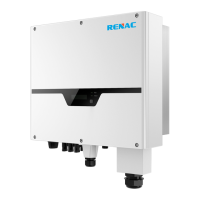
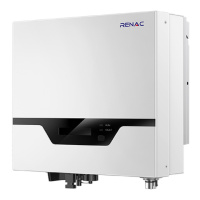
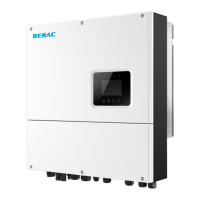
This document describes the RENAC R3 Micro Series of solar inverters, specifically models R3-4K-DT, R3-5K-DT, R3-6K-DT, R3-8K-DT, R3-10K-DT, R3-12K-DT, and R3-15K-DT. These are transformerless-based inverters designed for photovoltaic systems.
Function Description
The RENAC R3 Micro Series inverters convert direct current (DC) generated by solar panels into alternating current (AC) for use in the utility grid. They are equipped with advanced features to optimize energy production, ensure system safety, and provide comprehensive monitoring capabilities. The inverters automatically track the maximum power point (MPP) to absorb the maximum energy from solar panels. They start automatically when the input voltage reaches the start value and power off when irradiance is insufficient.
Key functional aspects include:
- Energy Conversion: Efficiently converts DC from PV strings to AC for grid injection.
- MPPT Tracking: Continuously tracks the maximum power point to maximize energy yield.
- Grid Connection: Designed for connection to the utility AC grid, adhering to various national and regional grid codes.
- Safety Features: Incorporates multiple integrated protection mechanisms to ensure safe operation for both the inverter and personnel.
- Monitoring and Control: Features an LCD display for local monitoring and an RS485 communication port for remote monitoring via Wifi or GPRS modules, allowing for detailed system management and data acquisition.
- Self-Test Function: Includes a self-test function in accordance with CEI 0-21 for inverters commissioned in Italy, checking protection reaction times and values for overvoltage, undervoltage, overfrequency, and underfrequency.
Important Technical Specifications
The R3 Micro Series offers a range of power outputs and features across its models:
DC Input Data:
- Max. Recommended PV Power: Ranges from 5200 Wp (R3-4K-DT) to 19500 Wp (R3-15K-DT).
- Max. DC Input Voltage: 1000V for all models.
- MPPT Operating Voltage Range: 160-950V for R3-4K-DT, R3-5K-DT, R3-6K-DT; 250-950V for R3-8K-DT, R3-10K-DT, R3-12K-DT, R3-15K-DT.
- Start-up Voltage: 160V for R3-4K-DT, R3-5K-DT, R3-6K-DT; 200V for R3-8K-DT, R3-10K-DT, R3-12K-DT, R3-15K-DT.
- No. of MPP Trackers: 1 for R3-4K-DT, R3-5K-DT, R3-6K-DT; 2 for R3-8K-DT, R3-10K-DT, R3-12K-DT, R3-15K-DT.
- No. of Input Strings per Tracker: 1/1 for most models, 2/1 for R3-15K-DT.
- Max. DC Input Current: 12.5A/12.5A for most models, 20A/12.5A for R3-15K-DT.
- DC Switch: Integrated.
AC Output Data:
- Rated AC Power: Ranges from 4000W (R3-4K-DT) to 15000W (R3-15K-DT).
- Max. Output Power (VA): Ranges from 4400VA (R3-4K-DT) to 16500VA (R3-15K-DT).
- Max. AC Current: Ranges from 6.4A (R3-4K-DT) to 24.0A (R3-15K-DT).
- Rated AC Voltage/Range: 3/PE 380, 400;+/-10%; 3/N/PE 380, 400;+/-10%.
- Grid Frequency/Range: 50Hz/60Hz; ±5Hz.
- Adjustable Power Factor[cos φ]: 0.8leading ~0.8lagging.
- Output THDi (@Rated Output): <3%.
Efficiency:
- Max. Efficiency: 98.3% for R3-4K-DT, R3-5K-DT, R3-6K-DT, R3-8K-DT, R3-10K-DT, R3-12K-DT, R3-15K-DT.
- Euro Efficiency: 97.6% for R3-4K-DT, R3-5K-DT, R3-6K-DT, R3-8K-DT; 97.8% for R3-10K-DT, R3-12K-DT, R3-15K-DT.
- MPPT Efficiency: 99.90% for all models.
Protection:
- Integrated Protections: DC Insulation Monitoring, Input Reverse Polarity Protection, Anti-island Protection, Residual Current Monitoring, Over-heat Protection, AC Overcurrent Protection, AC Short-circuit Protection, AC Overvoltage Protection, DC Surge Protection (Type III), AC Surge Protection (Type III).
General Data:
- Size (WidthHeightDepth): 455x390x160mm for R3-4K/5K/6K-DT; 455x390x175mm for R3-8K/10K/12K-DT; 455x390x190mm for R3-15K-DT.
- Weight: Ranges from 16.3KG to 21.6KG depending on the model.
- User Interface: LCD.
- Communication: RS485 (Standard), Wifi or GPRS (Optional).
- Ambient Temperature Range: -25 °C ~ 60 °C.
- Relative Humidity: 0-100%.
- Operating Altitude: ≤4000m.
- Standby Self Consumption: <0.2W.
- Topology: Transformerless.
- Cooling: Natural Convection.
- Protection Grades: IP65.
- Noise: <30dB.
- Warranty: 5/7/10 years.
- Certifications & Standards: VDE-AR-N-4105, VDE 0126-1-1, PEA, AS4777, EN50549, NB/T 32004-2013, CEI0-21, IEC61727, IEC62116, IEC60068, IEC61683, ABNT, IEC 62109-1, IEC 62109-2, EN 61000-6-1, EN 61000-6-2, EN 61000-6-3, EN 61000-6-4, EN 61000-4-16, EN 61000-4-18, EN 61000-4-29.
Usage Features
- Installation Flexibility: Can be mounted on a solid surface in a well-ventilated area, sheltered from direct sun, rain, and snow. Minimum clearances around the inverter are specified for optimal heat dissipation and maintenance.
- User-Friendly Interface: Equipped with an LCD display and pushbuttons for easy navigation through menus, allowing users to view operational data, fault codes, and adjust settings such as language, country grid code, and Modbus address.
- Communication Options: Standard RS485 for local communication, with optional Wifi or GPRS modules for remote monitoring via mobile terminals or PCs, enabling real-time data access and system management.
- Commissioning Process: A straightforward startup procedure involves connecting AC and DC circuit breakers, followed by an initial commissioning step for first-time use, including self-check mode and display of connection time.
- Grid Code Compliance: Supports a wide range of national and regional grid codes, ensuring adaptability to various regulatory environments worldwide.
- System Sizing Tool: Renac Power provides a tool to assist in dimensioning the photovoltaic system, ensuring optimal utilization of invested capital and energy yield based on local weather conditions.
Maintenance Features
- Safety First: Emphasizes critical safety warnings, including waiting at least 5 minutes after disconnecting AC and DC power to ensure capacitors are fully discharged before any maintenance.
- Qualified Personnel Requirement: Installation and maintenance must be performed by trained and authorized personnel familiar with electrical codes and safety regulations.
- Product Label for Information: The product label on the right side of the inverter provides essential information for identification and service.
- Troubleshooting Guide: An Appendix A: FAQ section offers common troubleshooting solutions for various fault conditions displayed on the LCD, guiding technicians to diagnose and resolve issues such as isolation faults, grid faults, over-temperature, and PV overvoltage faults.
- Warranty and Service: A 60-month standard warranty (up to 66 months from factory shipment) is provided. A clear warranty claim procedure requires specific information and documentation. Post-warranty services are available, covering on-site attendance fees, parts, labor costs, and logistic fees.
- Original Spare Parts: Only original spare parts from the supplier should be used for repairs to ensure optimum safety and performance.
- Functional Safety Parameters: Unauthorized changes to functional safety parameters are strictly prohibited as they can cause injury, damage, and void operating approval certificates.

 Need help?

 To Next Page
 General