EasyManua.ls Logo

Renault Master Van 2004 - Page 147

Renault Master Van 2004
190 pages
Print Icon
To Next Page IconTo Next Page
To Previous Page IconTo Previous Page
Loading...
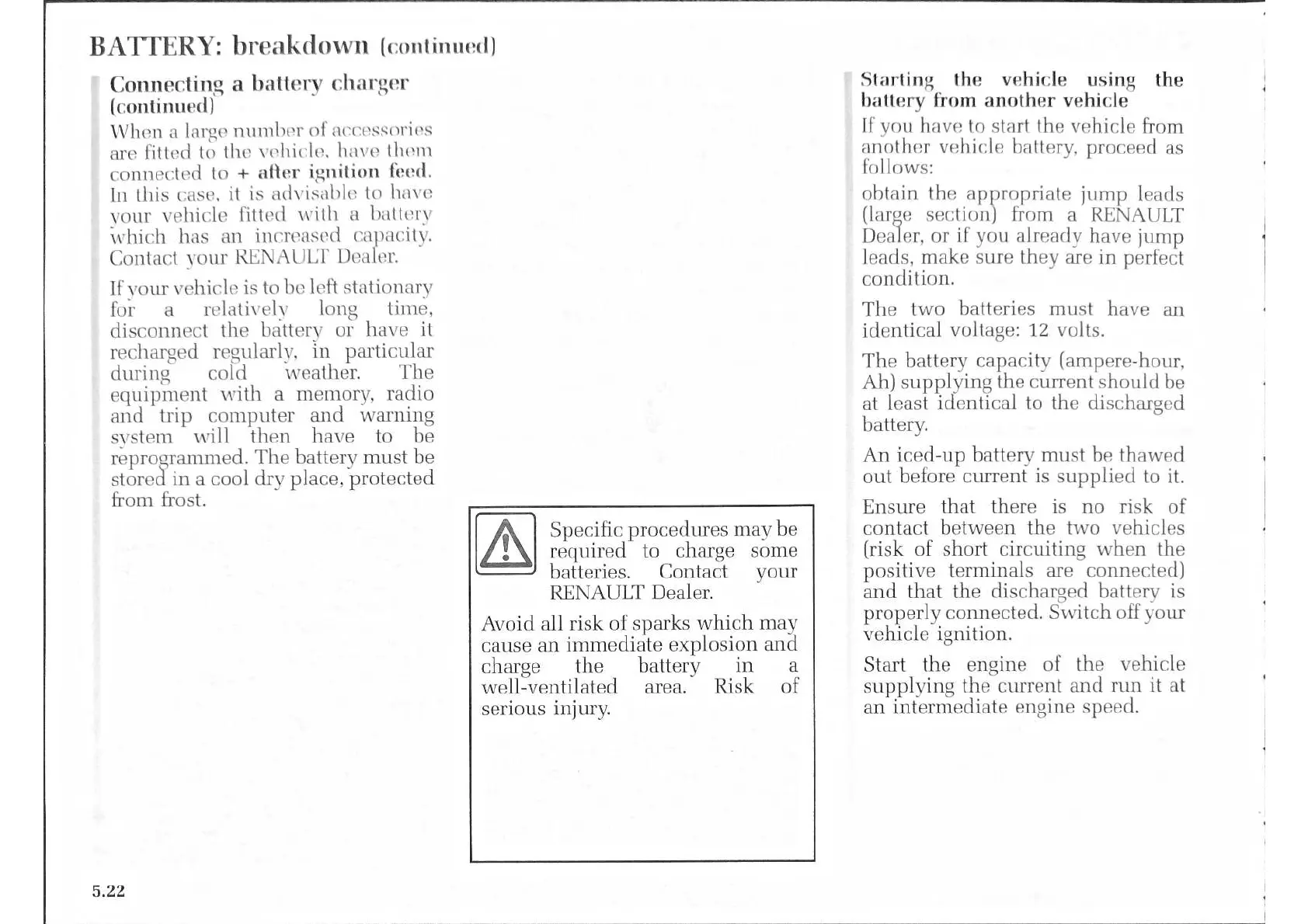
BATTERY:
breakdown
(continued)
Connecting
a
battery
charger
(continued)
When
a
large
number
of
accessories
are
fitted
to
the
vehicle,
have
them
connected
to
+
after
ignition
feed.
In
this
case,
it
is
advisable
to
have
your
vehicle
fitted
with
a
battery
which
has
an
increased
capacity.
Contact
your
RENAULT
Dealer.
If
vour
vehicle
is
to
be
left
stationary
for
a
relatively
long
time,
disconnect
the
battery
or
have
it
recharged
regularly,
in
particular
during
cold
weather.
The
equipment
with
a
memory,
radio
and
trip
computer
and
warning
system
will
then
have
to
be
reprogrammed.
The
battery
must
be
stored
in
a
cool
dry
place,
protected
from
frost.
5.22
Specific
procedures
may
be
required
to
charge
some
batteries.
Contact
your
RENAULT
Dealer.
Avoid
all
risk
of
sparks
which
may
cause
an
immediate
explosion
and
charge
the
battery
in
a
well-ventilated
area.
Risk
of
serious
injury.
Starting
the
vehicle
using
the
battery
from
another
vehicle
If
you
have
to
start
the
vehicle
from
another
vehicle
battery,
proceed
as
follows:
obtain
the
appropriate
jump
leads
(large
section)
from
a
RENAULT
Dealer,
or
if
you
already
have
jump
leads,
make
sure they
are
in
perfect
condition.
The
two
batteries
must
have
an
identical
voltage:
12
volts.
The
battery
capacity
(ampere-hour,
Ah)
supplying
the
current
should
be
at
least
identical
to
the
discharged
battery.
An
iced-up
battery
must
be
thawed
out
before
current
is
supplied
to
it.
Ensure
that
there
is
no
risk
of
contact
between
the
two
vehicles
(risk
of
short
circuiting
when
the
positive
terminals
are
connected)
and
that
the
discharged
battery
is
properly
connected.
Switch
off
your
vehicle
ignition.
Start
the
engine
of
the
vehicle
supplying
the
current
and
run
it
at
an
intermediate
engine
speed.

Related product manuals