— 2 —
Inspect the battery for any visible damage including cracks, dents, deformation, and other
visible abnormalities. All connector contacts shall be clean, free of dirt and corrosion, and dry.
z
Step 4: Size the battery cables appropriately.
Use high stranded copper and heavy gauge cables to handle possible loads from the battery.
Make sure to maintain identical cable lengths.
z
Step 5: Install battery terminals.
Verify the battery polarity. Reverse polarity can and will destroy the battery. Use a multimeter
to determine proper polarity.
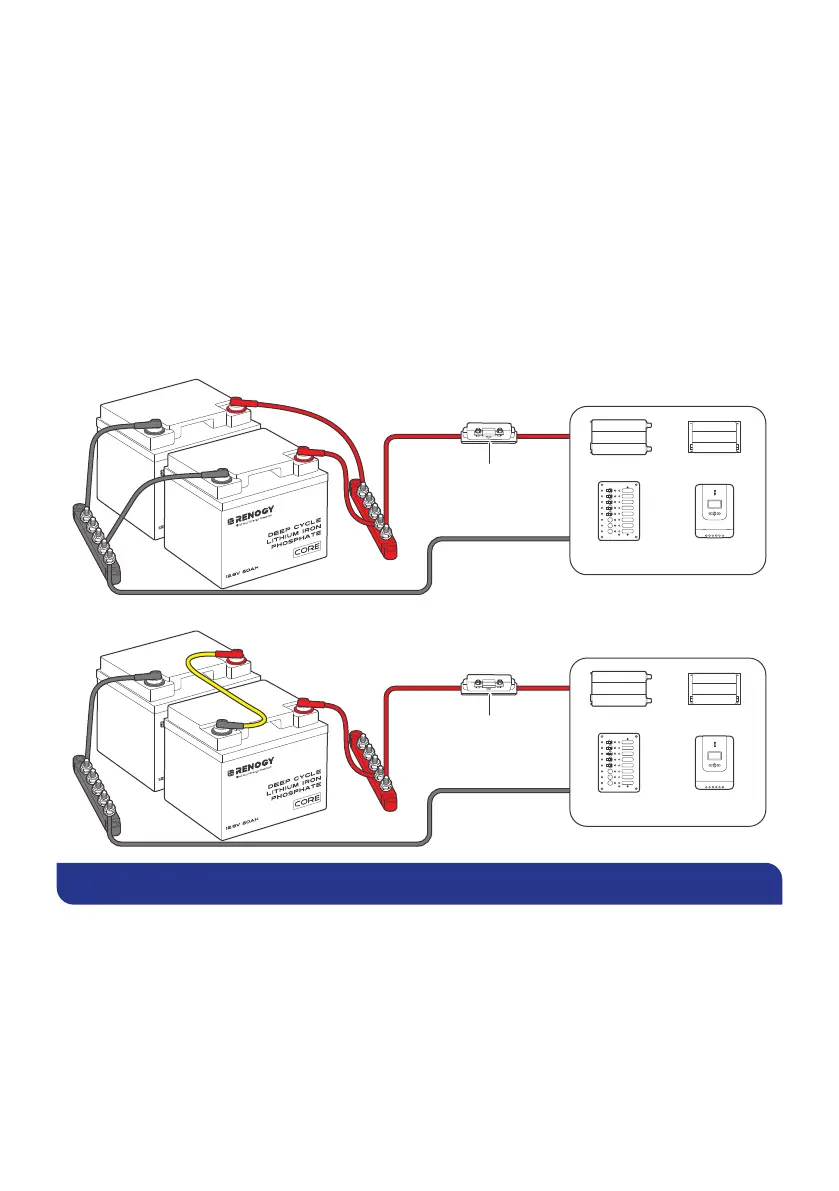
Always finish the negative terminals before positive ones. Connect batteries in series or
parallel as needed.
z
Step 6: Connect the battery to other devices.
z
Step 7: Tighten the cable connections.
Over-tightening cable connections can cause terminal breakage and loose cable connections
can cause terminal meltdown or fire.
█
For Batteries in Parallel
Battery Fuse
Inverter DC-DC Charger
DC Distribution
Panel
Charge
Controller
█
For Batteries in Series
Battery Fuse
Inverter DC-DC Charger
DC Distribution
Panel
Charge
Controller
Battery Operation
z
Depending on shipping times and the time since manufacture, the battery may be received at
a partial state of charge. Please fully charge the battery prior to the first use.
z
Standard charging consists of charging at 0.5C constant current until the battery reaches
14.4V. The battery is then charged at a constant voltage of 14.4V while tapering the charging
current. Charging is considered complete when the charging current has tapered to 0.05C.
Safe charging requires temperatures between 0°C and 55°C (32°F and 131°F) and takes
approximately 2.5 hours.
z
For standard discharging, the battery is discharged at 0.5C constant current until the battery
reaches 10V. Safe discharging requires temperatures between -20°C and 60°C (-4°F and
131°F).



 To Next Page