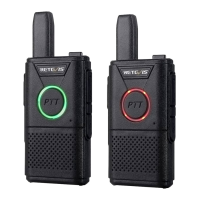
RF ENERGY EXPOSURE AND PRODUCT SAFETY GUIDE FOR
PORTABLE TWO-WAY RADIOS
Before using this radio, read this guide which contains important operating
instructions for safe usage and rf energy awareness and control for
compliance with applicable standards and regulations.
ATTENTION!
This two-way radio uses electromagnetic energy in the radio frequency (RF) spectrum to
provide communications between two or more users over a distance. RF energy, which when
used improperly, can cause biological damage.
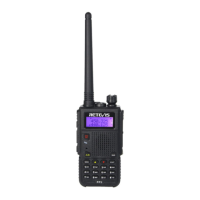
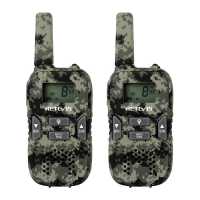
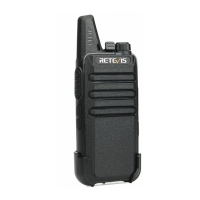
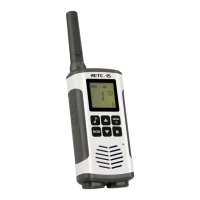
All Retevis two-way radios are designed, manufactured, and tested to ensure they meet
government-established RF exposure levels. In addition, manufacturers also recommend
specific operating instructions to users of two-way radios. These instructions are important
because they inform users about RF energy exposure and provide simple procedures on how
to control it.
Please refer to the following websites for more information on what RF energy exposure is and
how to control your exposure to assure compliance with established RF exposure limits:http://w-
ww.who.int/en/
Local Government Regulations
When two-way radios are used as a consequence of employment, the Local Government
Regulations requires users to be fully aware of and able to control their exposure to meet
occupational requirements. Exposure awareness can be facilitated by the use of a product label
directing users to specific user awareness information. Your Retevis two-way radio has a RF
Exposure Product Label. Also, your Retevis user manual, or separate safety booklet includes
information and operating instructions required to control your RF exposure and to satisfy
compliance requirements.
Radio License
Governments keep the radios in classification, business two-way radios operate on radio
frequencies that are regulated by the local radio management departments (FCC, ISED,
OFCOM, ANFR, BFTK, Bundesnetzagentur...).To transmit on these frequencies, you are
required to have a license issued by them. The detailed classification and the use of your two
radios, please contact the local government radio management departments.
Use of this radio outside the country where it was intended to be distributed is subject to
government regulations and may be prohibited.
Unauthorized modification and adjustment
Changes or modifications not expressly approved by the party responsible for compliance may
void the user’s authority granted by the local government radio management departments to
operate this radio and should not be made. To comply with the corresponding requirements,
transmitter adjustments should be made only by or under the supervision of a person certified
as technically qualified to perform transmitter maintenance and repairs in the private land
mobile and fixed services as certified by an organization representative of the user of those
services.
Replacement of any transmitter component (crystal, semiconductor, etc.) not authorized by the
local government radio management departments equipment authorization for this radio could
violate the rules.
FCC Requirements:
This device complies with part 15 of the FCC Rules. Operation is subject to the condition that this
device does not cause harmful interference. (Licensed radios are applicable);
This device complies with part 15 of the FCC Rules. Operation is subject to the following two
conditions: (Other devices are applicable)
(1) This device may not cause harmful interference, and
(2) this device must accept any interference received, including interference that may cause
undesired operation.
NOTE:
ïThis equipment has been tested and found to comply with the limits for a Class A digital device,
pursuant to part 15 of the FCC Rules. These limits are designed to provide reasonable protection
against harmful interference when the equipment is operated in a commercial environment. This
equipment generates, uses, and can radiate radio frequency energy and, if not installed and used in
accordance with the instruction manual, may cause harmful interference to radio communications.
Operation of this equipment in a residential area is likely to cause harmful interference in which case
the user will be required to correct the interference at his own expense.
ïThis equipment has been tested and found to comply with the limits for a Class B digital device,
pursuant to part 15 of the FCC Rules. These limits are designed to provide reasonable protection
against harmful interference in a residential installation. This equipment generates, uses and can
radiate radio frequency energy and, if not installed and used in accordance with the instructions, may
cause harmful interference to radio communications. However, there is no guarantee that
interference will not occur in a particular installation. If this equipment does cause harmful
interference to radio or television reception, which can be determined by turning the equipment off
and on, the user is encouraged to try to correct the interference by one or more of the following
measures:
—Reorient or relocate the receiving antenna.
—Increase the separation between the equipment and receiver.
—Connect the equipment into an outlet on a circuit different from that to which the receiver is
connected.
—Consult the dealer or an experienced radio/TV technician for help.
CE Requirements:
ï(Simple EU declaration of conformity) Shenzhen Retevis Technology Co., Ltd. declares that the
radio equipment type is in compliance with the essential requirements and other relevant provisions
of RED Directive 2014/53/EU and the ROHS Directive 2011/65/EU and the WEEE Directive
2012/19/EU; the full text of the EU declaration of conformity is available at the following internet
address: www.retevis.com.
ïRestriction Information
This product can be used in EU countries and regions, including: Belgium (BE), Bulgaria (BG),
Czech Republic (CZ), Denmark (DK), Germany (DE), Estonia (EE), Ireland (IE), Greece (EL), Spain
(ES), France (FR), Croatia (HR), Italy (IT), Cyprus (CY), Latvia (LV), Lithuania (LT), Luxembourg
(LU), Hungary (HU), Malta (MT), Netherlands (NL), Austria (AT), Poland (PL), Portugal (PT),
Romania (RO), Slovenia (SI), Slovakia (SK), Finland (FI), Sweden (SE) and United Kingdom (UK).
For the warning information of the frequency restriction, please refer to the package or manual
section.
ïDisposal
The crossed-out wheeled-bin symbol on your product, literature, or packaging reminds you
that in the European Union, all electrical and electronic products, batteries, and accumulators
(rechargeable batteries) must be taken to designated collection locations at the end of their
working life. Do not dispose of these products as unsorted municipal waste. Dispose of them
according to the laws in your area.
55


 To Next Page
 Loading...