EasyManua.ls Logo

Reversomatic RHRV-D100A - User Manual

Reversomatic RHRV-D100A
16 pages
Print Icon
To Next Page IconTo Next Page
Loading...
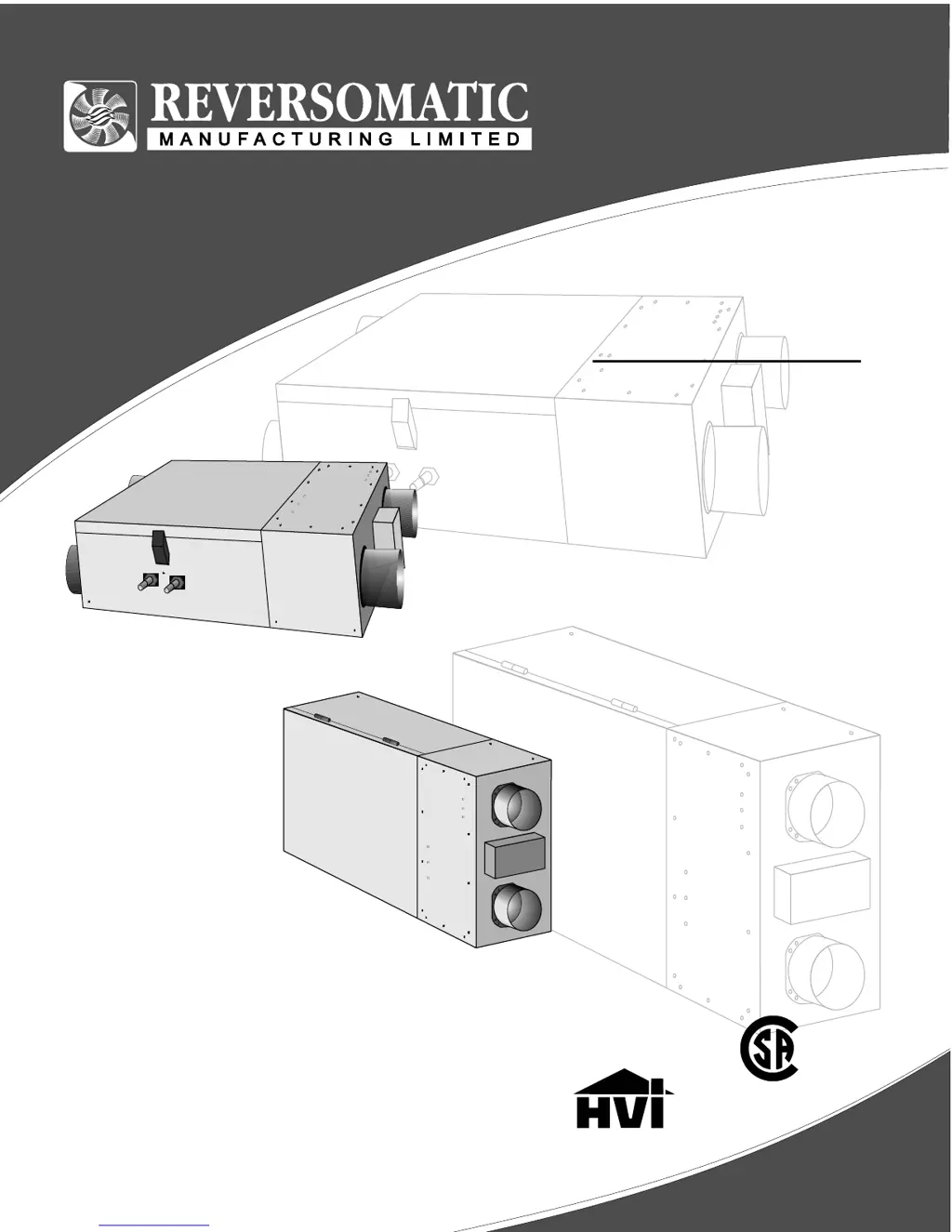
HRV / ERV INSTALLATION AND
OPERATING INSTRUCTIONS
Deluxe Series
model:
RHRV-D100A
Aluminum Core
RHRV-D100P
Polypropylene Core
RERV-D100
Enthalpy Core
C US
®
®
2100
CERTIFIED
Toll Free: 1.800.810.3473 (Canada)
1.800.499.5073 (U.S.A.)
790 Rowntree Dairy Road,
Woodbridge, ON Canada L4L 5V3
t: 905.851.6701
f: 905-851.8376
e: info@reversomatic.com
www.reversomatic.com
jtantay 1.19.11

Questions and Answers

  • M
    Michael BryantAug 12, 2025
    Why is the air flow low in my Reversomatic Heating System?
    • M
      Mark BishopAug 13, 2025
      Low air flow in your Reversomatic Heating System can stem from several causes: an improperly balanced HRV/ERV airflow (if your unit lacks built-in automatic electronic air-balancing), a clogged filter, an obstructed core, a blocked exterior fresh air supply, ductwork restrictions, or a low power supply. To resolve this, have a professional balance the unit, clean or replace the filter, clean the core, clear any blockage in the fresh air supply, inspect the duct installation, or have an electrician check the voltage if you suspect a low power supply.
  • D
    Dr. Christopher MorrisAug 16, 2025
    What to do if my Reversomatic Heating System's wall mount shows error codes E1, E2, E3, E4, or E5?
    • J
      Joseph HannaAug 16, 2025
      Error codes E1, E2, E3, E4, and E5 on your Reversomatic Heating System wall mount indicate various issues. These include loss of communication with the control board, defrosting temperature sensor failure, airflow sensor failure or humidity sensor failure. Check the wall control connections. For error code E2, clean the temperature sensor; if the error persists, replace it. For error code E3, clean the airflow sensors and reinstall them; if the error continues, replace the airflow sensors. For humidity sensor failure replace humidity sensor. Also check for kinked ducts and heavy dust build-up on airflow sensors. Finally, a fan failure may be the cause, requiring replacement of the intake or exhaust fan.
  • A
    Alfred ColonAug 20, 2025
    What to do if I sense cold air from the supply of my Reversomatic Heating System?
    • Y
      ygreenAug 21, 2025
      If you're sensing cold air from the supply in your Reversomatic Heating System, it could be due to a blocked exhaust hood outside the house, an improperly balanced HRV/ERV airflow (for units without built-in Automatic Electronic Air-balancing), furniture or closed doors restricting air movement, or extremely cold outdoor temperatures. Clear any blockage from the exhaust hood, have a professional balance the unit, or install a duct heater to address the issue.
  • A
    Ann PerkinsAug 25, 2025
    Why is there water in the bottom of my Reversomatic HRV Heating System?
    • S
      Sandra CrawfordAug 25, 2025
      Water accumulation at the bottom of your Reversomatic HRV Heating System can be attributed to clogged drain pans, drain tube, drain pipe, and/or the P-trap, or check connections. Inspect these components for blockages and kinks, and ensure that water drains properly.
  • A
    Amber CervantesAug 27, 2025
    What to do if the defrost mode doesn't work on my Reversomatic Heating System?
    • L
      Leslie VegaAug 27, 2025
      If the defrost mode isn't functioning on your Reversomatic Heating System, the fresh air duct might be frozen, the HRV/ERV airflow could be improperly balanced (for units without built-in Automatic Electronic Air-balancing), the defrost damper motor might be defective, or the temperature sensor may be faulty, or improper defrost cycle. Remove any ice from the fresh air duct, have a professional balance the unit, replace the defrost motor or the temperature sensor, or check defrost cycle on wall control and reprogram.
  • S
    Shelby ThompsonSep 1, 2025
    Why are all 3 LEDs of the timer switch blinking on my Reversomatic Heating System?
    • M
      Martin TannerSep 1, 2025
      If all three LEDs on your Reversomatic Heating System's timer switch are blinking, it indicates that the control board is reporting an error or there's a lost communication with main control board. Check all wire connections on the timer switch and main control board.
  • R
    Robert JohnsonSep 4, 2025
    What to do if the timer switch 20/40/60 minute light doesn't stay on in my Reversomatic Heating System?
    • E
      Emma SchroederSep 4, 2025
      If the 20/40/60 minute light on your Reversomatic Heating System timer switch doesn't stay on, it could be due to a loose connection or a defective switch. Check the connection and, if necessary, replace the timer switch.
  • W
    William HudsonSep 8, 2025
    What to do if there is no display on the wall control of my Reversomatic Heating System?
    • D
      dianaclineSep 8, 2025
      If there's no display on your Reversomatic Heating System's wall control, the wires might be damaged or there could be a loose connection. Check the continuity of the wires and replace them if necessary. Also, check the connections on both the main controller and the wall controller.

Summary

Important Safety Instructions

General Safety Warnings

Key safety precautions for reducing risk of fire, electric shock, or injury during installation and operation.

Packaging Inspection

Instructions for checking parts and accessories upon delivery for completeness and condition.

Parts List

Wiring Diagram

Control Board and Layout

Details on control board connections, HRV/ERV chassis layout, and internal harnesses.

Wall Control Units and Timer Switches

Diagrams and options for connecting multiple wall control units and timer switches to the HRV/ERV.

Furnace; Fan-Coil; Heat Pump Interlock

Wiring configurations for integrating the HRV/ERV with HVAC systems like furnaces or fan-coils.

HRV;ERV Operational Modes Functionality

Standard Ventilation Modes

Explanation of Normal, High Ventilation, and Energy Saving modes for air exchange.

Specialized Modes

Details on Defrost, Humidity, and Recirculation modes for specific environmental conditions.

Control and Balancing Features

Information on Manual Balancing mode and the optional Timer Switch functionality.

Programming Instructions for Wall Control Unit (WC100)

Switching Operational Modes

Guide on using the wall control unit to switch between HRV/ERV operational modes.

Adjusting Humidity Setpoint

Instructions for setting the desired humidity level for the HRV/ERV unit.

Setting Internal Programming Parameters

Configuration of timer, defrost, and airflow settings via the wall control unit.

Airflow Balancing and Fan Adjustment

Procedures for enabling/disabling automatic balancing and adjusting fan speeds.

Wall Control Unit Addressing

Instructions for setting unique addresses for multiple wall control units.

Displaying Error Codes

Explanation of error codes displayed on the wall unit and their meanings.

HRV and ERV Typical Installations

House Installation Types

Overview of fully ducted and semi-ducted installation methods for residential homes.

Furnace Return Air-duct Connection

Guidance on connecting the HRV/ERV to the furnace return air duct.

High-Rise Condominium Installations

Installation options for multi-unit buildings, including fully ducted and fan-coil systems.

Horizontal Installation

Specific considerations and clearances for horizontal mounting of the unit.

Vertical Installation

Details on strapping and chain mounting systems for vertical unit placement.

Single Vents and Access Door Installation

Instructions for installing single vents, wall boxes, and access doors.

Drain Connection and Freeze Protection

Guidance on connecting the condensate drain and ensuring freeze protection.

Air Flow Balancing

Balancing Procedure Overview

Steps to ensure balanced airflows for optimal HRV/ERV efficiency and performance.

Pitot Tube Balancing Method

Detailed method for measuring and balancing airflow using a Pitot tube and magnehelic gauge.

Balancing Options and Notes

Notes on using extension box cover plates and accuracy considerations for airflow readings.

Maintenance

Regular Maintenance Tasks

Routine checks and cleaning procedures for filters, sensors, and general unit upkeep.

Annual Maintenance Tasks

Comprehensive annual servicing including core cleaning, motor checks, and ductwork inspection.

Troubleshooting

Low Airflow and Supply Air Issues

Diagnosing and resolving problems related to low airflow and cold air supply.

Condensate and Drain Problems

Addressing issues with water in the HRV unit due to clogged drains or improper installation.

Error Code Diagnosis

Interpreting error codes E1 through E5 from the wall control unit.

Control and Timer Issues

Resolving problems with timer switches, wall control display, and communication loss.

Defrost and Functionality Problems

Troubleshooting non-functional defrost modes and general unit operation issues.

Select HRV;ERV for your Climate Zone

Reversomatic RHRV-D100A Specifications

General IconGeneral
ModelRHRV-D100A
Air Flow Capacity100 CFM
Power Supply120V AC
MaterialMetal
Noise Level45 dBA

Related product manuals