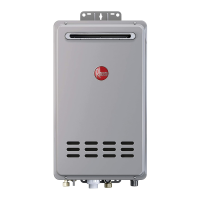
This document is the User's Information Manual for High Efficiency Condensing Combi Boilers, available in 99,000, 125,000, 160,000, and 199,000 Btu/hr models, designed for use with Natural Gas or Propane.
Function Description
The Combi Boiler is a high-efficiency appliance designed to provide both space heating and domestic hot water (DHW). It operates by burning gas to produce heat and is equipped with an ignition device that automatically lights the burner. The unit features a factory-installed pump for circulating heating system water through its heat exchanger and primary loop piping. It can also operate a separate building pump (120V 1.0AMP max) for the building's distribution piping system. The boiler incorporates an outdoor reset function, which, with an outdoor sensor installed, automatically adjusts the space heating water temperature based on programmed parameters. If no outdoor sensor is installed, it uses the temperature set in the "User Set Up" menu.
The unit offers different modes for domestic hot water:
- Standard Mode (OFF): Prioritizes DHW demand over space heating. The heat exchanger does not maintain DHW temperature between demands.
- Comfort Mode (ON): Maintains the heat exchanger at the DHW temperature for immediate hot water availability.
- ECO Comfort Mode (ECO): Similar to Comfort Mode but learns hot water usage patterns and allows the heat exchanger to cool during low-use periods to save energy.
A Frost Protection feature is included to protect the unit from freezing by operating the burner when necessary.
Important Technical Specifications
- Models: 99,000, 125,000, 160,000, and 199,000 Btu/hr.
- Fuel Type: Natural Gas or Propane.
- DHW Temperature Range (Programmable): 105°F (40°C) to 149°F (65°C).
- Minimum Flow Rate to Activate DHW Sensor: 0.5 GPM.
- Water Pressure (Max/Min): 150 PSI / 40 PSI.
- Acceptable pH Range for Domestic Water: 6.5 to 8.5.
- Total Dissolved Solids (Max): 500 mg/l.
- Total Hardness (Max): 200 mg/l (11.68 gr/gal).
- Maximum Allowable Concentrations for Domestic Water:
- Aluminum: 0.2 mg/L
- Chlorides: 250 mg/L
- Copper: 1 mg/L
- Iron: 0.3 mg/L
- Manganese: 0.05 mg/L
- Zinc: 5 mg/L
- Pressure Relief Valve: Must be ASME V or HV symbol, set to relieve at or below 150psi, with a minimum relieving capacity of 199,000 Btu/hr and 3/4" NPT threads.
- Carbon Monoxide Alarms: Required in the living space.
Usage Features
The unit is controlled via a user interface with a numerical display and various icons indicating status (Flame, White Dot for Power ON, Faucet for DHW, Radiator for Heating, Wrench for Service/Reset, Return Arrow for Enter/Save).
Turning Appliance ON/OFF:
- ON: Touch the area above the small white dot for 2 seconds until only the white dot is illuminated.
- OFF: Touch the area above the small white dot for 2 seconds. A dash appears to the right, and space heating pressure displays to the left.
Adjusting Space Heating Water Temperature:
- Touch the area above the white dot.
- Touch the Radiator button.
- Use Plus (+) or Minus (-) buttons to change the target temperature.
- Touch the Return button to save, or the area above the dot to exit without saving.
Adjusting Domestic Hot Water Temperature:
- Touch the area above the white dot.
- Touch the Faucet button.
- Use Plus (+) or Minus (-) buttons to change the DHW target temperature.
- Touch the Return button to save, or the area above the dot to exit without saving.
- Note: Factory setting is the lowest temperature. Recommended initial setting is 120°F/49°C. Setting temperature above 131°F/55°C is advised to prevent bacteria growth.
Switching DHW Modes (Standard, Comfort, ECO Comfort):
- Touch the area above the white dot.
- Touch the Faucet button twice.
- Use Plus (+) or Minus (-) buttons to change the DHW mode.
- Touch the Return button to save, or the On/Off button to exit without saving.
Safety Precautions:
- Scald Hazard: Water temperatures over 125°F (52°C) can cause severe burns. Children, disabled, and elderly are at highest risk. A thermostatic mixing valve is recommended.
- Gas Leaks: If gas is smelled, do not light appliances, touch electrical switches, or use phones. Immediately call the gas supplier or fire department.
- Combustible Materials: Keep the unit area free of flammable vapors and liquids.
- Corrosive Air: Do not draw combustion air from areas with corrosive air (e.g., swimming pools).
- Water Leaks: Protect the unit from overhead water leaks.
- Snowfall: Regularly check side wall exhaust vent and air intake terminations for blockages.
- Flooding: Do not use the unit if any part has been under water.
- Blocked Vent: The unit has a blocked vent shut-off system. If blockage occurs, remove it if accessible, or contact a service agency.
Maintenance Features
General Care:
- Keep combustible materials and flammable liquids away from the unit.
- Keep vent terminals clear of obstructions.
Regular Maintenance (Every Two Months):
- Check DHW temperature at the faucet.
- Check pressure relief valves and discharge piping for leaks.
- Examine and clean the condensate trap. Refill the trap before firing. If a condensate neutralizer is used, check pH (should be above 6.0pH) and recharge/replace if necessary.
Annual Maintenance (by a qualified service technician):
- Inspect flue gas exhaust and air intake connections for tightness and leaks.
- Inspect flue gas exhaust piping, combustion air piping, and terminations.
- Inspect and vacuum the unit's interior.
- Check for water, gas, and condensate leaks.
- Clean, refill, and reinstall the condensate trap.
- Check water pressure and chemistry (including water treatment and propylene glycol levels).
- Check electrical connections.
- Check and clean/replace the ignition electrode.
- Check the gas valve and ignition cable.
- Check controller settings.
- Check the burner flame for quick and quiet ignition.
- Clean the heat exchanger and burner if required.
Relief Valve Maintenance and Testing:
- Perform a "try lever test" quarterly, or more often under severe service conditions.
- Hold the test lever fully open for at least 5 seconds to flush sediment and debris, then release.
- If the lever does not activate or discharge, discontinue use and contact a licensed contractor.
- If the valve leaks after testing, repeat the test to flush debris. If leakage persists, replace the valve.
- When testing, discharged fluid must be replaced. Using a system pressurization unit (e.g., Axiom Industries model MF200) is recommended for refilling.

 Need help?
 General

 To Next Page