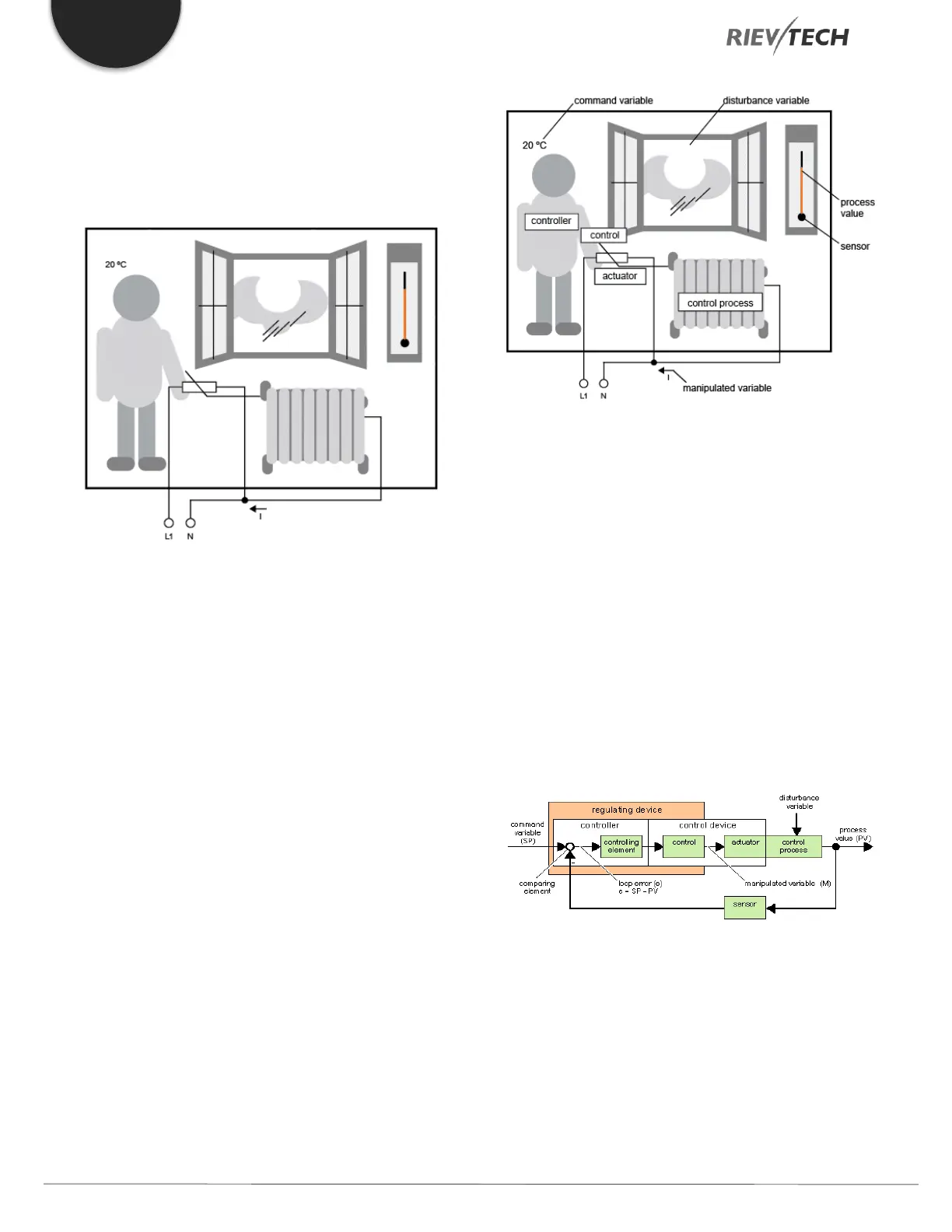
In the example below, regulating means that the person
can increase the heat output if the room temperature
drops to below 20 °C. If the room temperature rises above
20 °C, the heat output is reduced.
Basic concepts of regulating
In the example, the current for the electric heating is the
manipulated variable. The changeable resistance is the
actuator. The hand that operates the actuator is the
control. The actual room temperature is the controlled
variable or the process value. The desired room
temperature is the command variable or the setpoint value.
The electric heating is the control process. The
thermometer is the sensor. The temperature loss from
opening the window is the disturbance variable.
So, this means that the person measures the process value
(room temperature) with the sensor (thermometer),
compares the process value (room temperature) with the
command variable (desired room temperature) and uses
the actuator (changeable resistance) to manually regulate
the manipulated variable (heating current), in order to
compensate for the disturbance variable (temperature
drop from opening the window). The person is, therefore,
the controller.
The control device is formed from the actuator and the
control.
The control and controller together form the regulating
device.
The following picture gives an abstract portrayal of the
situation described above.
The comparing element uses the sensor to compare the
command variable with the process value. If the command
variables and process value deviate from one another, this
results in a positive or negative loop error that in turn
changes the process value.
Control loop
The process value x influences the manipulated variable M
by means of the regulating device. This creates a closed
circuit that is also known as a control loop.
If in the example above, the window is opened, the
temperature in the room drops. The person must increase


 To Next Page
 Loading...