Parameter p (number of decimals)
The values V1, V2, V3, and V4 can be provided by the
actual value of another already-programmed function:
Analog comparator (Ax – Ay) Analog threshold trigger
(Ax)
Analog amplifier (Ax) Analog multiplexer (AQ)
Analog ramp (AQ) Mathematic instruction
(AQ)
PI controller (AQ) Up/down counter (Cnt)
Analog filter (AQ) Average value (AQ)
Max/Min (AQ) On-delay (Ta)
Off-delay (Ta) On-/off-delay (Ta)
Retentive on-delay (Ta) Wiping relay(pulse output)
(Ta)
Edge triggered wiping relay (Ta)
Asynchronous pulse generator (Ta)
Stairway light switch (Ta) Multiple function switch
(Ta)
Stopwatch (Ta)
Parameter p applies to the display of V1, V2, V3, V4, and
AQ in a message text.
Description of the function
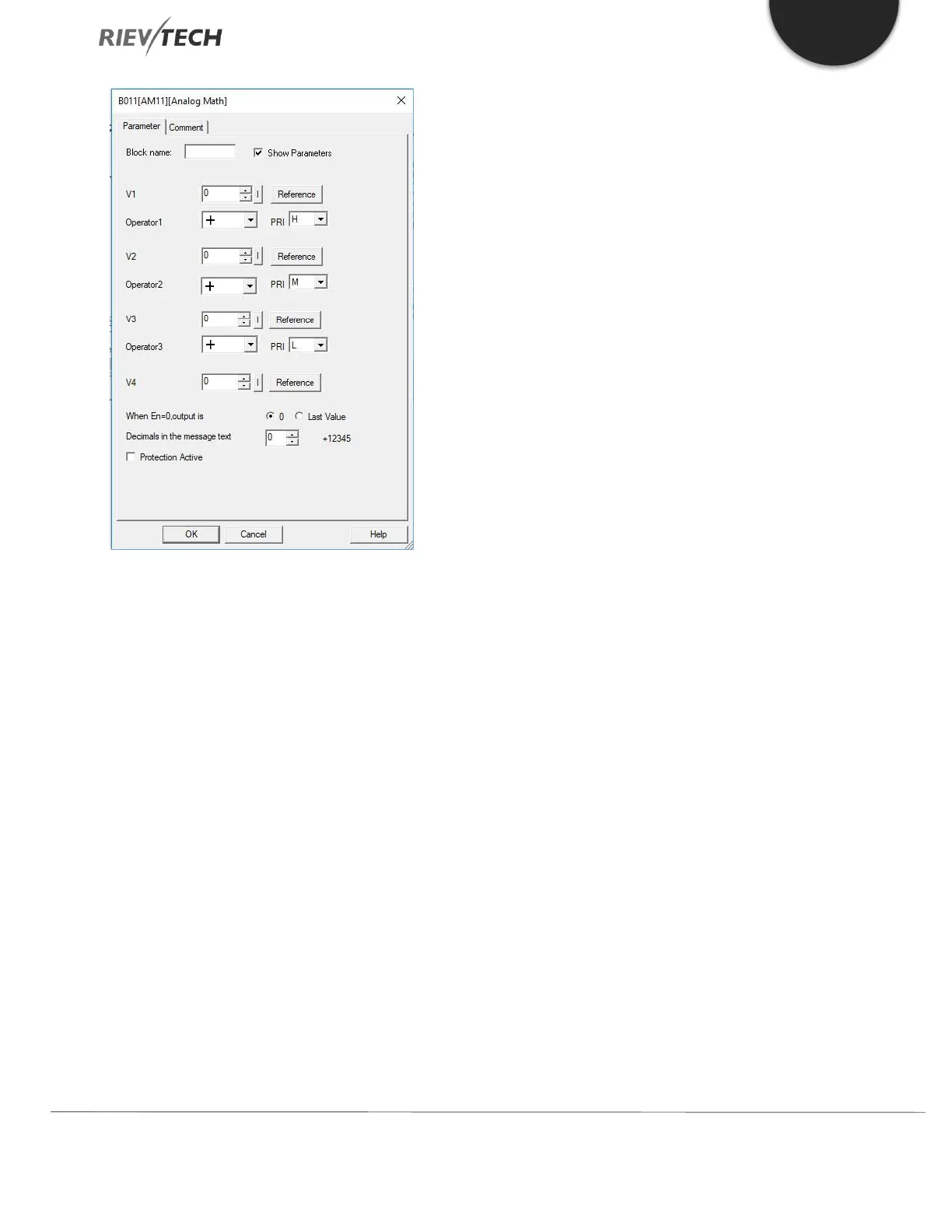
The analogue math function combines the four operands
and three operators to form an equation. The operator
can be any one of the four standard operators: +, -, *, or
/. For each operator, you must set a unique priority of
High ("H"), Medium ("M"), or Low ("L"). The high operation
will be performed first, followed by the medium operation,
and then by the low operation. You must have exactly one
operation of each priority. The operand values can
reference another previously defined function to provide
the value. The analogue math function rounds the result
to the nearest integer value.
The number of operand values is fixed at four and the
number of operators is fixed at 3. If you need to use fewer
operands, use constructions such as " + 0" or " * 1" to fill
the remaining parameters.
You can also configure the behaviour of the function when
the Enable parameter "En"=0. The function block can
either retain its last value or be set to 0.
Possible errors: Zero division and overflow


 To Next Page
 Loading...