Retentive on-delay (Ta) Wiping relay(pulse output)
(Ta)
Edge triggered wiping relay (Ta)
Asynchronous pulse generator (Ta)
Stairway light switch (Ta) Multiple function switch
(Ta)
Stopwatch (Ta)
Parameter p (number of decimals)
Parameter p applies only to the display of the Ax value in
a message text.
Description of the function
The function reads the value of the signal at the analogue
input Ax.
This value is multiplied by the value of parameter A (gain).
Parameter B (offset) is added to the product, as follows:
(Ax * Gain) + Offset = Actual value Ax
The function block calculates the proportion of the value
Ax to the range. The block sets the digital output Q high
for the same proportion of the PT (periodic time)
parameter and sets Q low for the remainder of the time
period.
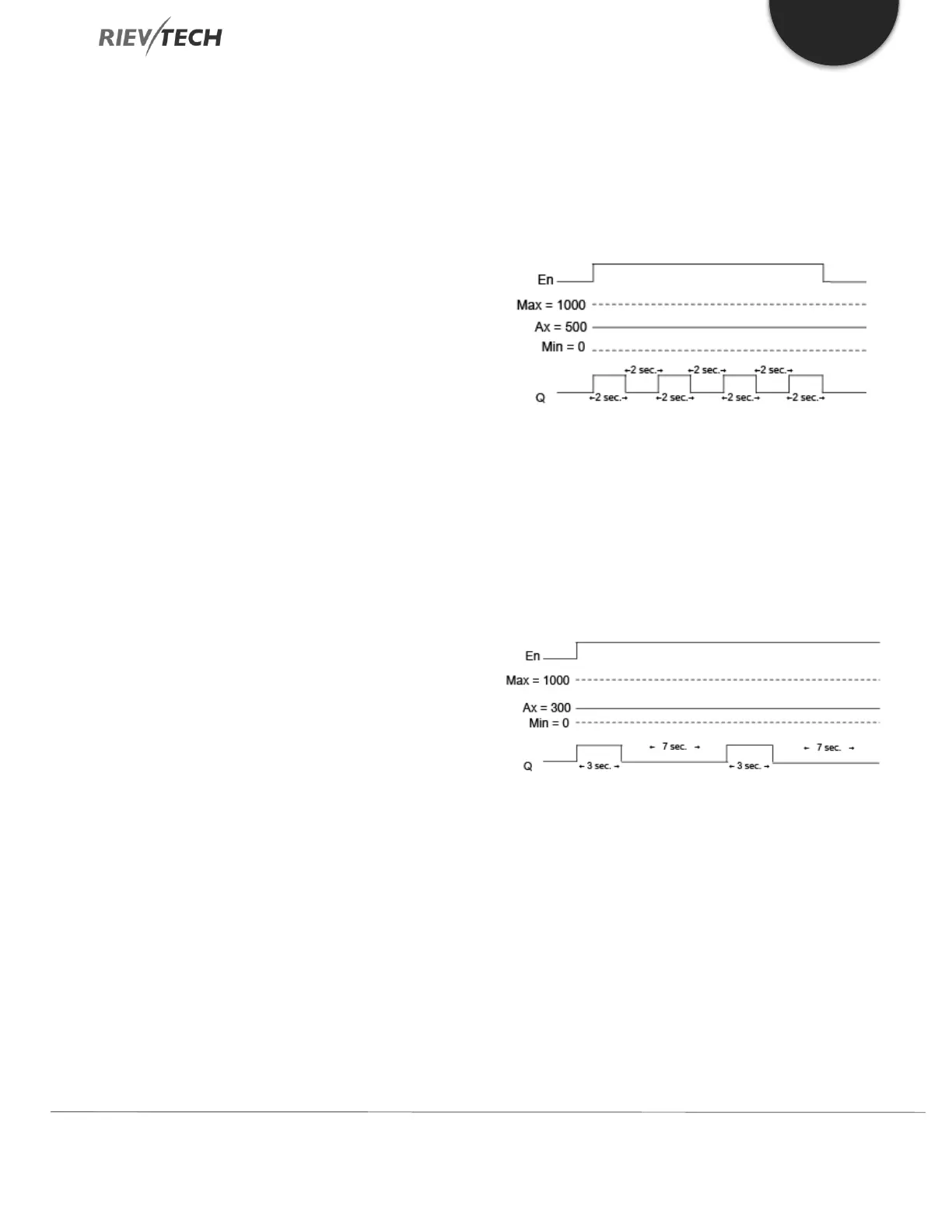
Examples of Timing Diagrams
The following examples show how the PWM instruction
modulates a digital output signal from the analogue input
value:
Example 1
Analog input value: 500 (range 0...1000)
Periodic time T: 4 seconds
The digital output of the PWM function is 2 seconds high,
2 seconds low, 2 seconds high, 2 seconds low and
continues in that pattern as long as parameter "En" = high.
Example 2
Analog input value: 300 (range 0...1000)
Periodic time T: 10 seconds
The digital output of the PWM function is 3 seconds high,
7 seconds low, 3 seconds high, 7 seconds low and
continues in that pattern as long as parameter "En" = high.
Calculation rule
Q = 1, for (Ax – Min) / (Max – Min) of time period PT
Q = 0, for PT – [(Ax – Min) / (Max – Min)] of time period
PT.
Note: Ax in this calculation refers to the actual value Ax as
calculated using the Gain and Offset. Min and Max refer
to the minimum and maximum values specified for the
range


 To Next Page
 Loading...