Quick Release Levers
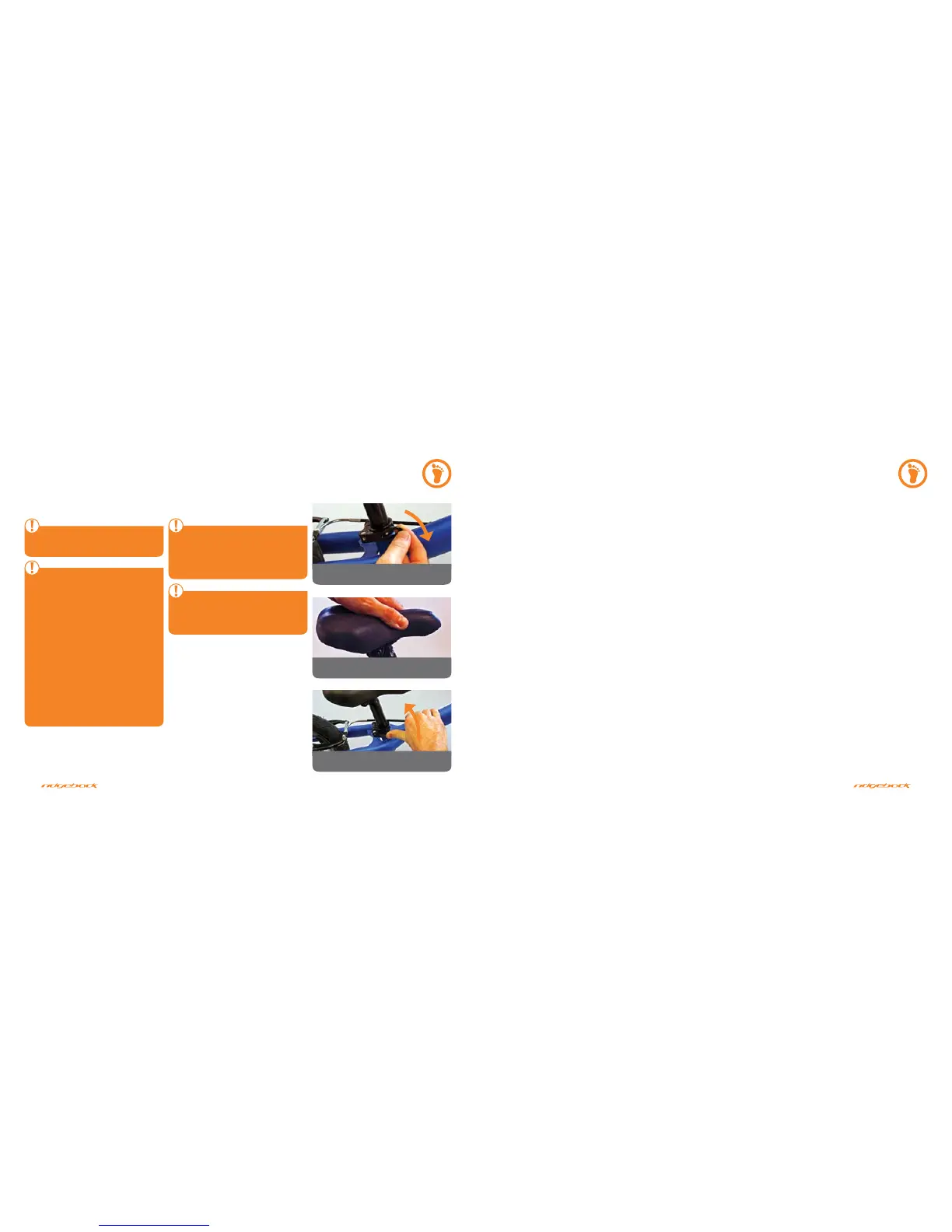
Saddle Adjustment
Always double check that quick release
levers are done up tightly.
NOTE that a quick release is NOT a nut and
bolt mechanism - it is a cam action device.
As the lever rotates to a closed position,
tension is applied to the clamp band. The
amount of clamping force is controlled by
the tension adjusting nut. Having undone
the cam lever, turning the tension adjusting
nut (on the other end of the quick release
skewer) clockwise whilst keeping the cam
lever from rotating increases the clamping
force when the cam lever is closed. Turning
it anticlockwise reduces the clamping force.
Less than half a turn of the adjusting nut
can make the difference between safe and
unsafe clamping force – as a guide, if the
adjusting nut is finger tight when the lever
is half-closed, the tension when fully closed
will be correct.
If you are at all unsure about the use of
quick release mechanisms, please ask your
Ridgeback Ridgeback stockistto show you
the correct method. It is simple once the
correct method of use is understood.
Failure to use a quick-release lever
correctly can result in saddle slippage
and loss of stability.
Before riding Things to check every time they ride
Bars and stem
Check the security of the bars and stem with a sharp
pull or twist. If they’re loose, tighten them carefully.
If you notice the bars moving in relation to the stem,
stop using your Scoot beginner bike immediately and
tighten them. Riding with a loose handlebar or stem
may cause an accident.
Brakes
Give the brakes a quick squeeze before use. It’s easy
to forget to reconnect brake cables after repairing a
flat tyre. Make sure that the brake blocks aren’t worn
and that they contact the rim properly. If in doubt,
ask your Ridgeback stockist for reassurance.
Wheels
Spin the wheels and make sure they’re not binding
on the brake blocks and that the brake blocks fully
clear the tyre at all times. A brake block rubbing
on the tyre sidewall will cause a sudden jamming
or a blow-out if not corrected. Sometimes this can
be fixed by adjusting the brake balance, but any
interference between rim, tyre and the brake blocks
needs to be fixed by an experienced mechanic.
Tyres
Give your tyres a squeeze to check the pressure (or
use a tyre gauge if you have one). For general use,
tyres should be pumped up to the pressure written on
the sidewalls, around 30-35 psi for the tyres fitted.
For use on rougher ground such as a woodland trail
or cycle path, a lower pressure of around 25-30 psi
may aid control and comfort but increase the risk of
punctures if under-inflated. Always be guided by the
recommended figures on the tyre sidewall and check
them before use.
Helmet and gloves
Although wearing a helmet won’t make anyone
invincible, it can dramatically reduce damage to
your head in event of a fall. Children’s helmets are
available in a vast array of styles and colours and
we recommend that your child wears a helmet when
riding any bike– just as you might wear a seat belt
while driving. While learning to ride should not be
dangerous, tumbles are inevitable and wearing a
helmet is good practice as well as a good habit to get
into for future cycling years.
Gloves are always a good idea as hands naturally
go out to break a fall and mitts or gloves will protect
against gravel rash.
Before riding Things to check every time they ride
Ridgeback recommends that you always wear a helmet while cycling.
Adjust saddle height
Open Quick-release lever. ONLY if required
– loosen / tighten tension adjusting nut
Close lever. Ensure lever requires force to
close fully


 To Next Page
 Loading...