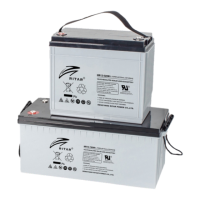
The device described in this manual is an OPzV VRLA Tubular Gel Battery, designed for various applications requiring reliable power storage. These batteries are a type of Valve Regulated Lead Acid (VRLA) battery that utilizes a tubular positive plate design and a gel electrolyte, offering enhanced performance and longevity compared to traditional lead-acid batteries.
Function Description
The OPzV VRLA Tubular Gel Battery functions as a robust and environmentally friendly energy storage solution. It operates on the principle of a sealed lead-acid battery, where oxygen generated at the positive plate during charging or over-charging is absorbed by the negative plate, preventing hydrogen generation and water loss. The tubular positive plates, made of a high-purity Pb-Ca alloy, increase the surface area for electrochemical reactions, contributing to improved cycle life and deep discharge recovery. The gel electrolyte, formed by a three-dimensional porous construction, immobilizes the sulfuric acid, preventing stratification and allowing for efficient recombination. This design makes the battery virtually maintenance-free, as it eliminates the need for water topping-up.
The battery is designed to provide stable and continuous power, making it suitable for applications that require reliable backup power or energy storage. Its sealed construction allows for flexible installation in various orientations (except inverted) and minimizes gas emissions, making it safe for indoor use.
Important Technical Specifications
The manual provides detailed technical specifications for various OPzV models, ranging from OPzV2-200 to OPzV2-3000. Key specifications include:
- Voltage: All models are 2V cells.
- Capacity (C10): Capacities range from 200Ah (OPzV2-200) to 3000Ah (OPzV2-3000).
- Dimensions (per cell):
- Length: Varies from 102mm (OPzV2-200) to 212mm (OPzV2-3000).
- Width: Varies from 206mm (OPzV2-200) to 212mm (OPzV2-3000).
- Height (total): Varies from 397mm (OPzV2-200) to 813mm (OPzV2-3000).
- Weight (per cell): Ranges from 16.8kg (OPzV2-200) to 225.0kg (OPzV2-3000).
- Internal Resistance: Varies inversely with capacity, ranging from 1520 mΩ (OPzV2-200) to 35 mΩ (OPzV2-3000).
- Short Circuit Current: Ranges from 3410A (OPzV2-200) to 10700A (OPzV2-3000).
- Designed Floating Life: 20 years at 25°C.
- Longer Cyclic Life: 80% DOD 1500 cycles.
- Lowest Self-Discharge: < 2% per month.
- Super Recovery Capability: From deep discharge.
- Recombination Efficiency of Gas: More than 99% (2 months of float use).
- Charge Voltage: 25°C.
- Equalizing Charge: 2.35V/cell.
- Float Use: 2.25 – 2.27V/cell.
- Max. Charge Current: ≤ 2I10.
- Operating Temperature Range:
- Max. Range: -40°C ~ +70°C.
- Optimal Range: 25±5°C.
- Relative Humidity: ≤ 95%.
- Altitude: ≤ 4000m.
- Keep the battery away from any source of ignition, organic solvent, or direct sunlight.
- Keep the consistent ambient temperature; the temperature difference between each battery of the same battery bank: ≤3°C.
The manual also includes detailed tables for constant current and constant power discharge characteristics at various rates (1h, 2h, 3h, 4h, 5h, 6h, 8h, 10h) and final voltages (1.90V, 1.87V, 1.85V, 1.83V, 1.80V, 1.75V, 1.70V, 1.65V, 1.60V per cell at 25°C). These tables are crucial for system designers to accurately size and select batteries based on specific load requirements.
Usage Features
The OPzV VRLA Tubular Gel Battery is designed for ease of use and versatility across a broad range of applications:
- Applications:
- Solar Energy & Wind Energy
- IT/Telecommunications
- Electric Vehicle, Floor Machines, Marine, Touring Coach
- Power Storage Plant
- Uninterruptible Power Supplies (UPS)
- Security/Emergency lighting
- Installation: The batteries can be installed in various configurations, including single-floor vertical installation racks for 48V systems (e.g., OPzV-250/48V, OPzV-350/48V, OPzV-500/48V, OPzV2-800/48V, OPzV2-1000/48V, OPzV2-2000/48V, OPzV2-3000/48V) and double-floor vertical installation racks (e.g., OPzV-200/48V, OPzV-300/48V, OPzV2-2000/48V, OPzV2-3000/48V). There are also three-floor vertical installation racks for larger systems (e.g., OPzV-1000/48V, OPzV-1500/48V). The manual provides detailed drawings and dimensions for these installation racks.
- Charging Characteristics: The battery exhibits excellent charge acceptance and over-discharge resistance. It supports both float and equalizing charging modes. The manual provides characteristic curves for charge current vs. time, discharge capacity vs. ambient temperature, and charge voltage vs. temperature, guiding users on optimal charging practices.
- Discharge Characteristics: The battery offers good performance in small current discharge and deep discharge recovery. Discharge characteristics are provided for various rates and temperatures, including 0.5-hour and 1-hour continuous discharge, as well as 1-minute discharge.
- Capacity Conversion Factor: A capacity conversion factor curve is provided to adjust the rated capacity based on different discharge times.
- Cycle Life: The battery boasts a long cycle life, with graphs illustrating discharge capacity vs. cycles at different depths of discharge (10%, 25%, 50%, 80%, 100% DOD).
- Temperature Performance: Excellent performance in constant discharge power and good performance in small current discharge and deep discharge recovery, suitable for PSOC environments. High-temperature accelerated life test data is also provided.
- Self-Discharge: The battery has a low self-discharge rate, with a graph showing remaining capacity vs. storage time.
- Final Discharge Voltage: Recommendations for final discharge voltage are provided to avoid over-discharge and maximize battery service life.
Maintenance Features
The OPzV VRLA Tubular Gel Battery is designed to be low-maintenance, but certain checks and procedures are recommended to ensure optimal performance and longevity:
- Unpacking and Inspection:
- Do not press or pull the battery top and terminals to prevent damages.
- Do not invert, roll, throw, or strike batteries.
- Do not use steel or any other metal wires and prevent battery short circuit.
- Inspect for damages on the appearance of packages and batteries.
- Check that batteries and accessories are complete without missing.
- Read the Reference: Technical Manual, installation drawings, notice.
- Installation Cautions:
- Match batteries into battery banks, and group the batteries of the same or similar open-circuit voltage as a bank. The voltage difference of a single cell is recommended to be a grade.
- Check and make sure batteries are normal, then install batteries at the predetermined location (e.g., a battery rack).
- Do not install batteries near any heat sources (e.g., a transformer).
- Because batteries may produce flammable gas during storage, keep away from any devices with possibility of sparks (e.g., a fuse) during installing.
- Before connection, clean battery terminals and make them shine with metallic luster.
- Be careful not to short-circuit battery positive and negative terminals with conductive materials.
- In multiple use, make sure batteries are connected correctly and then connect batteries to the charge circuit or load. The battery positive terminals should be connected with the positive of the charger or load, while negative terminals with negative. If batteries are connected to the charger correctly, the charge will be damaged. Make sure there is no connection error.
- Connect wires tightly and make sure every connection nut and bolt is screwed down. Do not overexert to prevent damages to terminals. The recommended tightening torque is as follows:
- M5: 6.5N*m
- M6: 9.0N*m
- M8: 12.0N*m
- Wiring:
- Use insulating tools. The metal tools (such as a wrench) should be wrapped with insulating tape and given insulation treatment.
- Connect batteries firstly and then connect battery banks to the charger or load.
- When multiple battery banks are to be in parallel connection, they should be connected in series first and then connected in parallel.
- The gap between batteries should be more than 20mm to ensure good ventilation.
- Apply anti-rust agent (such as vaseline) on battery terminals before and after connection.
- When batteries are installed, measure the total voltage of battery banks and confirm it is correct, then load power.
- Battery Operation:
- Discharge: The maximum discharge current should be within the following range:
- Discharge Current I<3C10, Discharge Time T<1min.
- Discharge Current I<4C10, Discharge Time T<5s.
- Final Discharge Voltage: Recommended final discharge voltages are provided for different discharge currents (e.g., ≥0.1C10: 1.80V, ≥0.2C10: 1.75V, ≥0.3C10: 1.70V, ≥0.6C10: 1.60V).
- The voltage of battery terminals must not be below the required values.
- Charging Parameters:
- Float Charge: Charging Voltage: 2.25V-2.30V/Cell (25°C), Max. Charging Current: ≤0.20C10, Temperature Compensation Factor: -3mV/°C/Cell.
- Equalizing Charge: Charging Voltage: 2.37V-2.40V/Cell (25°C), Max. Charging Current: ≤0.20C10, Temperature Compensation Factor: -3mV/°C/Cell.
- Notice: There is no need to perform Equalizing Charge when in normal float charging operation. Equalizing Charge can be considered in the following situations:
- Discharge capacity is lower than 20% of the rated capacity.
- Storage time is more than 3 months.
- A single cell's float charge voltage is lower than 2.18V/cell.
- After 3-6 months of continuous float charge or when there are some voltage lag batteries in a battery bank.
- Cleaning:
- Keep the battery appearances and operating environment clean and dry.
- Clean batteries with a wet cloth. It's prohibited to use gasoline, alcohol or any other organic solvents to clean batteries.
- Do not cause static when cleaning batteries.
- Inspection and Maintenance:
- Monthly Inspection: Check the total float charge voltage of the battery bank, inspect the voltage of each battery, and check the positive and negative terminals for corrosion. Benchmark values and maintenance actions are provided for each item.
- Quarterly Inspection: Inspect the battery case for leakage, blow-up, or damage, check if the appearance is normal, clean dust and dirt, inspect whether the connection cables and terminals get rusty, tighten the loose bolts and nuts, clean the battery bank and terminals, shake the safety valve to ensure it is fastened securely, check whether the safety valve is working properly, cut off the AC power, and check the DC power. Benchmark values and maintenance actions are provided.
- Yearly Inspection: Verification of discharge 30%-40% of rated capacity. If it is lower than the benchmark value, please check the battery bank firstly and then equalizing charge for 1-2 months. If it is still lower than the benchmark value, please contact us.

 Need help?
 General

 To Next Page