Need help?
Do you have a question about the RIVIT RIV 503 and is the answer not in the manual?
Instructions on how to change the nosepiece size using the provided spanner.
Details procedures for checking jaws, cleaning, and performing general maintenance on the tool.
This document describes the Rivit 503 hydro-pneumatic riveting tool, a device designed for efficient and reliable installation of blind rivets. The tool operates using compressed air and features a mechanism for holding the rivet and recovering the spent mandrel, ensuring a clean and efficient riveting process.
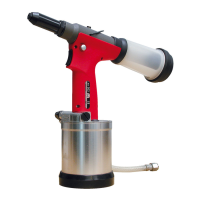
The Rivit 503 is a hydro-pneumatic tool primarily used for setting blind rivets. Its core function involves using compressed air to actuate a hydraulic system that pulls the rivet mandrel, causing the rivet body to deform and create a secure joint. A key feature of this tool is its ability to hold the rivet in place during the setting process, which can improve accuracy and ease of use, especially in certain applications. Furthermore, it incorporates a system for recovering the broken mandrel with open air, preventing debris from scattering and maintaining a cleaner work environment. This mandrel recovery system is crucial for safety and efficiency, as it eliminates the need for manual collection of spent mandrels. The tool is designed to handle rivets made from various materials, with specific size ranges supported. It can set rivets in all alloys from Ø 2.4 mm to Ø 4.8 mm, and for aluminum rivets, it can handle sizes up to Ø 6.0 mm. This versatility makes it suitable for a wide range of fastening applications across different industries.
The Rivit 503 is designed for user-friendly operation, with several features contributing to its ease of use and adaptability. The tool requires a compressed air supply, and it is recommended to use pressure regulators and automatic filtering systems to ensure optimal performance and longevity. These systems should be positioned within 3 meters of the tool to maintain adequate pressure. The flexible air hoses used with the tool must be capable of supporting at least 10 bars of pressure, resistant to oil, covered with abrasion-resistant material, and protected from damage in harsh working conditions. The minimum passage diameter for these hoses should be 6.4 mm or 1/4 inch. The pressure regulator should be set to 6.5 bars to account for any pressure drop.
The tool includes a knob for adjusting air suction, allowing the user to fine-tune the suction power for different rivet types or working conditions. This adjustment helps in securely holding the rivet before installation and ensuring effective mandrel recovery. The container on the tool, which collects the mandrels, should not be disassembled by the user, as it is an integral part of the mandrel recovery system.
For changing the nosepiece to accommodate different rivet sizes, a 12 mm spanner (supplied with the tool) is used. The tool comes with a range of nosepieces for various rivet diameters, including Ø 2.4, Ø 3.2, Ø 4.0, Ø 4.8, and Ø 6.0 for aluminum, as well as a Ø 4.8 3/16 nosepiece for Monriv rivets. Additionally, it includes jaws, a jaws opener, jaws return spring, and cone holding jaws, all essential for the riveting process.
Optional extensions of 100 mm and 200 mm are available for the Rivit 503, which can be assembled by disassembling existing parts and reassembling them with the new extension components. These extensions increase the reach of the tool, making it suitable for applications where access to the riveting point is restricted.
Safety is a paramount consideration in the use of the Rivit 503. Users are instructed to operate the tool properly and only for its intended purposes. Any modifications to the tool or its equipment are done at the customer's full responsibility, and Rivit S.r.l. disclaims any liability in such cases. The tool must always be kept in safe working conditions and regularly inspected by expert and authorized personnel. It must be used in compliance with EC directives on health and safety measures (Directive 2006/42/EC). Before any regulation, repair, or cleaning operations, the air supply must be disconnected. The tool should not be used if it is pointed towards other persons. The operating pressure should not exceed 7 bars (100 LBF/IN²). Air discharges must not be blocked, and feeding hoses must be in good condition. Protective glasses or visors and gloves must be worn when using the tool. If the noise level exceeds 85 dB (A), appropriate hearing protection (e.g., antinoise headset) should be used.
Regular maintenance is crucial for the optimal performance and longevity of the Rivit 503. The manual outlines several key maintenance procedures. One important aspect is checking the grip of the jaws on the rivet's nail. If the grip is anomalous, it could indicate dirty jaws or worn jaws. For dirty jaws, cleaning and oiling are recommended. If the jaws are worn, they must be replaced with new ones. To perform these operations, the air supply must first be disconnected. The head carrying the nosepiece is then removed using a 25 mm spanner. Subsequently, a 16 mm and 17 mm spanner are used to remove the cone holding jaws, allowing for cleaning or replacement.
The air pressure should be checked regularly to ensure it does not exceed 7 bars. Any oil or air losses should be identified and addressed promptly. The stroke of the riveting tool also needs to be checked; if it is anomalous, new oil should be topped up.
Oil topping up is necessary when the tool experiences a power loss or after a long period of use. The procedure involves disconnecting the air supply and keeping the tool in a vertical position. The oil screw is removed using a 3 mm allen wrench, and the oil syringe (supplied with the tool) is used to add oil until no resistance is felt. The syringe is then removed, the oil screw is re-tightened, and air is purged without pressing the trigger. The screw is slowly unscrewed until excess oil comes out, then re-tightened. The tool is ready for use once these steps are completed. It is important to use protective gloves and avoid spilling oil in the environment during this operation. In case of skin contact, wash carefully with soap and water.
For the elimination of the tool at the end of its lifespan, users are instructed to make reference to national laws for safety and environmental care. The tool's components (aluminum, steel, plastic, etc.) should be disassembled and divided for proper scrap in compliance with current laws. Only original spare parts should be used for repairs and maintenance. Rivit S.r.l. disclaims responsibility for damages resulting from non-observance of these instructions.
 General
| Model | RIV 503 |
|---|---|
| Category | Rivet Tools |
| Type | Hand Riveter |
| Material | Steel |
| Handle | Ergonomic |

 To Next Page