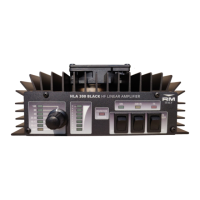
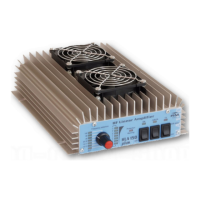
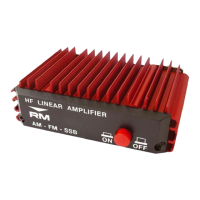
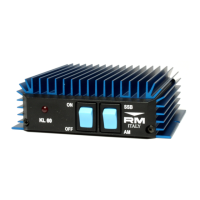
Operation:
Before using the amplifier the user must be familiar with all of the controls and be sure that it has
been connected correctly.
Important!!
Before the amplifier is switched on the power output of the drive radio should be adjusted correctly
if it is capable of outputting a power greater than 15W. This may be done with the amplifier con-
nected but switched off. 15W is the maximum permissible input power to the amplifier, but ap-
proximately 10W input should be sufficient to realise full output, and an input power of 1-15W is
OK as it is not necessary to run the amplifier at full output if not required.
The amplifier features protection against excessive input power and will switch in a 3dB attenuator
when the input power reaches approximately 16 to 17W, if the input power is more than about 30-
35W the amplifier will disable the input relay and put the amplifier into a protection mode. The
input power should be reduced to an acceptable level and then to restore operation the amplifier
must be reset by cycling the on / off switch. The 3dB attenuator can also be selected manually to
reduce the output power of the amplifier if the input power is not adjustable say for instance a fixed
10W output. It should not however be used to reduce the input power to the amplifier from a radio
that has say 30Watt output. The maximum input to the amplifier should always be adjusted on the
radio.
The cross sectional area of the cables used to connect the amplifier to the PSU should not be less
than 6mm² or 10 AWG. They should also be kept as short as practicably possible to avoid voltage
drop due to ohmic losses. This is less of a problem in a fixed installation where the power supply
may be placed close to the amplifier.
For a mobile installation the leads should not exceed a length of 3m and they should be connected
directly to the Auto battery. An additional fuse may also be connected inline to provide protection
in case of cable short circuit to chassis ground from the amplifier to the battery.
The installation location must also provide a suitable ground system both for RF and the AC line
supply. This is very important safety requirement for any radio transmission equipment but as
power increases becomes increasingly important. A good RF ground will also help to prevent any
returned RF from causing problems with the equipment. Usually erratic operation of equipment
when in transmission may be attributed to RF being present or poor RF grounding. Installations
where a good RF ground is not possible like operation above the ground floor may require alterna-
tive solutions such as artificial earths or the connection of 1/4 wave counterpoises to the operating
equipment. for the bands being used . Correct RF earthing techniques are however beyond the
scope of this manual.


 To Next Page
 Loading...