Need help?
Do you have a question about the ROBAND PA100 and is the answer not in the manual?
The provided document is an operating manual for ROBAND Pie Warmers, manufactured by ROBAND AUSTRALIA PTY LTD. These instructions cover models PA50, PA100, PA40L, and PA80L, including alternative models ending in "-G". The manual outlines the device's function, usage, and maintenance, emphasizing safety and proper operation.
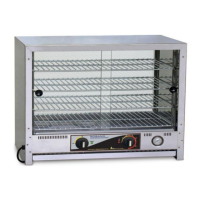
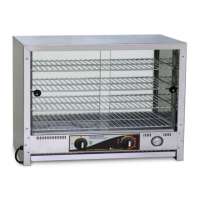
The ROBAND Pie Warmer is a commercial heating unit designed primarily for warming and holding food items such as pies, sausage rolls, and similar articles at serving temperatures. It is not intended for cooking food. The unit is thermostatically controlled, allowing users to select and maintain a desired operating temperature, typically between 85-90°C for pies and sausage rolls. A green pilot light indicates when the unit has power, and an amber pilot light cycles on and off to show when the warmer is actively heating or has reached the set temperature. The PA40L model also includes an internal light.
For optimal performance, it is recommended to pre-heat the pie warmer for approximately 20 minutes on the maximum temperature setting before placing food inside. After pre-heating, the thermostat should be adjusted to the desired operating temperature. The warmer should always be operated with the crumb tray in position. While the units are designed for use with freshly baked or refrigerated products, if frozen products are used, they should be thawed beforehand to ensure they reach the desired serving temperature within a reasonable timeframe. Approximate warming times for thawed foods placed in a pre-heated unit at 90°C are provided: Meat Pies (35-45 mins), Sausage Rolls (20 mins), Party Pies (15 mins), and Pasties/Pockets (15-20 mins).
The design of the pie warmer allows for flexibility in configuration. These units can be retrofitted with glass doors on both sides, and the glass front can be swapped to the back. This allows for various combinations, such as glass doors at the back with a fixed glass front, glass doors at the front with a fixed glass back, or glass doors on both the front and back. A runner separates the doors at the top, and when doors are removed, they should be re-inserted into different runners.
Heat is generated from the bottom of the unit. When loading products, it is important to allow spacing on the lower racks to facilitate the rise of hot air to the upper shelves. If foil is used on the shelves, sufficient area must be left free for air to pass through to ensure even heating. The bottom shelves will be the hottest due to direct heat emission from the element, making them ideal for quickly warming new products placed in the unit throughout the day.
The pie warmer incorporates several usage features designed for safety and durability. It is constructed with Ultra-Life Stainless Steel Elements and Toughened Safety Glass. The toughened safety glass is approximately five times stronger than normal glass, capable of handling high temperatures, and designed to shatter into small, relatively harmless pieces in the event of breakage, minimizing the risk of lacerations. However, the edges of the glass are as fragile as normal glass and require careful handling. The glass also has a unique property where impacts that do not immediately shatter it can store stress, which may be released later, causing spontaneous shattering. This is a normal property of toughened glass, also seen in the building and automotive industries. Stainless steel doors are available as an alternative if glass doors are a concern.
General safety precautions emphasize that the machine should only be operated by qualified personnel familiar with the operating and safety instructions. Servicepersons must also be instructed on safety warnings before performing any maintenance or service. The unit can get very hot, so users must be aware of its operation and avoid contact with hot surfaces. It is recommended to keep the unit out of reach of children. National Standards for positioning, spacing, and ventilation should be consulted during installation, with a recommendation for a well-ventilated air gap of not less than 100mm on all sides, especially near heat-sensitive materials. The power cable should never be in contact with hot parts of the machine, and any damaged power cord must be replaced immediately by a qualified professional. The machine contains no user-serviceable parts, and all repairs should be carried out by Roband Australia, one of its agents, or a similarly qualified person.
Maintenance features focus on ensuring the longevity and hygienic operation of the pie warmer. Regular cleaning is essential. Before cleaning, the power must be turned off, and the unit allowed to cool completely. Surfaces should be wiped down with warm soapy water using a damp sponge or cloth. It is crucial not to immerse the unit in water or allow water to enter ventilation holes or controls. The crumb tray, which slides out from the unit, requires daily emptying and washing with warm soapy water. The glass should also be cleaned daily with an appropriate cleaning agent for aesthetic and hygienic reasons. While some cleaning agents can damage stainless steel over prolonged use, soapy water is recommended. Any damage resulting from harsh or improper cleaning agents is the user's responsibility. Despite care taken during manufacturing to remove sharp edges, caution should be exercised when cleaning and handling the pie warmer to avoid injury. If foil is used on trays, it should be replaced daily, and ventilation holes must be made every few centimeters to ensure even heating.
 General
| Model | PA100 |
|---|---|
| Type | Food Warmer |
| Power | 1000W |
| Temperature Range | 30°C to 85°C |
| Capacity | 100 Pies |
| Weight | 45kg |
| Frequency | 50Hz |
| Shelves | 2 |
| Construction | Stainless Steel |
| Material | Stainless Steel |
| Voltage | 230-240V |
| Temperature Control | Thermostatic |
| Dimensions | 620mm W x 485mm D x 740mm H |

 To Next Page