ENGLISH
12
Instructions and User Manual
PREFACE
Congratulations on your purchase of the new AMPLITUDE!
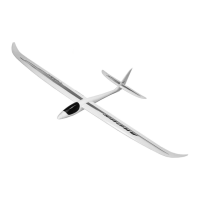
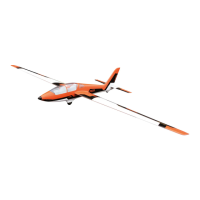
The AMPLITUDE is a high-quality FRP hotliner with a dynamic ight envelope. It can be own within a broad speed
range. There are various ways of constructing the model, depending on your preferences. Therefore the solutions
stated in this manual should only be considered as recommendations. For the most part, the PNP (plug and play)
version is already pre-assembled.
The ARF version (almost ready to y) requires modeling experience and basic technical knowledge in construction.
Thus there are dierent ways to achieve a model with good ight skills.
This is why most steps are explained in the manual but not necessarily shown in the pictures.
PLEASE READ THIS MANUAL CAREFULLY BEFORE YOU START ASSEMBLING THE MODEL.
ARF PNP
Motor not included Robbe X36-800 (included)
ESC not included from RoControl 6-60 (not included)
Battery not included 4S 3200-4000mAh (not included)
Servo ELE not included 1x Robbe FS-155 BB MG HV (included)
Servo RUD not included -
Servo AILE not included 2x Robbe FS-155 BB MG HV (included)
Servo FLAP not included 2x Robbe FS-155 BB MG HV (included)
Servo LANDING FLAP not included -
Servo cable not included 3x 50cm, 2x 20cm, 4x 25cm MPX-JR Plug (included)
Landing gear not included No
MULITlock not included No
MPX plugs Yes (not included) -
Adhesives UHU Por (not included) -
Epoxy resin Yes (not included) -
Locking screw Yes (not included) -
Velcro strap not included Yes
Spinner not included Alu Turbo Spinner 38mm (included)
Propeller not included 12x8“ CAM Prop (included)
TX min. 5 channels (not included) min. 5 channels (not included)
RX min. 7 channels (not included) min. 7 channels (not included)
TECHNICAL DATA
BOX CONTENT / NEEDED ACCESSORIES
Span 1800 mm
Length 1040 mm
Weight (dry) 725 g
Flying weight 1590 g
Wing Area 27,8 dm²
Airfoil MH-30
C.G. 68-72mm behind the leading edge
Elevator Yes
Rudder No
Ailerons Yes
Flaps Yes
Landing aps No
Motor Yes
FLIGHT INSTRUCTIONS
• Before the rst ight, observe the instructions in the „Safety Instructions“ section.
• When ying the model, you should choose a day with as little wind as possible
• A large, at area without obstacles (trees, fences power lines etc.) is suitable for the rst ights.
• Please carry out a functional test of the drive train / power set and remote control.
• After assembling the model on the aireld, check once again that all model components such as wing, tail units,
wing mounts, engine, linkages, etc. are rmly and properly fastened.
• For a hand start a helper should be present, who can throw the model with enough thrust into the air.
• The start usually takes place against the wind.
• Do not stall the model near the ground
• Do not initiate tight turns in the immediate vicinity of the ground.
• Check the reactions of the model to the rudder deections. If necessary, adjust after landing to increase or
decrease the deections accordingly.
• The minimum ight speed must be at an adequate safety altitude.
• Initiate the landing with sucient speed
SAFETY INSTRUCTIONS FOR RECHARGEABLE BATTERIES
• Do not immerse the battery in water or other liquids.
• Do not heat, throw into re or microwave.
• Do not short-circuit or charge with reversed polarity
• Do not expose, deform or throw the battery
• Do not solder directly on the battery
• Do not change or open the battery
• Only charge the battery with suitable chargers, never connect it directly to a power supply unit.
• Never charge or discharge the battery or charger on a ammable surface.
• Never leave the battery unattended during charging or discharging processes.
• Never charge or discharge the battery in direct sunlight or near heaters or re.
• Do not use the battery in places subject to high static discharge.
All this can cause the battery to be damaged, explode or even catch re!
• Keep the battery away from children
• Keep leaked electrolyte away from re, as it is highly ammable and may ignite.
• The electrolyte liquid should not get into the eyes, if it does, rinse immediately with plenty of clear water and
then see a doctor.
• The electrolyte liquid can also escape from clothes and other objects with a lot of water or washed o.
• Observe the safety instructions of the battery manufacturer and the charger manufacturer.


 To Next Page
 Loading...