The Robbe Windstar (No. 1087) is a model sailing boat designed for assembly and operation, with instructions provided in German, English, and French. This manual details the construction process, technical specifications, and operational guidelines for the model.
Function Description:
The Robbe Windstar is a remote-controlled model sailboat. Its primary function is to replicate the sailing experience on water, allowing users to control its movement and sail settings via a radio control system. The model is designed for various wind conditions, with different rig setups (standard, strong wind, light wind) to optimize performance. The construction involves assembling the hull, rudder system, RC components, and the mast and boom, followed by rigging the sails and making final adjustments.
Important Technical Specifications:
The manual provides detailed dimensions for various components, which are crucial for accurate assembly.
- Length: 1000 mm
- Beam: 195 mm
- Displacement: approx. 2.3 kg
- Sail Area:
- Standard rig: approx. 52 dm²
- Strong wind rig: approx. 37 dm²
- Light wind rig: approx. 24 dm²
The construction involves specific parts and materials:
- Hull (1.4): The main body of the boat, where all internal components are housed.
- Boatstand (Stage 0): Composed of main struts (0.1), captive nuts (0.2), screws (0.3), washers (0.4), beech dowels (0.5), support straps (0.6), and self-tapping screws (0.7).
- Rudder System (Stage 3): Includes the tiller (3.1), collet (3.2), screw (3.3), rudder (3.4), washer (3.5), rudder bush (3.6), pushrod (3.7), rubber bellows (3.8), tube (3.9), and clevis (3.10).
- RC Installation (Stage 4): Features doublers (4.1, 4.2), RC installation plate (4.3), servo mount (4.4), sailwinch (4.5), self-tapping screws (4.6), servo (4.7), endless sheets (4.8, 4.9), servo output arm (4.10), screw (4.11), collet (4.12), receiver (4.13), wooden rail (4.14), receiver battery (4.15), and double-sided foam tape (4.16).
- Endless Sheet Completion (Stage 5): Involves a sliding clamp (5.1), crimp sleeves (5.2), spring (5.3), and jib sheet (5.4).
- Booms and Mast (Stage 6): Includes jib boom (6.1), main boom (6.2), mast (6.3), retaining wire (6.4), and retaining wire (6.5).
- Rigging Parts (Stage 7, 8, 9, 10, 11): Various components for mast and boom assembly, sail attachment, and sheet control, such as heat-shrink sleeving, crimp sleeves, S-hooks, lashings, clevises, ring-bolts, luff tensioners, and sliding clamps.
Usage Features:
The Robbe Windstar is designed for remote-controlled sailing.
- Sail Control: The model utilizes a sailwinch (4.5) to control the main and jib sheets, allowing for precise adjustment of the sails to different wind conditions. The manual describes how to set the winch winding travel and position the sails for "close-hauled" sailing.
- Rudder Control: A servo (4.7) connected to the rudder system (Stage 3) enables steering. The rudder is aligned to ensure proper course correction.
- Rig Options: The model supports three different rigs: standard, strong wind, and light wind. This adaptability allows the user to optimize the boat's performance for varying weather conditions. The manual emphasizes the importance of correctly setting up each rig according to the provided diagrams and instructions.
- RC System Integration: The RC installation plate (4.3) houses the receiver (4.13), receiver battery (4.15), servo (4.7), and sailwinch (4.5). The aerial is to be secured to a wooden rail (4.14) inside the hull.
- Transport: The manual provides instructions for disassembling the rig for transport, including disconnecting sheets, backstay, mast brace, and shrouds. This allows for safe and convenient transportation of the model.
Maintenance Features:
The manual implicitly suggests several maintenance practices through its detailed assembly and adjustment instructions.
- Adhesive Application: Proper use of adhesives (e.g., cyanoacrylate for rivet nuts, glue for various joints) is critical for structural integrity.
- Lubrication: Lubricating threaded shanks (1.7) and the pushrod (3.7) with soapy water ensures smooth operation and prevents wear.
- Regular Checks: The instructions emphasize visual checks, such as ensuring the rudder and keel fin are aligned, and verifying the correct tension of the forestay and backstay.
- Component Replacement: The detailed parts lists and diagrams facilitate the identification and replacement of individual components if they become damaged or worn.
- Cleaning: While not explicitly detailed, the nature of model sailing implies regular cleaning of the hull and components to remove water, dirt, and salt residue, especially after use in saltwater.
- Storage: Proper disassembly of the rig for transport also serves as a guide for long-term storage, protecting the delicate components from damage.
- Adjustments: The manual highlights various adjustments, such as setting the sailwinch travel, aligning the mast, and tensioning the sheets, which are essential for optimal performance and longevity. These adjustments should be re-checked periodically.
- Wiring Management: The RC installation section implies careful routing and securing of wiring to prevent interference and damage.

 Need help?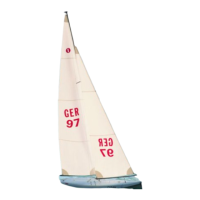

 To Next Page
 General